

By IBP Paving. Published 9 October 2026.
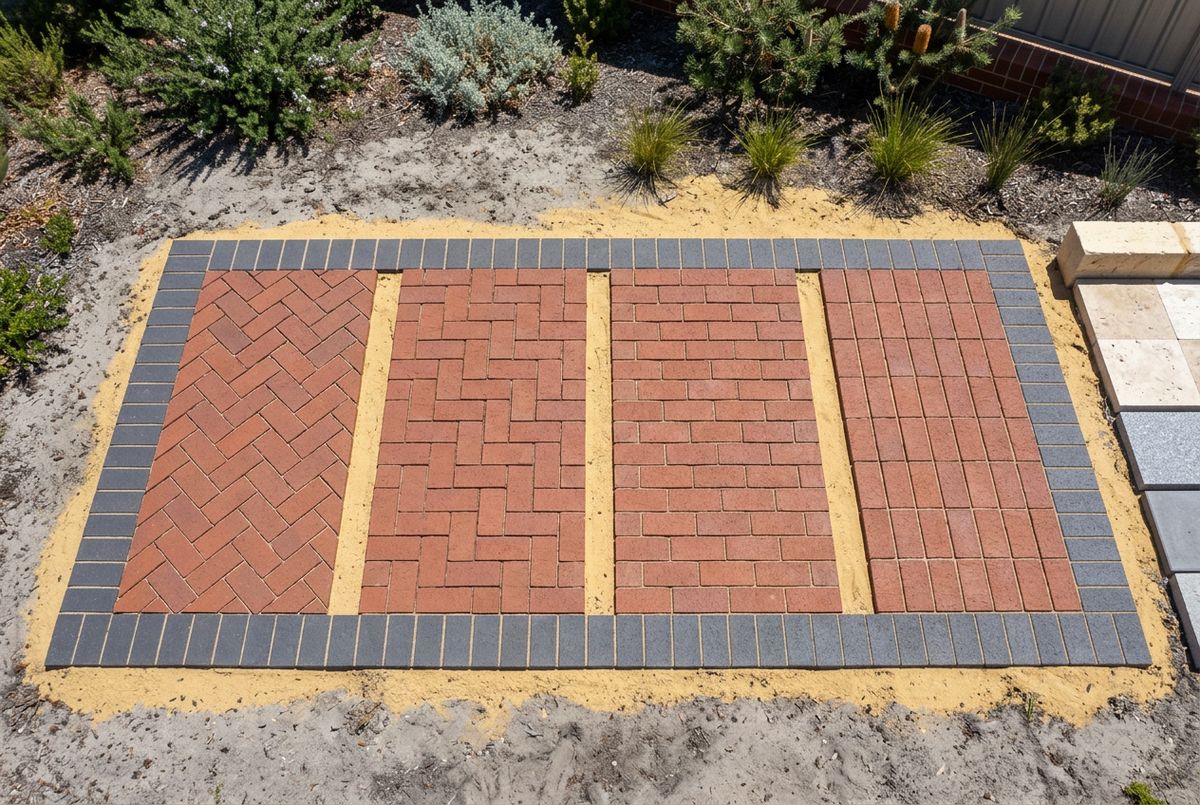
Why the pattern matters more than it looks
In Perth almost all brick paving is laid flexibly: pavers on a bed of washed yellow sand over compacted sand or road base, with sand swept into the joints and nothing glued down. The pavers stay where they are because they are locked against each other and held at the edges. That makes the laying pattern a structural decision, not just a decorative one. A pattern that interlocks in two directions spreads a wheel load sideways to its neighbours; a pattern with a straight joint running through it gives a turning tyre a line to push along.
The second thing a pattern decides is the number of cuts, which is the number of pavers that go through a saw and the amount of waste in the skip. The third is the look: a driveway in a diagonal pattern reads as busy and traditional, a large format alfresco in straight rows reads as calm and modern. This guide walks through the common patterns for brick paving in Perth on all three counts, and links to the full page on each.
The patterns compared
| Pattern | Interlock and load | Cutting and waste | Look | Best use |
|---|---|---|---|---|
| Herringbone 45 degree | Strongest, locks both directions | Most cuts, diagonal at every edge | Busy, traditional, hides a skewed boundary | Driveways, crossovers, vehicle areas |
| Herringbone 90 degree | Strong, locks both directions | Fewer cuts than 45, square at edges | Structured, slightly calmer | Driveways where edges run square |
| Basketweave | Weakest interlock, pairs can rock | Few cuts on square areas | Heritage, cottage, Federation | Patios, paths, courtyards, not driveways |
| Stretcher bond | Locks one direction only | Fewest cuts, reusable halves | Quiet, familiar, brick wall look | Alfrescos, patios, paths |
| Stack bond | None, grid of joints | Few cuts, shows every size variation | Modern, needs very consistent pavers | Large format alfrescos and courtyards |
| Ashlar or random | Moderate, mixed sizes break joints | Moderate, pattern repeats need planning | Natural stone, flagstone | Stone patios, pool surrounds, paths |
Herringbone
Each paver sits at right angles to the next in a zigzag, so there is no straight joint anywhere in the field. That is why it is the default for Perth driveways on sand: the pavers brace each other against the twisting load of a car turning in. At 45 degrees to the edge the interlock is strongest and the pattern forgives a boundary that is not square, at the cost of a diagonal cut on every edge paver. At 90 degrees the cuts are square and fewer, and the strength is still ample for a residential driveway. The herringbone page goes into the 45 versus 90 question, cost and which pavers suit it.
Basketweave
Pairs of pavers laid side by side, each pair turned 90 degrees to the pair next to it, so the surface reads as a woven mat. It needs pavers twice as long as they are wide, which is why it belongs to the 230 by 115 mm clay brick paver, and it gives the Federation and cottage look that suits older homes in suburbs like Greenwood and Duncraig. Its weakness is the joints: every pair makes a small square with straight joints on all four sides, so under a turning wheel the pairs can rock and creep. Keep it for patios, paths and courtyards and it will last as long as any other. See the basketweave page for sizes and where it works.
Stretcher bond and stack bond
Stretcher bond lays pavers in rows with each row offset by half a paver, exactly like the bricks in a wall. Joints line up in one direction only, which hides the natural size variation in clay pavers and keeps cutting to the row ends. It is the quietest pattern and the one most Perth alfrescos are laid in, in 400 by 400 or 600 by 400 concrete as often as in brick. Stack bond lines the joints up in both directions as a grid. It looks sharp with large format wet cast concrete or porcelain, but it shows every millimetre of variation and has no interlock at all, so it stays off driveways. The stretcher bond page covers the stretcher versus stack choice and the third offset variant for long pavers.
Ashlar and random patterns for stone
Natural stone and large format flagstone usually come in two or three sizes that are laid in a repeating but irregular arrangement, often called ashlar, French pattern or random. The mixed sizes break up the joints, which gives moderate interlock, and the look belongs to travertine, limestone and granite rather than brick. Our stone paving and crazy paving pages cover those materials, including the fully irregular crazy paving where no two pieces match.
Soldier courses, header courses and borders
Almost every well laid brick area has a border, and the border does three jobs. It frames the field, which makes any pattern look finished. It hides the cuts, because the field pavers are cut to meet a straight border rather than a wobbly garden edge. And, when it is bedded in mortar and haunched with concrete on the outside, it is the edge restraint that stops the whole area spreading under traffic. Without a restrained edge, flexible paving on sand creeps outward a few millimetres a year, the joints open, the sand runs out and the pavers start to rock.
A soldier course is a single row of pavers laid end to end along the edge, long side following the boundary. A header course lays them across the edge, short side to the boundary, which gives a wider band and uses more pavers. Both are commonly laid in a contrasting colour, charcoal against red or cream, so the border reads as a deliberate frame. On a driveway a double soldier course along the sides adds restraint where tyres load the edge; across the top of a crossover a header course gives a strong, flat band at the footpath. Borders also solve the junction between two areas: a header course between a herringbone driveway and a stretcher bond path lets both patterns end cleanly.
Which paver sizes suit which pattern
The pattern and the paver choose each other.
- 230 by 115 mm clay or concrete brick pavers are the only common size that works for every brick pattern. Herringbone and basketweave both depend on a 2:1 length to width ratio, so that two pavers side by side equal one paver lengthways. Any other proportion and the pattern will not close.
- 400 by 400, 400 by 200 and 600 by 400 concrete pavers suit stretcher bond, stack bond and simple two size ashlar layouts. They cannot be laid in herringbone or basketweave unless the proportions happen to be 2:1, and large squares in a diagonal pattern waste a great deal at the edges.
- Large format stone, 600 mm and up, belongs in stretcher, stack or a supplier's set ashlar layout, laid on a mortar bed rather than loose sand, with the pattern drawn before the first piece goes down.
- Thickness is independent of pattern but not of use. The usual Perth guidance is 40 mm for paths and patios, 50 mm as the minimum for a residential driveway with 60 mm preferred, and 80 mm for anything heavier than a car, laid in herringbone on compacted road base.
Matching the pattern to the area
For a driveway, choose herringbone in 50 or 60 mm pavers with a mortared, haunched soldier course down each side. For an alfresco under the main roof, stretcher bond in large format concrete or stack bond if the pavers are consistent enough, running the long joints away from the house so the eye follows them out to the garden. For a garden path, stretcher bond or basketweave in brick, with a soldier course to hold the edges where they meet lawn. For a courtyard, basketweave or a bordered herringbone panel gives a small space some interest. Around a pool, stone or concrete in an ashlar layout with bullnose coping, where slip rating matters more than pattern.
Choosing with the paver in hand
The best way to settle a pattern is to lay a square metre of the actual paver in two patterns on the sand and look at it from the back door. Colour, size and the direction of the joints change how every pattern reads. IBP Paving lays all of the patterns above as part of our brick paving work across Perth's northern suburbs, and we are happy to lay out the options on site before you decide.