

Why water pools on paving
There are four usual causes, and most wet driveways and alfrescos have more than one. The paving was laid flat or with the fall running the wrong way. There is no drainage point at the low spot, so water has nowhere to go. Downpipes discharge straight onto the paving or into the sand beside it. Or the base has settled, often over an old soakwell, and created a dish. One Perth inspection firm, Sure Building Inspections, reports downpipes discharging to ground in 22.1 per cent of its reports, which is that firm's figure rather than a city wide statistic, but it matches what we find.
What you cannot do is push the water next door or onto the street. The City of Wanneroo and City of Joondalup require runoff to be confined within the property boundaries, and the City of Swan states that no stormwater is to be discharged from the property over the crossover or verge onto the roadway. The water has to be collected and soaked away on your own lot, which is what our soakwells hub covers.
Falls: which way the paving must slope
Paving should fall away from the house towards a drainage point. The figures that follow are industry guidance, not a council rule. The inspection source above cites the National Construction Code for a minimum fall of 1 in 100 for the first metre out from walls. Typical paving falls run from 1 in 80 to 1 in 100, and drainage channels can carry their own built in fall of about 0.5 per cent so the paving around them can stay flatter.
The usual Perth failure is an alfresco enclosed on three sides by the house. There is no open edge for water to run off, the slab or paving was laid level, and rain tracks along the slab edge and sits against the wall. The fix is a fall across the paving to a grate on the open side, or a channel along the house, both draining to a soakwell. Our patio and alfresco paving page shows how the fall is set when the base is screeded.
Grated drains, strip drains and ag pipe
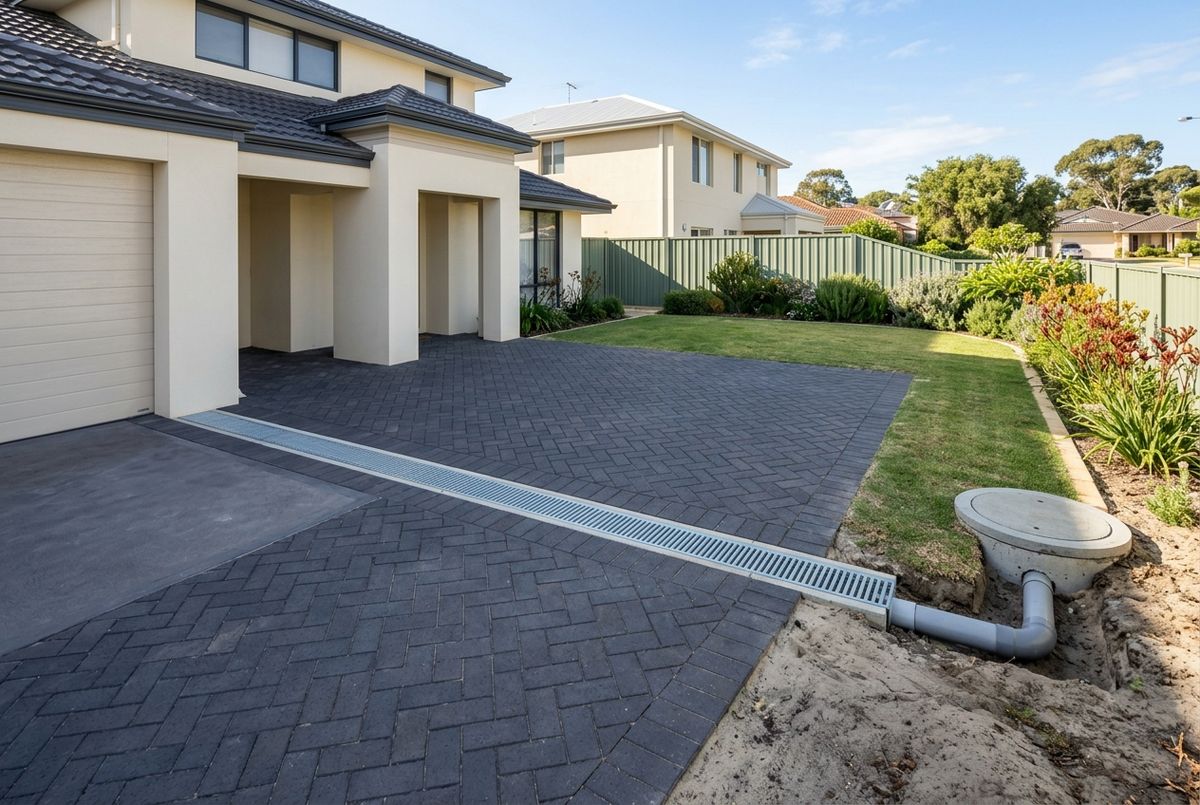
Each drainage fitting has a place. A strip drain or grated channel runs across the garage threshold, along the alfresco edge and around pool surrounds, where water would otherwise run under a door or sit against a wall, and discharges to a soakwell. A grated inlet sits at the low point of a driveway; the City of Stirling has downpipes discharging to grated inlets, and the City of Nedlands specifies that a driveway sloping towards the road needs a drainage channel across the driveway within the property, connected to a 900 mm by 900 mm deep soakwell by 100 mm PVC pipe, which is that council's specification rather than a general rule. For a wet side path, the common practice from forum trades is a socked ag pipe in a trench under the paving, running to a soakwell.
One rule is universal: never pave over a grate. The City of Swan states that brick paving is not to be laid over the top of gully grates, and the Town of Victoria Park says grates "shall in no way be covered by any paving material". A grate that is buried cannot be cleaned and will block. See our garden path paving page for how a side path drains.
Soakwells under driveways and paving: what councils require
Paved area is impervious area in every council formula. The City of Bayswater defines impervious area as any hard surface that sheds water, including roofs, paving, driveways and patios, and the others size the same way. So a new driveway adds to the storage you need, and where the unit sits under the paving the councils are specific about how it is built:
- City of Stirling: "All drainage structures located within or under driveways/carports/garages shall be designed to be trafficable and shall be provided with an approved base to prevent any subsidence of well liners." Stirling also requires roof runoff to be stored separately from paved area runoff, so a Stirling driveway gets its own unit.
- Town of Victoria Park: "All stormwater soakwells located in driveway areas are to have a grated, trafficable lid."
- City of Swan: trafficable lids on all soakwells in paved or concrete areas, kept accessible for maintenance.
- Town of Claremont: PVC soakwells are not acceptable in areas subject to vehicular traffic.
- City of Gosnells: concrete soakwells are required under all paved areas.
Our practice follows the strictest of these: concrete or a trafficable rated unit under anything a car crosses, on a compacted approved base, with the lid set flush in the pavers and left accessible. The detail for the two councils with the most to say is on our City of Stirling and City of Swan soakwell pages, and the paving side is on our driveway paving page.
Retrofitting drainage in a yard that is already paved
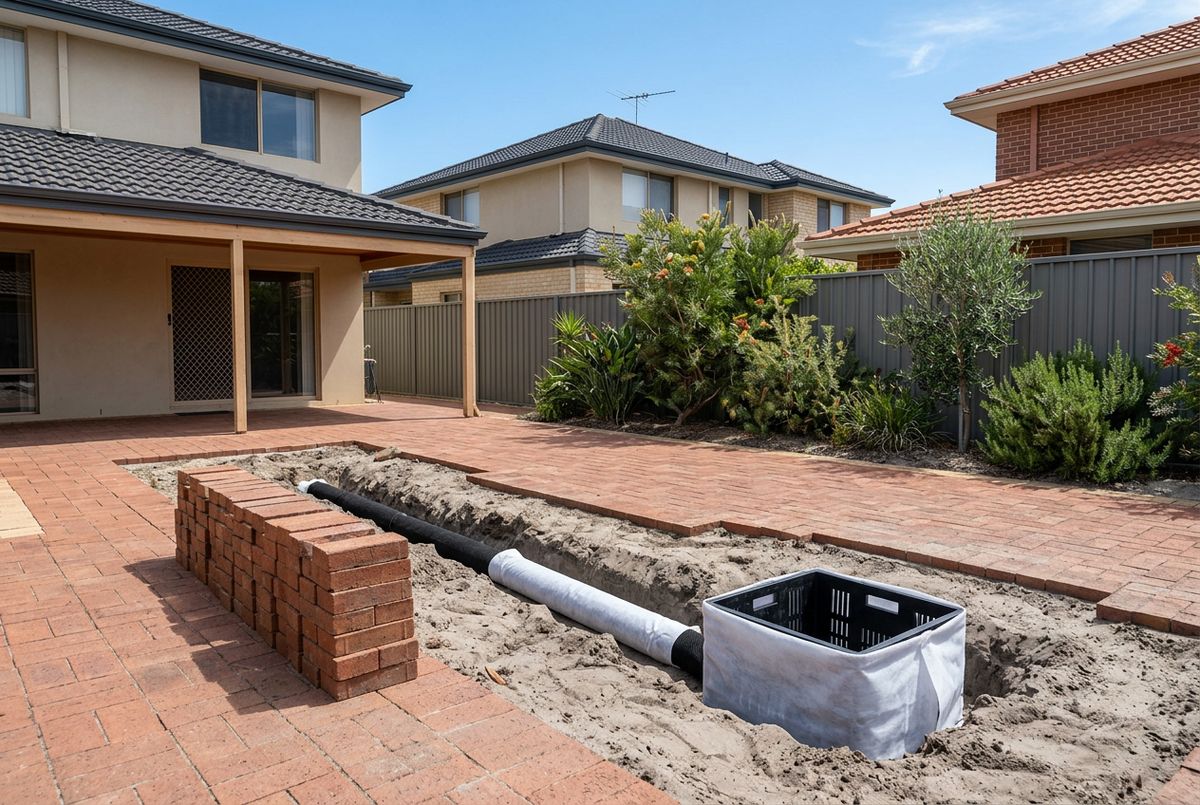
Most of our drainage work is in yards that were paved years ago. The sequence is the same each time. Find the source first: where the water comes from and where it wants to go. Lift the paving along the drain line or over the soakwell position and stack it. Trench and lay the pipe or channel. Install the new unit, or dig out and upsize the old one. Backfill and compact in layers so nothing settles later. Then relay the same pavers so the patch does not show.
Two signs tell you an existing soakwell has failed rather than the paving. Pavers sinking in a ring around one spot mean sand has washed into an unwrapped unit and left a void. Water bubbling back out of a downpipe means the chamber is full of silt or sand. The fix is a geofabric wrapped or new unit, recompaction and a relay, which is covered on our sunken paving repair page. The cheapest time for any of this is when the paving is being relaid anyway, so if you are planning a paving relay, sort the drainage in the same job.
Permeable paving: does it reduce the soakwells you need?
The City of Stirling encourages permeable paving, and DWER publishes a pervious paving sheet in its water sensitive urban design series. Permeable paving does reduce runoff. It does not remove the calculation: councils still require the stormwater sums, and the Town of Victoria Park classes permeable type pavers as impervious for stormwater calculations, so in that town they earn you nothing on paper. Our position is that permeable paving is a design choice for patios and paths that cuts ponding, not a substitute for sized soakwells under a driveway. Our core work is brick and stone paving; permeable products are quoted on request.
How IBP builds drainage into a paving job
One crew and one plan. The soakwells go in before the base goes down, so the pits are dug in open ground rather than through finished paving. Falls are set when the base is screeded, not guessed afterwards. Grates and channels are cut into the paving pattern so they read as part of the design. Trafficable lids sit flush with the pavers. And where we are retrofitting, the paving goes back without a visible patch. Based in Landsdale, with over 20 years of experience and a lifetime workmanship warranty on every job.
Related pages
For installation and repairs, start at the soakwells hub. For the rules in each council, read council soakwell requirements in Perth. For the sizing arithmetic and what a job costs, see soakwell cost and sizing.