

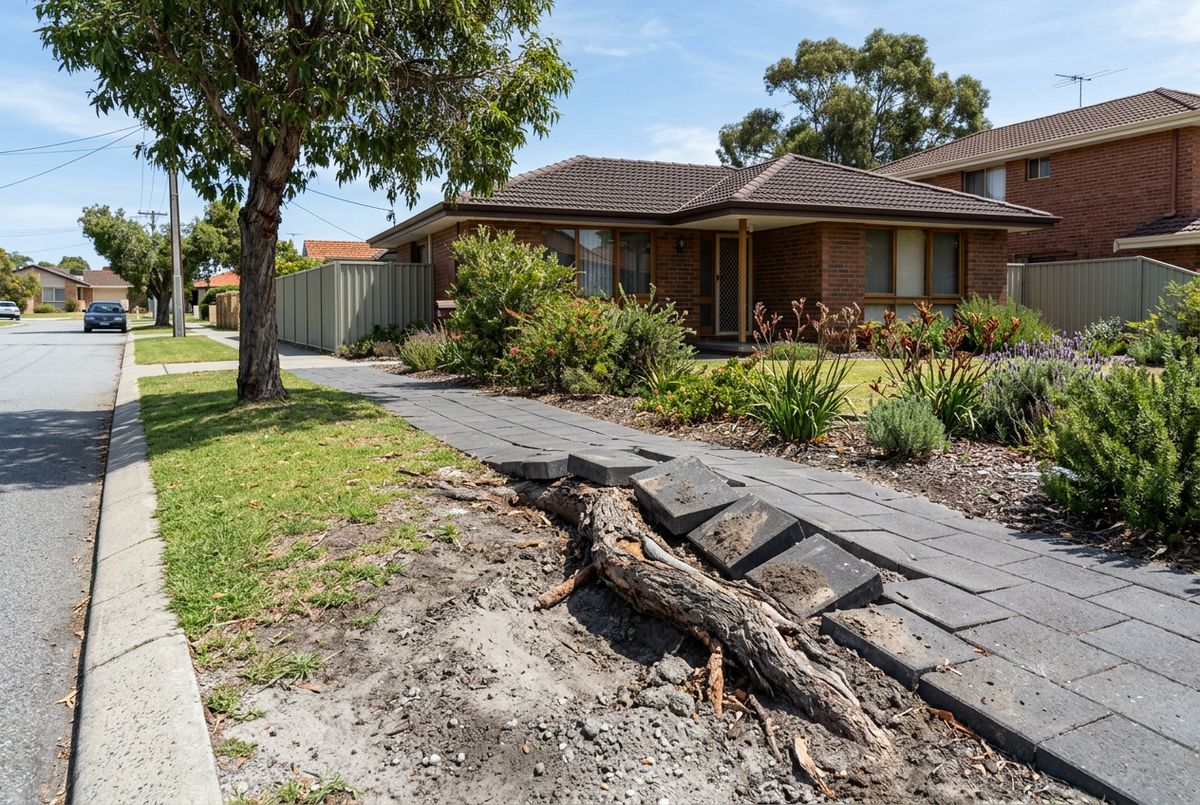
What causes pavers to lift
Four things push pavers up rather than down: tree roots, heave from a wet clay pocket under the bed, thermal expansion across a long run with no movement joints, and a mortar bed debonding where stone has been laid over concrete. On Perth verges and front paths, roots are the common one by a wide margin.
The mechanism is simple. A root runs under the bed and thickens a little every year. A sand bed can absorb some of that, but not much, and eventually the pavers above the root tilt and rise in a ridge that follows it back toward the trunk. Pavers that have dropped into a dish are a different problem, covered under sunken paving repair, and pavers drifting apart at an edge are a restraint problem, covered on the main paving repairs page.
How we fix pavers lifted by tree roots
- Lift along the root line. The pavers over and beside the ridge come up and are set aside in order so the pattern goes back as it was.
- Expose and assess the root. We dig out the bedding sand to see the root's size and direction. Pruning is only done where it is safe for the tree; for a large tree, and for any council tree, that is an arborist's call, not a paver's.
- Fit a root barrier. Where there is room between the tree and the paving, a vertical root barrier goes into the trench to turn future growth downward and away from the bed.
- Re-bed and relay. Compacted sand, or road base under a driveway, then screeded paving sand, the original pavers relaid, compacted and re-sanded.
- Redesign where the root cannot be cut. Sometimes the honest answer is that the tree will keep winning. Then we change the paving instead: a gravel or mulch ring around the trunk, a raised bed, a flexible gravel strip over the root zone, or moving the path a metre sideways.
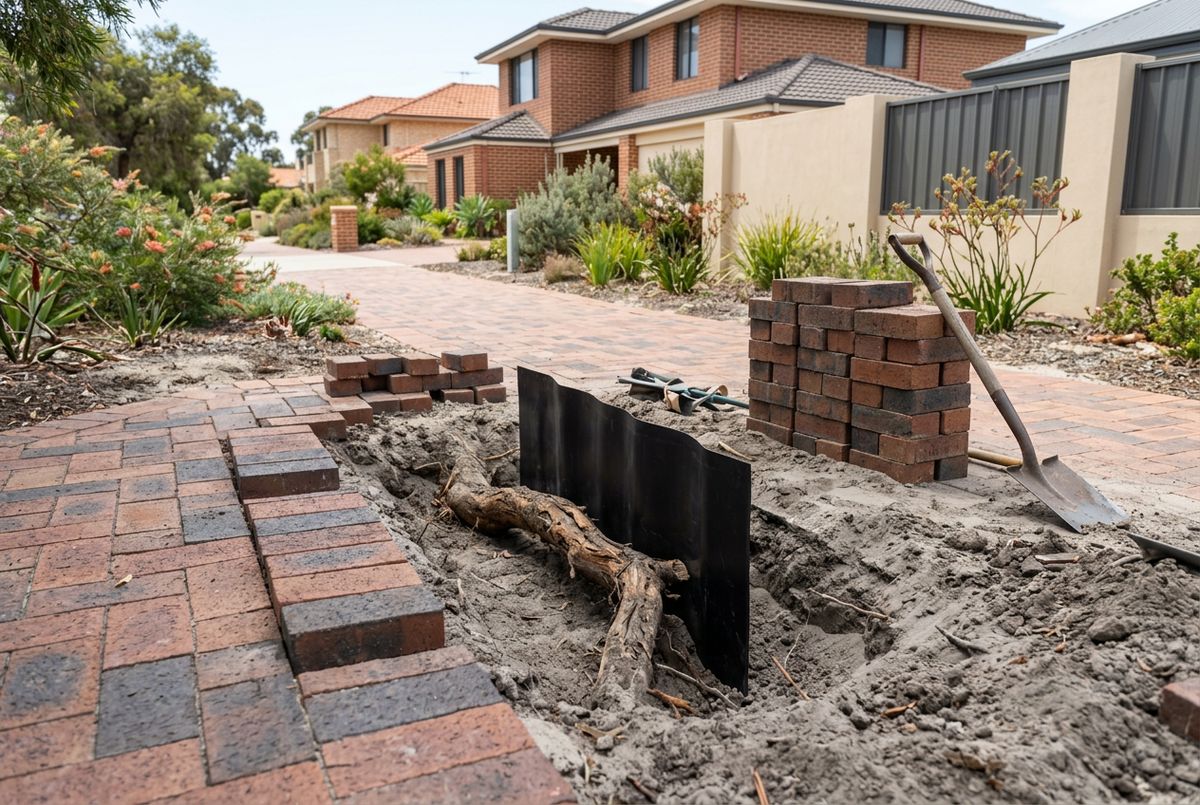
Laying pavers straight back over a live root is not a repair; it looks flat for a season and lifts again. Our lifetime workmanship warranty covers IBP's own work and the section IBP re-lays. A living root is not a workmanship fault, which is exactly why the fix has to include the barrier or the redesign.
Council street trees in Perth's northern suburbs: what the councils say
Most root damage on front paths and crossovers comes from a verge tree, and the verge tree belongs to the council. Each council sets out what you can and cannot do about it.
City of Wanneroo. The City Tree Policy, approved in December 2024, states that "Residents are not permitted to prune street trees". Where roots are causing damage, Administration "will consider the need for tree root abatement measures such as tree root pruning, exploratory trenching and or tree root barriers". On repairs, "Minor infrastructure repairs such as small areas of paving or concrete may be undertaken at Administration's discretion", but "Administration will not undertake repairs of any walls, fences, large concrete areas or any damage to a dwelling". Removal is a last resort, considered only if "no practical arboricultural or engineering solution" exists. The City's Public Places and Local Government Property Local Law 2015 prohibits damaging or removing a City tree, or part of one, without a licence.
City of Joondalup. The Tree Management Guidelines say unauthorised pruning or removal of a City tree is an offence and prosecution can occur. Trees are not pruned or removed for "perceived damage to infrastructure", or to make way for non essential crossovers or verge paving. New crossovers need a 1 to 1.5 m offset from a street tree, more for a large tree.
City of Swan. Residents must not prune or remove street trees; the City prunes to AS 4373-2007. Its verge guidelines ask residents to "be careful not to cut or interfere with the root systems of mature trees" when renovating a garden or verge.
City of Stirling. The Crossover Policy says that "Where a crossover may have been damaged by street tree roots, the City will inspect the crossover and street tree and take remedial action", and that street trees "must not be interfered with under any circumstances". Crossover setback from a street tree runs from 1 m for a trunk up to 200 mm in diameter to 4 m for a trunk over 601 mm.
Source: City of Wanneroo City Tree Policy (December 2024) and Public Places and Local Government Property Local Law 2015; City of Joondalup Tree Management Guidelines and Crossover Guidelines; City of Swan street tree and verge guidance; City of Stirling Crossover Policy.
In practice: report root damage on the verge to the council first, do not cut council tree roots yourself, and get the council's position in writing before any paving goes down on the verge. Who pays for paving inside your boundary that a council tree has lifted is not something these documents settle. Wanneroo and Stirling describe discretionary repairs to small areas of paving or crossovers, nothing more, so ask your own council and get the answer in writing. Verge and crossover rules are explained in what a crossover is in Perth.
A neighbour's tree
Roots from next door's tree are one of the most common versions of this call, and one of the easiest to get wrong. Before anyone cuts anything, the practical first step is an arborist's report on the root, the tree's health and what pruning it could tolerate, then a conversation with the neighbour with that report in hand. We do not give legal advice on cutting roots from a neighbour's tree or on who is liable; that is for the owner to confirm. Once the root decision is made, IBP quotes the paving fix.
Stopping roots lifting new paving
Prevention is cheaper than the second repair. When paving goes in near an existing tree, a root barrier along the paving edge at install time turns roots down before they reach the bed. When planting, choose species with less aggressive roots and keep large trees 3 m or more from paving. Where a mature tree already sits beside a path, give it a gravel or mulch ring rather than paving to the trunk. For a new driveway near a verge tree, the council crossover offsets above apply, and in Joondalup any hardstand verge treatment must leave a clear 2 m by 2 m planting square for the tree, so the verge design has to make room for it from the start.
What a root damage repair costs
As an indicative Perth industry principle rather than a price list, lift and relay work is priced per square metre and costs less than new paving because the pavers are reused. The extras on a root job are fresh bedding sand, a skip, replacement for any cracked units and the root barrier itself. No published Perth figure for root barrier work exists in our research, so IBP quotes each job after seeing the root. Arborist fees are separate. See paving cost in Perth.
Lifted, sunken or spreading: which repair page you need
- Lifted in a line along a root: this page.
- Dipped, with pooling water: sunken paving repair.
- Whole bed tired, pavers still sound: paving re-laying.
- Pavers cracked or crumbling: paving replacement.
Front paths that need a rethink around a tree are covered under garden paths and walkways.
Where we fix root lifted paving
Root damage follows the big trees, and the big trees follow the older suburbs: Duncraig (mid 1970s), Greenwood (from 1969), Girrawheen (1970s State Housing lots), Kingsley (1970s to 1980s), Dianella (1960s onward) and Balga (1960s). Fifty years is long enough for a verge tree to find a path. See Duncraig, Greenwood, Girrawheen, Kingsley, Dianella, Balga and the full list of areas.