

Travertine paving installers, supply and lay
Perth has no shortage of travertine importers and showrooms. What it is short of is installers who will take responsibility for the slab, the bed and the stone together. That is the job IBP Paving does. Travertine is part of our stone paving in Perth and one of the paving services we have run from Landsdale for over 20 years, fully licensed, with a lifetime workmanship warranty on the bed and the laying.
Supply and lay means we source the travertine, quote one price and hold one warranty. Lay only means you pick the stone at a showroom and we lay it. Both are fine. To start either, request a free site measure or call 0449 020 336.
Travertine formats, finishes and the French pattern
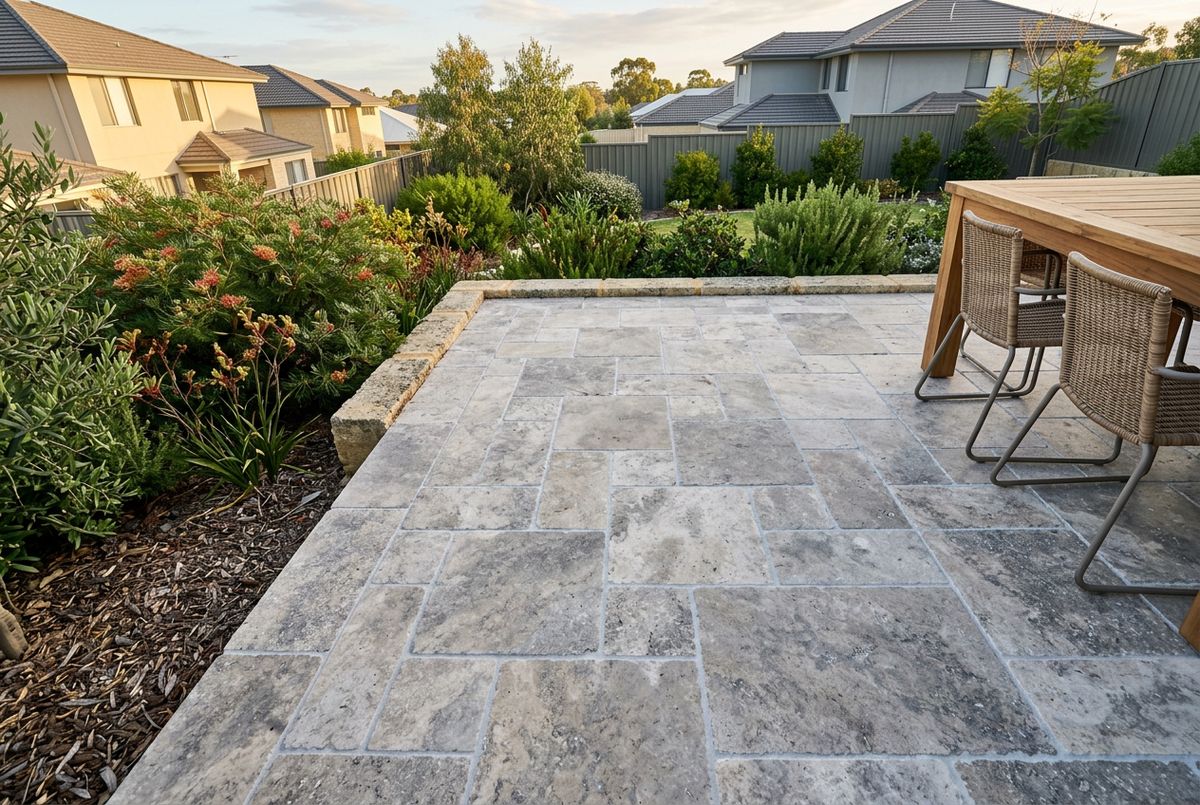
Most travertine sold in Perth is Turkish, and most of it arrives as 610 x 305 x 30 mm pavers with a honed face. Granite and Stone Gallery in Malaga lists that format in Classic Cream, Casablanca, Pewter, Nutmeg, Nebula, Cappadocia and Philadelphia, plus 100 x 100 x 30 mm cobbles. Freo Stone, with a factory in Bibra Lake and a display in Greenwood, sells its travertine and marble lines Primo, Maltese, Roma, Arctic Marble and Atlantis in French pattern sets. Remastone, Parto Stone in Osborne Park, Eco Stone Australia and Natural Stone Paving are other Perth importers. Ranges change, so ask us for current samples.
Two choices decide how the stone behaves. Finish: tumbled travertine has softened edges and a textured face that grips when wet; honed is smooth and flat, looks more formal, and can be slippery wet. Filled or unfilled: travertine is full of natural holes, and filled stone has them packed with resin or cement at the factory for a smoother face, while unfilled leaves them open for more texture and grip.
The French pattern, also called Versailles pattern, is a repeating set of four paver sizes laid in a fixed module. It gives a random looking surface without any random cutting, because every piece is a standard size and the module repeats. It is the most asked for travertine layout in Perth and the one we lay most around pools and on alfrescos; see patio and alfresco paving for the alfresco side. The truly irregular alternative is crazy paving, which takes far more fitting time. Our pattern guide shows both.
Travertine around pools: heat, slip and barriers
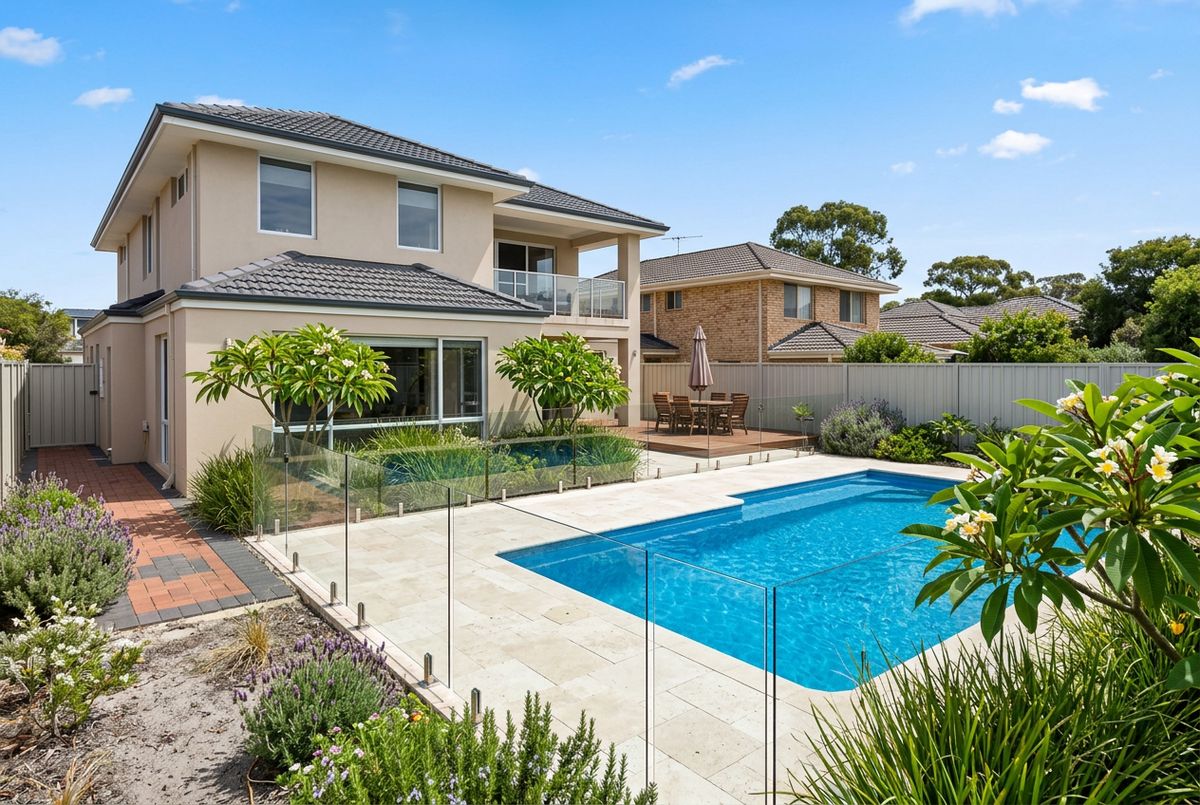
Pools are where most Perth travertine ends up, for one reason: light tumbled travertine stays noticeably cooler underfoot than dark concrete or dark granite. On a February afternoon that is the difference between walking to the pool and running.
Grip comes from the finish. Tumbled, unfilled travertine is slip resistant; honed or polished is not, so around a pool we specify tumbled every time. The CMAA and Midland Brick surface requirements factsheet gives a P4 minimum slip rating for external walkways and P5 for ramps, and tumbled travertine is chosen to meet that. Pool chemicals and salt water etch unsealed travertine, so sealing is part of the job.
The rule that catches people out is the barrier. Under the WA Rules for Pools and Spas (December 2025 edition), the pool barrier must be at least 1.2 m high measured from the finished ground level, and nothing climbable may sit within 500 mm of the fence. New paving raises the finished level, so a surround laid without checking can shorten a compliant fence. We set finished levels to keep the 1.2 m intact. The full barrier and coping detail is on our pool paving and coping page, with more in best pool pavers for Perth and pool paving slip ratings.
Source: WA Building and Energy, Rules for Pools and Spas, December 2025 edition; CMAA and Midland Brick, Surface Requirements for Pavers factsheet, July 2024.
Travertine in Perth conditions: salt, bore water and sand
Within about 1 to 2 km of the ocean, Hillarys, Sorrento, Mullaloo, Ocean Reef, Mindarie and Scarborough are high salt sites. Salt attack on porous stone shows first as a white crust and then as spalling, so coastal travertine needs sealing and washed, salt free bedding materials under it. Bore water staining is a separate northern suburbs problem, and travertine takes it readily.
Perth's free draining Spearwood and Bassendean sands are what make flexible brick paving work here, but travertine does not get that benefit. At 30 mm it is too thin for a sand bed, so it goes on a mortar bed over a concrete slab. Our Hillarys and Mindarie pages cover the coastal specifics.
Sealing travertine
Travertine is porous and full of natural holes, so it needs sealing. We use a penetrating sealer, not a film, applied after the stone has dried out and any efflorescence has worked out, with at least 48 hours of dry weather first. Around pools, reseal every 2 to 3 years.
Acids etch travertine. That rules out acid cleaners and vinegar based efflorescence removers; use a pH neutral cleaner and low pressure instead. One honesty point: Freo Stone marks its travertine as not to be sealed with its own sealer product. Supplier advice differs line by line, so we recommend a sealer per product and per supplier rather than one for everything. Later maintenance is through our paving sealing and cleaning service.
How IBP lays travertine
Travertine is a rigid bed stone. The method is a reinforced concrete slab laid to fall, a sand cement mortar bed or flexible adhesive on top, and every paver pressed into full contact so there is no hollow under it. Hollows and slab movement are what crack travertine, so bed contact is the detail we check hardest. Joints are grouted. Pool coping is bedded on the bond beam with sand cement or flexible adhesive.
If you have a sound existing alfresco slab, travertine can often go straight over it, as long as the door thresholds and finished levels allow the extra height. Travertine driveways are possible with 30 mm plus stone on a reinforced slab, and most Perth travertine driveways are built that way, but the slab makes them costly and we will say so.
Mortar laid areas shed water fast, so falls, strip drains at thresholds and soakwell sizing matter more than they do for sand laid paving. We size the soakwells and the drainage for the paved area as part of the quote. Slab thickness, reinforcement and bed type are confirmed for your site at the measure.
Travertine paving cost in Perth
These are indicative Perth industry ranges from published 2026 cost guides, not IBP's price list.
| Item | Indicative range |
|---|---|
| Travertine, per square metre | $185 to $370 |
| Pool paving, per square metre (national figure) | $130 to $180 |
| Pool coping, per lineal metre (national figure) | $130 to $220 |
Source: Perth Pavers 2026 paving cost comparison; national pool paving cost guides. Indicative Perth industry ranges only.
Travertine costs more to lay than brick because there is a slab to pour, then a mortar bed, grouting and sealing on top. French pattern adds set out time, and crazy pave adds the most labour of all. The drivers in a quote are stone grade and thickness, whether a slab exists or must be poured, pattern, coping metres, sealing and access. Our Perth paving cost guide keeps the bands current.
Travertine or limestone
Travertine is harder, shows more colour variation, is imported and is always mortar laid. Limestone is local, softer, more uniform, cheaper, and can go on a sand bed at 40 mm or more. Both are cool underfoot, which is why they share the pool and alfresco market; our post on limestone versus travertine goes through the trade offs. For driveways, granite is the harder wearing stone. For warm tones on a low traffic patio, see sandstone.