

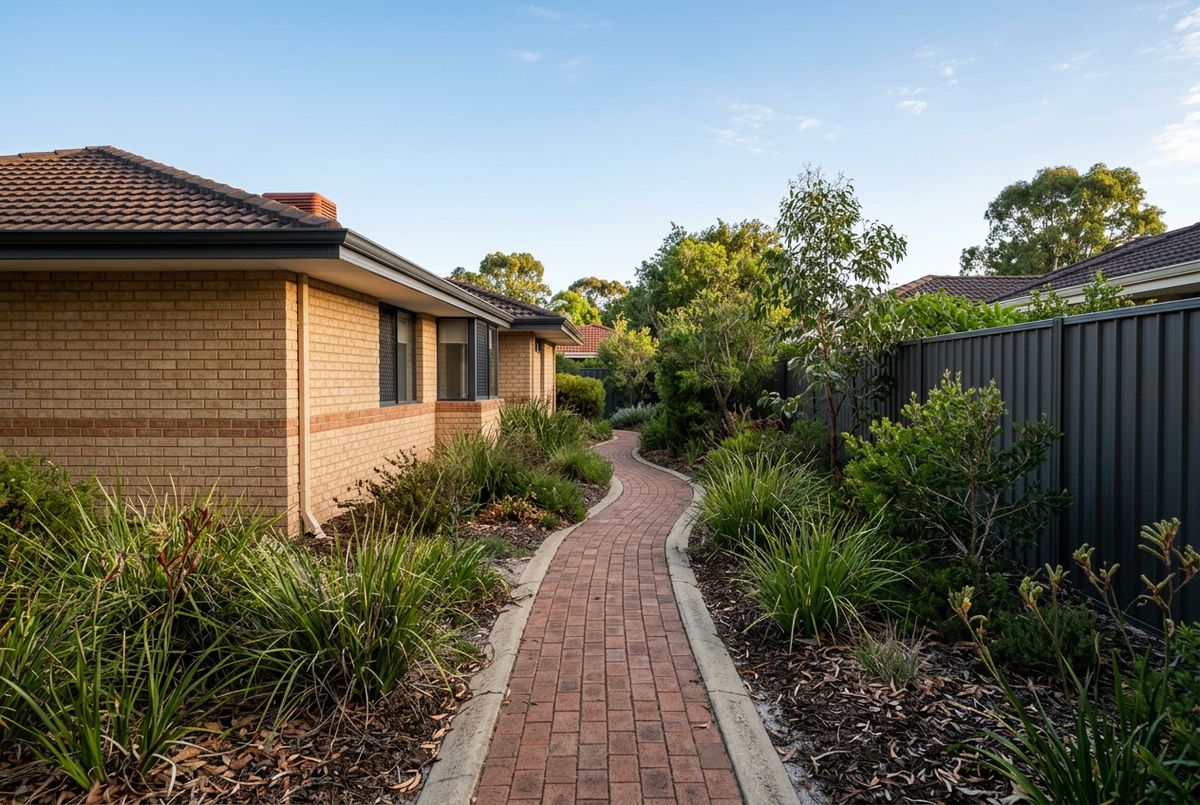
Garden path and walkway paving
We lay three kinds of path. A solid brick or concrete paver path is the side of house standard and the one most people mean. Stepping pavers set in gravel or lawn give the garden path look and are the easiest to change later. Limestone slabs or crazy paving make a feature path to a front door or through a garden; see crazy paving and limestone paving.
IBP Paving is Landsdale based with over 20 years in Perth, fully licensed, with a lifetime workmanship warranty on the work we lay. Paths are usually part of a bigger job such as a driveway, alfresco or landscaping package, but we quote them on their own as well. Paths sit within our brick paving service and our Perth paving work. For a quote, request a free site measure or call 0449 020 336.
Width, fall and edging
A main path runs 900 to 1,200 mm wide, and wider where bins or a wheelbarrow pass. 40 mm pavers are the pedestrian standard: the CMAA Surface Requirements for Pavers factsheet sets a minimum 2 kN breaking load and 40 mm, and Midland Brick specifies 40 mm for paths. The cross fall is 1:60 to 1:80 away from the house so water runs to lawn or garden, not against the wall.
Edge restraint goes on both sides, as concrete haunching or a mortared border, because a narrow path with no edge spreads faster than any other paving. For pattern, stretcher bond runs long and uses the fewest cuts on a path; basketweave or herringbone suit a character home.
Stepping pavers are set each on a compacted sand pad, spaced to a comfortable stride, with gravel over a weed mat between them or set flush into turf so the mower runs over them.
Source: CMAA and Midland Brick, Surface Requirements for Pavers factsheet, July 2024.
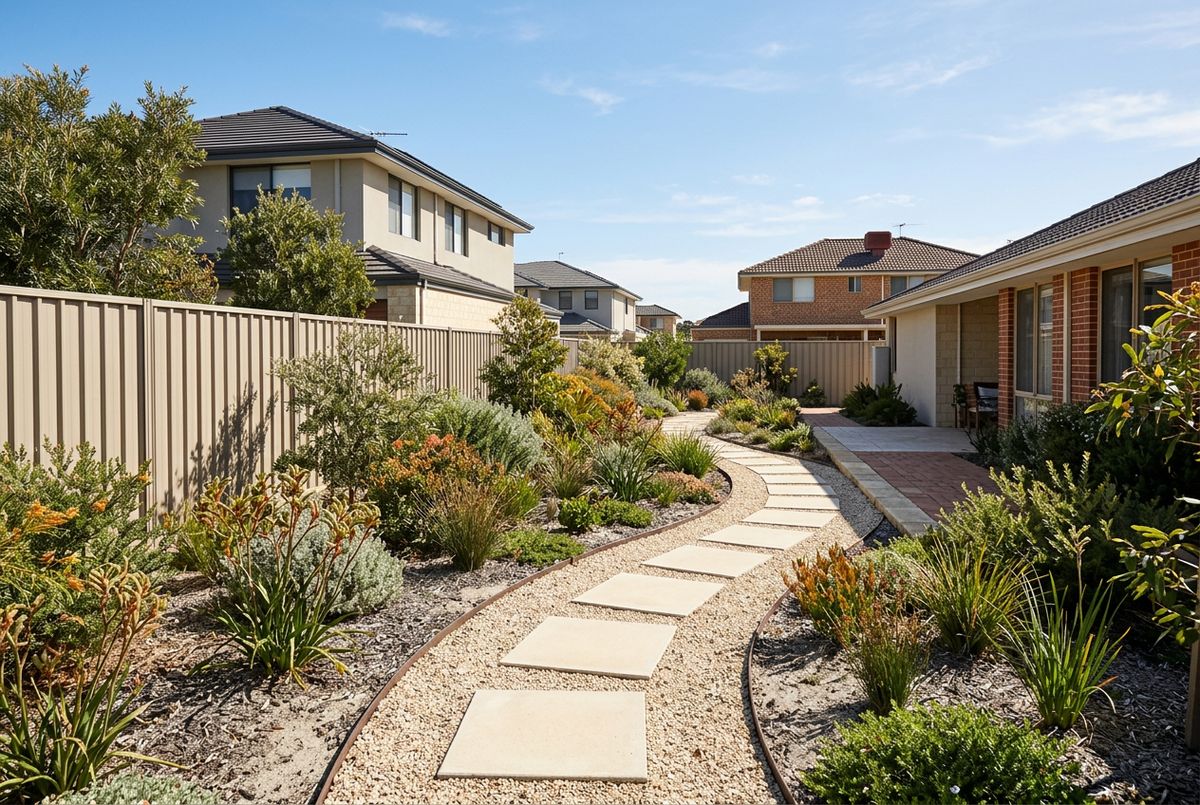
Side paths over services: pavers, not concrete
The side of a Perth house carries the water, sewer, gas and NBN runs. When a plumber or the NBN crew trenches through, pavers are lifted and relaid with the same units; a concrete path has to be cut and patched, and the patch never matches. That is the strongest reason to pave a side path rather than pour it, and relaying after a trench is a service we offer.
Side paths also carry downpipe water. The path should fall away from the wall, and a downpipe that discharges onto it should go to a soakwell instead, because water running across a sand bedded path is what washes the bed out.
Paths on Perth sand and around trees
Paths on compacted natural Perth sand can be bedded straight on washed yellow paving sand without road base. Over fill or on a slope the base is built up and compacted in layers.
Tree roots are the main reason garden paths lift. Keep large trees around 3 m or more from new paving, use a root barrier at install where a path must pass a tree, or set stepping pavers in gravel so the path can flex over the roots. A path already lifted by roots is covered on lifted pavers and tree roots.
A verge path from the footpath to your front door sits on council land and needs council approval in most northern councils. Ask us; we quote verge paths to the council's rules, which are summarised on our landscaping page.
Cost and which page you need
As indicative Perth industry ranges, not IBP's price list, published 2026 cost guides put concrete pavers at $75 to $110 per square metre supplied and laid, clay at $130 to $210 and limestone at $80 to $160. Narrow paths cost more per square metre than open areas because of the cuts and the two edges, and stepping paver paths are priced per paver, so we quote per job. Current bands are in our Perth paving cost guide.
Source: Perth Pavers 2026 material comparison. Indicative Perth industry ranges only.
A wider entertaining area is on patio and alfresco paving; an enclosed space is courtyard paving; a path lifted by roots or sunk by water is a repair; the front yard as a whole, including the verge, is landscaping. The mature 1960s and 1970s streets of Greenwood, Duncraig, Kingsley, Girrawheen and Balga, with their established trees and original side paths, are where most of our path work is. See all areas we service.