

What soakwells cost to install in Perth
Nobody in Perth publishes a current price list for installed soakwells. Suppliers list unit prices, councils publish sizing rules, and the installed figure that joins the two sits in individual quotes. So the honest starting point is that the public numbers are few and old. What follows are indicative Perth industry ranges, not our price list.
- A PropertyChat forum thread from 2015 quoted $3,500 plus GST for four polypropylene 1500 x 900 soakwells installed, which works out at about $875 plus GST per unit.
- The same 2015 thread shows a builder's provisional sum for soakwells rising from $4,000 to $6,000 once council sizing called for four units instead of two.
- An undated strata maintenance guide from ESM Strata puts remediation or retrofit of a soakwell at $1,000 or more per unit.
Those figures are a decade old or undated, so treat them as a floor rather than a quote. Today a single installed unit runs from several hundred dollars for a small polypropylene crate dropped into open sand under a lawn, to well over $1,000 where a concrete unit goes under a driveway and the paving has to come up and go back down. IBP quotes per job after a site visit, because access, ground and reinstatement move the price far more than the unit itself does. Our soakwell installation and repairs in Perth page covers the service as a whole.
What drives the price
Six things decide what a soakwell job costs, and only one of them is the soakwell.
- Size and number of units. Your council's rule sets this, not the installer. The 2015 forum case above is the usual story: the storage target comes out higher than the builder allowed for, so more units go in.
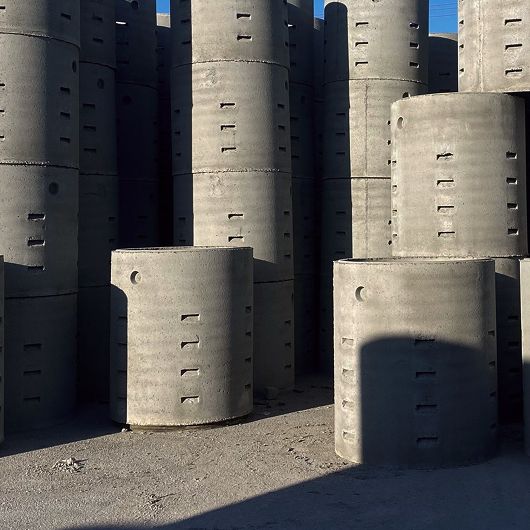
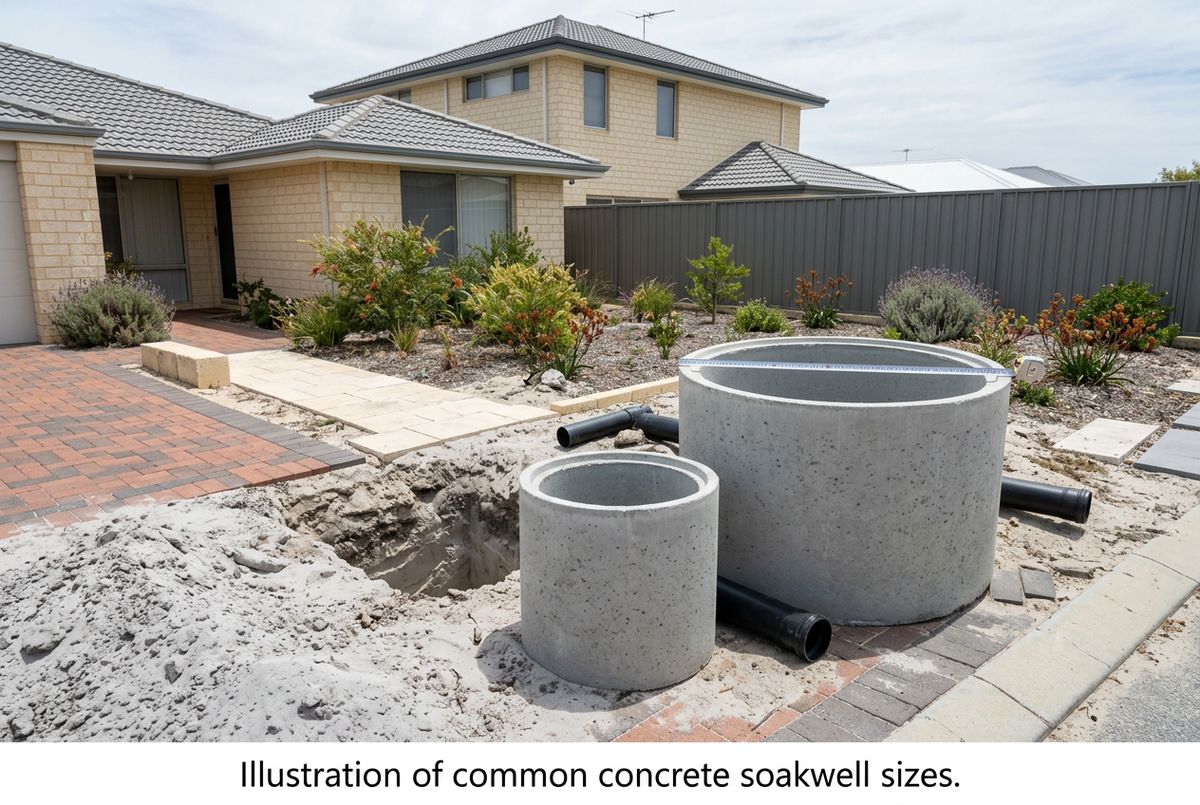
- Concrete or polypropylene. A 1200 x 1200 concrete unit weighs about 1,100 kg on the Wanneroo table, so it arrives on a truck and goes in by machine. Polypropylene crates are carried through a side gate and assembled in the pit. Our guide to concrete versus polypropylene soakwells weighs the two.
- Access. A machine dig in an open front yard is quick. A hand dig behind a narrow side setback on a 2000s lot in Landsdale, Darch or Banksia Grove is not, and Banksia Grove's newer precincts are built on narrow lots by design.
- Ground. Spearwood sand suburbs such as Duncraig and Woodvale sit over Tamala Limestone, and the state's water sensitive urban design sheet notes that installation "will be more difficult if rock or other hard material is present". Clay around Dayton and the Midland area drains poorly and may need an engineered alternative instead of a soakwell.
- Pipe runs. Every downpipe and grated drain needs PVC stormwater pipe to the unit, trenched and backfilled.
- Paving removal and reinstatement. Under a driveway the City of Stirling requires a trafficable design on an approved base and the City of Swan requires trafficable lids, so the unit costs more and the pavers must be lifted and relaid over it.
How Perth councils size soakwells
Every council starts from your impervious area. The City of Bayswater defines it as "any hard surface that sheds water e.g. roofs, paving, driveways and patios", and that definition holds across Perth. Councils then publish either a capacity table that matches unit sizes to the area they drain, or a litres per square metre factor. The verified rules for the councils we work in most:
- City of Wanneroo and City of Joondalup use the same six size table, from 600 x 600 (180 L, about 14 m²) up to 1800 x 1200 (3100 L, about 250 m²), plus one downpipe for approximately every 15 m² of roof and no more than 12 m between downpipes.
- City of Stirling: impervious area (m²) x 0.015 m = capacity required (m³), derived from a 1 in 1 ARI 60 minute event equal to 15 mm of rain across the site.
- City of Bayswater: impervious area x 0.0125, retaining 12.5 mm of rainfall.
- City of Swan: volume (m³) = 0.0122 x impervious area, given as a general guide for sandy soil of high permeability and sized for a 5 year 10 minute storm. It comes from an engineering guideline written for development sites rather than single houses, so confirm it with the City.
The full comparison, including Canning, Cockburn and Gosnells, is on our council soakwell requirements page.
Worked examples: 150, 250 and 400 m²
Impervious area here means roof plus paving. Unit counts are estimates, because councils publish the storage target rather than the combination of units; we confirm the layout on site.
| Impervious area | Wanneroo and Joondalup table | Stirling formula | Bayswater | Swan |
|---|---|---|---|---|
| 150 m² | One 1800 x 600 (125 m², 1550 L) plus one 900 x 600 (31 m², 385 L) serves 156 m²; or two 1200 x 1200 (222 m², 2600 L). Est. | 150 x 0.015 = 2.25 m³. Two 1200 x 1200 at 1.36 m³ each = 2.72 m³. Est. | 150 x 0.0125 = 1.875 m³ | 150 x 0.0122 = 1.83 m³ |
| 250 m² | One 1800 x 1200 (250 m², 3100 L); or three 1200 x 1200 (333 m², 3900 L). Est. | 250 x 0.015 = 3.75 m³. Three 1200 x 1200 = 4.08 m³, or one 1800 x 1800 at 4.58 m³. Est. | 250 x 0.0125 = 3.125 m³ | 250 x 0.0122 = 3.05 m³, which is one 1800 x 1200 on Swan's Table 4 |
| 400 m² | Two 1800 x 1200 (500 m², 6200 L); or one 1800 x 1200 plus two 1200 x 1200 (472 m², 5700 L). Est. | 400 x 0.015 = 6.0 m³. One 1800 x 1800 plus two 1200 x 1200 = 7.3 m³. Est. | 400 x 0.0125 = 5.0 m³ | 400 x 0.0122 = 4.88 m³ |
Sources: City of Wanneroo, Stormwater Runoff Information Sheet (July 2019); City of Joondalup, Residential soakwells web page; City of Stirling, On Site Stormwater Drainage Criteria (June 2024); City of Bayswater, Clearance of Subdivision Conditions Information Sheet (2022); City of Swan, Property Development Design Guidelines D12 (August 2016). All checked 9 October 2026.
Three notes before you pick units. In Stirling, roof runoff must be stored separately from runoff off paving, so split the total into two catchments before choosing units. The Wanneroo and Joondalup table is "recommended based on normal rainfall conditions" and the City of Wanneroo warns that overflow can occur in clay or limestone. And on a 150 m² roof the Wanneroo and Joondalup downpipe rule gives about ten downpipes, which does not mean ten soakwells: downpipes are piped to shared units. The detail for each is on our City of Wanneroo and City of Stirling soakwell pages.
Minimum sizes, design storms and when the sums change
The City of Stirling sets 900 mm diameter by 600 mm deep as the smallest soakwell allowed for roof water, and the Town of Victoria Park and Town of Claremont publish the same minimum. The design storm behind the sums differs by council. Stirling uses a 1 in 1 ARI 60 minute event as its minimum, rising to a 1 in 20 ARI storm where a drainage management plan is triggered. The City of Cockburn designs for a 1 in 20 year storm of 5 minutes duration. The City of Gosnells uses 1 in 20 where there is an overland flow path and 1 in 100 where there is not. The City of Wanneroo states no 1 in 10 or 1 in 20 year rule for single houses, so we do not claim one.
The arithmetic also changes on difficult ground. Gosnells requires 0.5 m from the soakwell base to the maximum groundwater level or a clay layer. The City of Swan says capacity is reduced where the water table rises above the base and soakwells may not be suitable. The City of Nedlands advises shallow, larger diameter units where the water table is high. If your lot sits beside a lake, a wetland or on clay, read our guide to soakwells in clay, limestone and high water table areas before you size anything.
How IBP quotes a soakwell job
We come out from Landsdale and measure the roof and paved area, count the downpipes, check setbacks against the rule for your council, test whether a machine can reach the dig, look for rock and signs of a high water table, and work out whether paving has to come up. The quote is itemised by unit, excavation, pipe and reinstatement, so you can see what the council rule is costing you and what access is costing you.
The cheapest time to add or upsize soakwells is while the paving is already up. If we are lifting a driveway to relay it, or laying a new alfresco, the trench and the pit are part of the same dig. Over 20 years of experience and a lifetime workmanship warranty cover every job.
When to read the other soakwell pages
For the full rule set, permits and setbacks for each council, read council soakwell requirements in Perth. If your problem is water pooling on a driveway or alfresco rather than a missing soakwell, start with stormwater drainage for paved areas. If an existing unit is overflowing or the pavers are sinking in a ring around it, see sunken paving repair and the repairs section of the soakwells hub.