

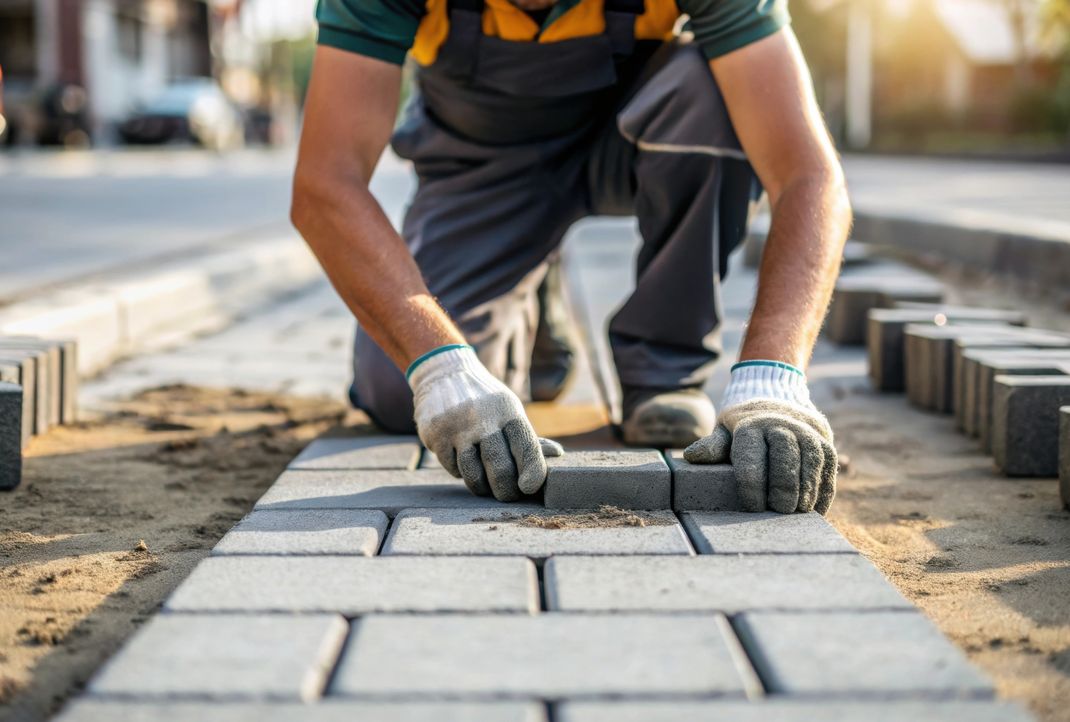
Why paving fails in Perth
In Perth the pavers themselves rarely fail. Clay and concrete pavers last 30 to 50 years, but the sand bed and joints under them give out after 10 to 20 years on sand. That is why most repair work here is a lift and relay, and why the first job on any repair is finding what moved the bed. Six causes account for nearly every call we get.
Sand base settlement
Most Perth brick paving is laid flexibly on a screeded sand bed over compacted natural sand. Landsdale, Darch, Madeley, Wanneroo and Ellenbrook sit on deep, pale grey Bassendean sand. Joondalup, Woodvale, Duncraig and Kingsley sit on Spearwood sand over Tamala limestone caprock. Both drain well, but both settle if they were never compacted. Some settlement in year one is normal. Sinking that keeps going means water, ants or an uncompacted base is still at work. Uncompacted fill on new builds is a specific Perth problem, especially on newer estates such as Alkimos, Banksia Grove and Yanchep.
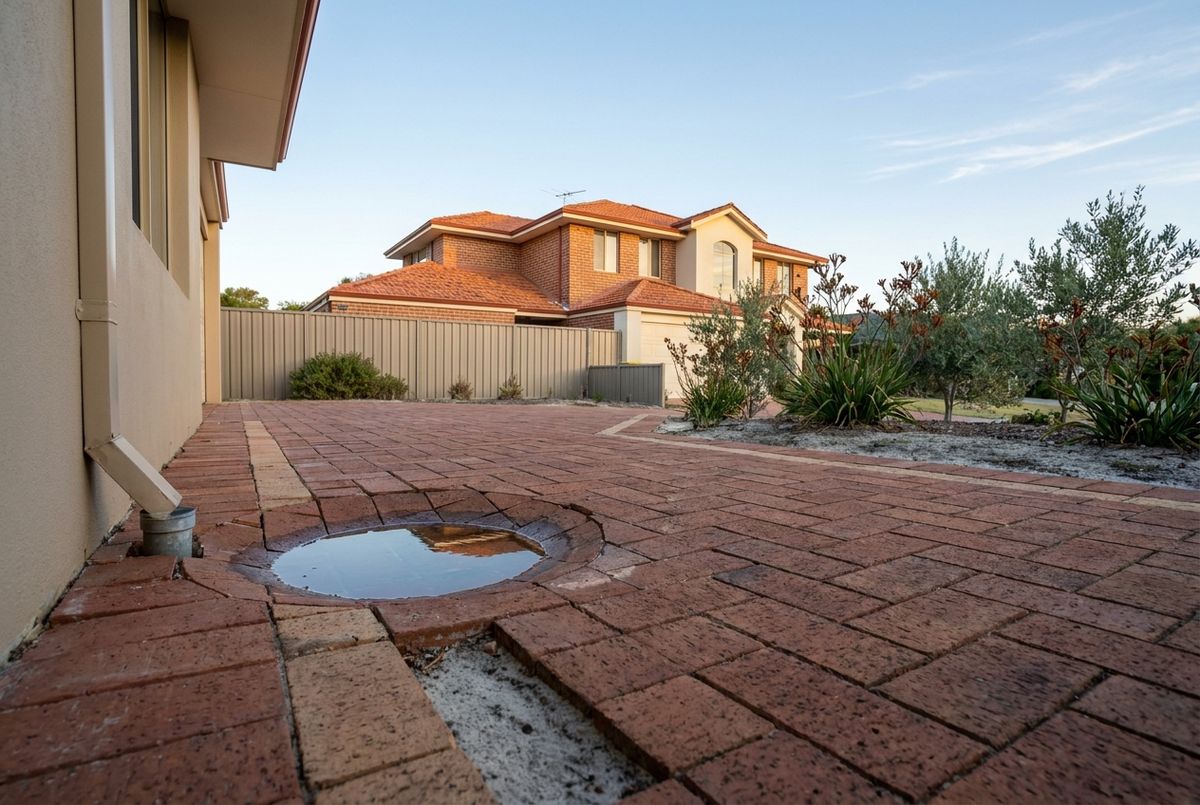
Soakwell overflow and water
Water washing out the bedding sand is the number one cause of sunken paving in Perth: downpipes discharging onto paving, a leaking tap or pool pipe, or soakwells that are missing, undersized or full. Dark staining on a sunken patch usually means a bed that stays wet. If the water keeps coming the repair will not hold, so we check soakwells and stormwater drainage before lifting a paver.
Tree roots
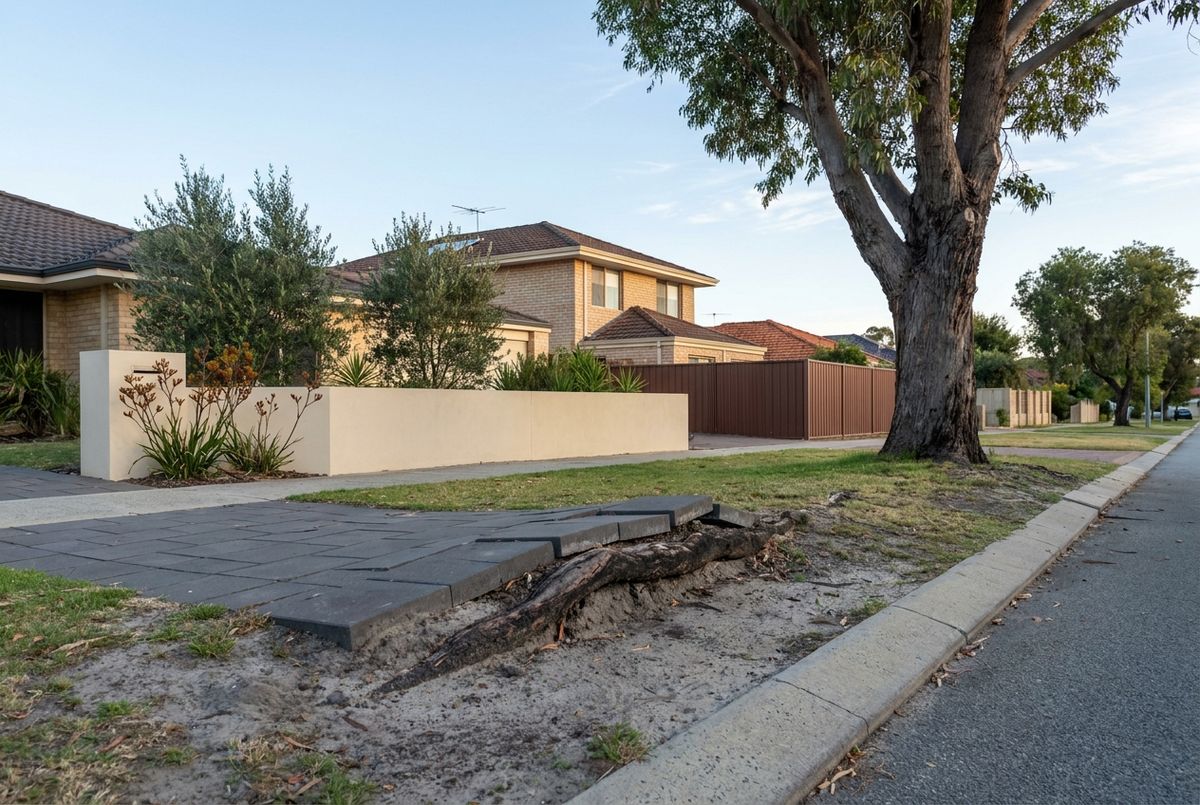
Roots from street trees and large garden trees lift pavers in a line and crack mortar beds. Council street trees cannot be pruned or removed by residents. The City of Wanneroo Tree Policy says the City will consider "tree root abatement measures such as tree root pruning, exploratory trenching and or tree root barriers", may repair small areas of paving or concrete at its discretion, and will not repair walls, fences, large concrete areas or damage to a dwelling. The City of Stirling says it will inspect a crossover that may have been damaged by street tree roots and take remedial action. Paving on your own land is your repair; see lifted pavers and tree root damage.
Source: City of Wanneroo Tree Policy (approved December 2024); City of Stirling crossover and street tree guidance.
Ants mining the bedding sand
Ants nest in loose bedding sand on Perth's sandy soils and carry it up through the joints, leaving sand cones on top and a hollow underneath. The fix is to treat the nest, re-bed and relay the patch, then re-sand with a bound joint sand.
Poor or missing edge restraint
Gaps opening between pavers and a border course creeping outward mean nothing is holding the field in. Paving needs a concrete haunch or a mortared border course along every free edge. Driveways suffer most.
Vehicle loading
Pavers too thin for a driveway, or laid with no compacted road base beneath, crack and rock under car loads. The sign is a rut along the wheel lines and broken units where cars turn. The repair is a relay over a proper base, covered on our driveway paving page.
Five early warning signs: a low spot that holds water, gaps that keep growing, a paver that wobbles underfoot, pooling after rain, and weeds or ants in the joints. Catch them early and the repair is a small patch. More in why pavers sink in Perth.
The four repair types we do
Sunken and uneven paving repair
A dished area in a driveway, a step down at the alfresco door or a patch of pool surround that has dropped away from the coping. We lift the area, find and fix the water source, re-bed with washed yellow paving sand, compact, relay and re-sand. Small areas can be spot relayed; wide settlement needs the whole bed redone. Sunken pool surrounds are a common Perth case because the backfill around the shell keeps settling. See sunken and uneven paving repair.
Lifted pavers and tree root damage
A ridge of pavers tilting along the line of a root, usually near a verge tree. We lift the pavers, prune roots only where it is safe for the tree, install a root barrier where practical, then re-bed and relay. Where the tree will keep winning, we redesign with a gravel or mulch ring around the trunk. Pavers laid straight back over live roots lift again. See lifted pavers and tree root damage.
Lift and relay
For driveways and patios where the pavers are sound but the bed has gone. The pavers are reused, so the cost sits well below new paving; you pay for labour, new sand, a skip and a few replacement units. A typical enquiry is a 150 square metre driveway relay, and the same method puts paving back after plumbing or NBN trenching. See paving re-laying.
Paving replacement
When pavers are crumbling, salt affected near the coast or a pool, or discontinued with no match, relaying only puts a bad paver back. We replace the full area or a section, matched where possible or with a contrasting band where not. See paving replacement.
Matching old and discontinued pavers
The hardest part of replacing broken pavers is matching a colour or size that has not been made for years. First, identify the paver: clay or concrete, and the size, since 230 by 115 mm clay units and 200 by 100 mm concrete units will not mix in one pattern. Second, check the current Midland Brick and Austral Masonry ranges; Brikmakers was folded into Midland Brick in 2021, so some older colours have a close equivalent there. Third, look for a genuine second hand match. Fourth, and often the best answer, harvest matching pavers from behind the shed or under the bin bay and lay the new pavers there. Where no match exists, a contrasting border or band makes the repair read as a design choice. More on this under paving replacement and brick paving.
Re-sanding, jointing and sealing
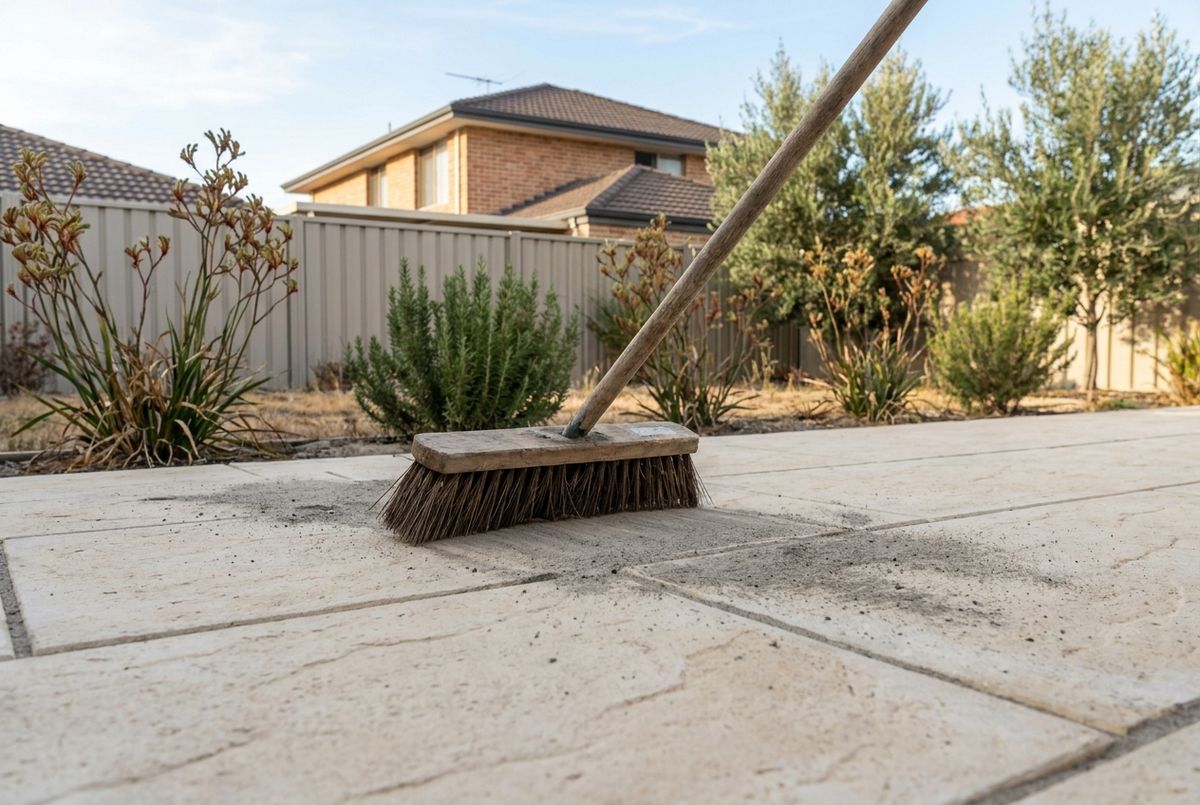
Every repair ends with re-sanding, because joint sand locks the pavers together. Pressure washing strips it out, so any clean needs a re-sand afterwards. Perth has three joint options: plain washed paving sand, a bound product such as pave set or polymeric sand, and a dry sand and cement mix, the last two chosen where ants and weeds have been the problem.
Sealing after a repair is maintenance that protects the work, not a separate trade. We wait for efflorescence to work out and the pavers to dry, then apply a penetrating sealer on limestone and travertine, or an acrylic or wet look sealer on concrete and clay. We laid it, so we know what sealer suits it. Details are on paving sealing and cleaning, and the blog covers whether brick pavers should be sealed and paving maintenance in Perth.
What a repair visit looks like
- Site look and diagnosis. Falls, downpipes, soakwell condition, tree roots, ant activity, edge restraint and paver condition. The cause comes first, because a relay over an active leak sinks again.
- Quote. Square metres of lift and relay, replacement units, new sand, skip hire and edge works, with any soakwell or drainage work itemised separately.
- Lift. Pavers are set aside in order where the pattern matters, such as herringbone or basketweave.
- Fix the cause. Redirect downpipes, replace or add soakwells, remove roots and fit a barrier, or treat ants.
- Re-bed. Typical Perth practice is compacted road base under driveways and washed yellow paving sand screeded to a fall of 1:60 to 1:80 away from the house, with geofabric over any fill.
- Relay, compact, re-sand and haunch. Pavers go back, the area is plate compacted, joints sanded and free edges haunched in concrete.
- Clean and optional seal once the pavers have dried out.
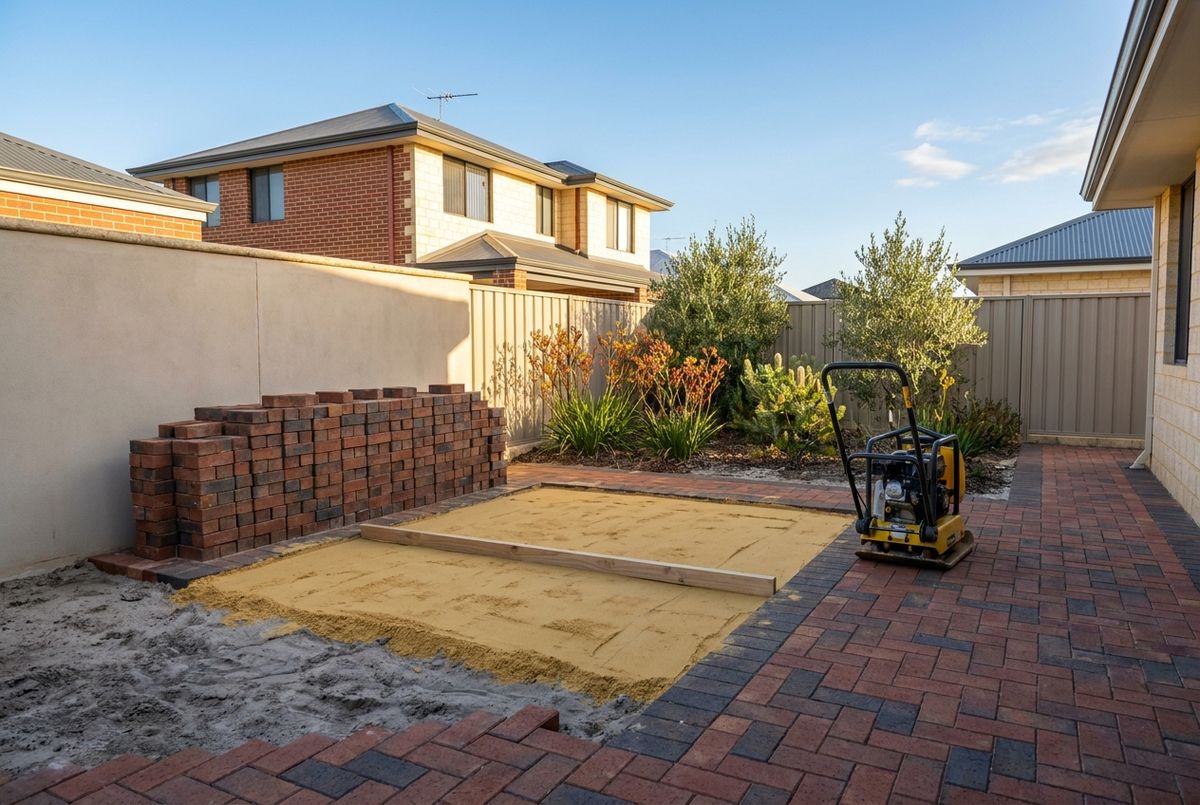
Small patches are usually a single visit; we give the timing for a full driveway relay with the quote.
What paving repairs cost in Perth
These are indicative Perth industry ranges from published sources, not an IBP price list. We quote after a site visit.
| Job | Indicative Perth industry range | What drives it |
|---|---|---|
| Small patch repair | Perth paving jobs listed on Airtasker show a median of about $360 | Area, access and whether the cause needs fixing too |
| Lift and relay | Priced per square metre, well below new paving because the pavers are reused | New sand, skip hire, replacement units, pattern |
| Full replacement, supply and lay | Concrete pavers about $75 to $110 per m2, clay brick $130 to $210, limestone $80 to $160 (third party 2026 guide) | Material, area, removal of the old paving, base work |
| Clean and seal after repair | Cleaning about $3 to $6 per m2, sealing about $5 to $10 per m2 on top, or $5 to $15 per m2 for sealing alone | Paver type, sealer type, condition |
Source: Airtasker Perth paving listings; a third party Perth paving cost guide (2026); PPS Exterior Cleaning. Indicative Perth industry ranges only.
What moves a repair quote: the area, whether the pavers can be reused, access for a skip and plate compactor, whether a soakwell or drainage fix is needed, and the pattern, since a herringbone relay takes more labour than stretcher bond. See paving cost in Perth and soakwell cost.
Repair or replace?
Relay if the pavers are sound and a match exists. Replace if they are crumbling, chipping across the whole area, salt attacked near the coast or a pool, or discontinued with no match. Because pavers last 30 to 50 years and beds 10 to 20, most Perth jobs are relays. Clay pavers hold colour for 50 years or more; concrete fades at 25 to 40. Within 1 to 2 km of the ocean, salt drives efflorescence and surface weathering, which pushes toward replacement with dense or sealed pavers.
| Symptom | Usual fix | Why |
|---|---|---|
| Sunken patch, pavers sound | Spot relay | The bed failed, not the paver |
| Whole driveway uneven | Full lift and relay | Bed and base need redoing as one |
| Pavers lifted in a line | Root work, barrier, relay | Roots lift them again if ignored |
| Gaps opening at the edge | Relay edge, concrete haunch | No restraint holding the field |
| Crumbling or flaking faces | Replace | Salt or weathering has reached the paver itself |
| Broken pavers, colour discontinued | Harvest, source or contrasting band | A visible mismatch looks worse than a border |
More on the decision at paving replacement and repair or replace paving.
Repairs backed by a lifetime workmanship warranty
IBP Paving is based in Landsdale, fully licensed, with over 20 years of experience across Perth's northern suburbs. Every repair carries our lifetime workmanship warranty. In plain words, that covers the workmanship of the section we re-lay: the base, bed, compaction and edge restraint on the area we worked on. It does not extend to paving we did not touch. Sinking is nearly always a base or workmanship issue rather than a paver defect, which is why we warrant the workmanship. The business is owned and run by Idris. Read more in what a paving warranty covers.
Where we repair paving
We work across Perth's northern suburbs from Landsdale, and repair calls follow the age of the housing. Landsdale's market gardens were converted from the late 1990s, so its first driveways are reaching the 20 to 25 year mark where relays start. Darch was named in 1997 and is mostly 2000s homes. Madeley came out of East Wanneroo Cell 6, released in 1996. Tapping is a 1990s to 2000s estate. Ellenbrook's early villages date from the 1990s and are reaching 25 to 30 years, the point where first relays are due. See Landsdale, Darch, Madeley, Tapping, Ellenbrook and the full list of areas. Older 1970s and 1980s stock in Woodvale, Alexander Heights and Ballajura tends to need full relays or replacement rather than patches.