

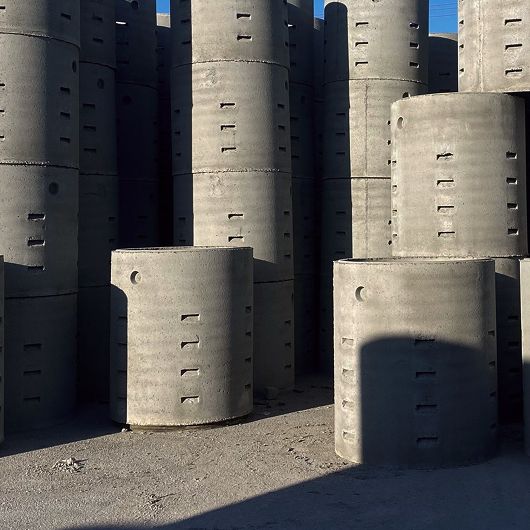
What a soakwell does and why Perth councils require one
A soakwell is an underground chamber, either precast concrete rings or a modular polypropylene crate, buried in the sand beside your home. Downpipes and paving drains feed into it and the water soaks out through the slotted walls and open base instead of running off your lot. Perth works this way because most suburbs sit on deep, free draining sand, many streets have little piped drainage, and every metropolitan council expects stormwater to stay where it falls.
"Property owners have a statutory obligation under common law precedents and the Local Government Act 1995 to confine water runoff within their property boundaries."
Source: City of Wanneroo, Stormwater Runoff Information Sheet (correct as of July 2019). The City of Joondalup's Residential soakwells page uses the same wording about a statutory obligation under common law and the Local Government Act 1995.
The City of Stirling requires all rainfall within lot boundaries to be contained on site by soakwells or an approved alternative such as a holding tank or infiltration basin (On Site Stormwater Drainage Criteria, June 2024). At state level, DWER's Decision process for stormwater management in Western Australia (2017) says runoff from the first 15 mm of rainfall should be managed at source, on the lot.
Without soakwells, water ponds against footings, crosses into the neighbour's yard, washes out the sand under paving and can attract a council notice. Sure Building Inspections reports downpipes discharging to ground in 22.1 per cent of its Perth reports (that firm's figure). See council soakwell requirements across Perth.
How soakwell sizing works in Perth
Sizing starts with your impervious area: the roof plus every hard surface that sheds water, including driveways, patios and pool surrounds. Your council then applies its design rule, either a capacity table matching soakwell sizes to the area they drain, or a litres per square metre formula. The result is a total storage volume, split across the downpipes and drains around the house.
| Council | Verified sizing rule |
|---|---|
| City of Wanneroo | Capacity table: 600 x 600 mm = 180 L (about 14 m² drained); 900 x 600 = 385 L (31 m²); 900 x 900 = 580 L (47 m²); 1200 x 1200 = 1300 L (111 m²); 1800 x 600 = 1550 L (125 m²); 1800 x 1200 = 3100 L (250 m²). One downpipe per about 15 m² of roof, no more than 12 m apart. |
| City of Joondalup | Same six size table and the same downpipe rule as Wanneroo. |
| City of Stirling | Impervious area (m²) x 0.015 m = capacity (m³), that is 15 L per m², based on a 1 in 1 year ARI 60 minute event (15 mm across the site). Minimum unit 900 mm diameter x 600 mm deep. |
| City of Bayswater | Volume (m³) = impervious area (m²) x 0.0125, retaining 12.5 mm of rainfall. Example: 240 m² needs 3 m³. |
| City of Swan | Volume (m³) = 0.0122 x impervious area (m²), a general guide for sandy soil of high permeability, sized for a 5 year 10 minute storm. |
| City of Cockburn | Volume (m³) = impervious area (m²) divided by 80, for a 1 in 20 year storm of 5 minutes duration. A 1200 x 1200 unit serves 108.56 m². |
Sources: City of Wanneroo, Stormwater Runoff Information Sheet (correct as of July 2019); City of Joondalup, Residential soakwells (stormwater runoff) web page (accessed 9 October 2026); City of Stirling, On Site Stormwater Drainage Criteria (June 2024); City of Bayswater, Clearance of Subdivision Conditions Information Sheet (2022); City of Swan, Property Development Design Guidelines, Specification D12 (August 2016) and Handbook of Stormwater Drainage Design (April 2022); City of Cockburn, On Site Drainage Requirements (Residential Lots) (8 November 2019). All documents checked 9 October 2026; councils revise them, so confirm the current version before you build.
A worked example: a 200 m² roof in the City of Wanneroo needs two 1200 x 1200 units (111 m² each) or one 1800 x 1200 unit (250 m²) on the City's table. The same roof in the City of Stirling needs 3 m³ of storage. Two cautions: Wanneroo notes its table assumes "normal rainfall conditions" and overflow can occur in clay or limestone, and the Swan figures come from guidelines written for development sites, so confirm the single dwelling rule with the City. This page gives the method; our soakwell cost and sizing guide, with worked examples, does the arithmetic.
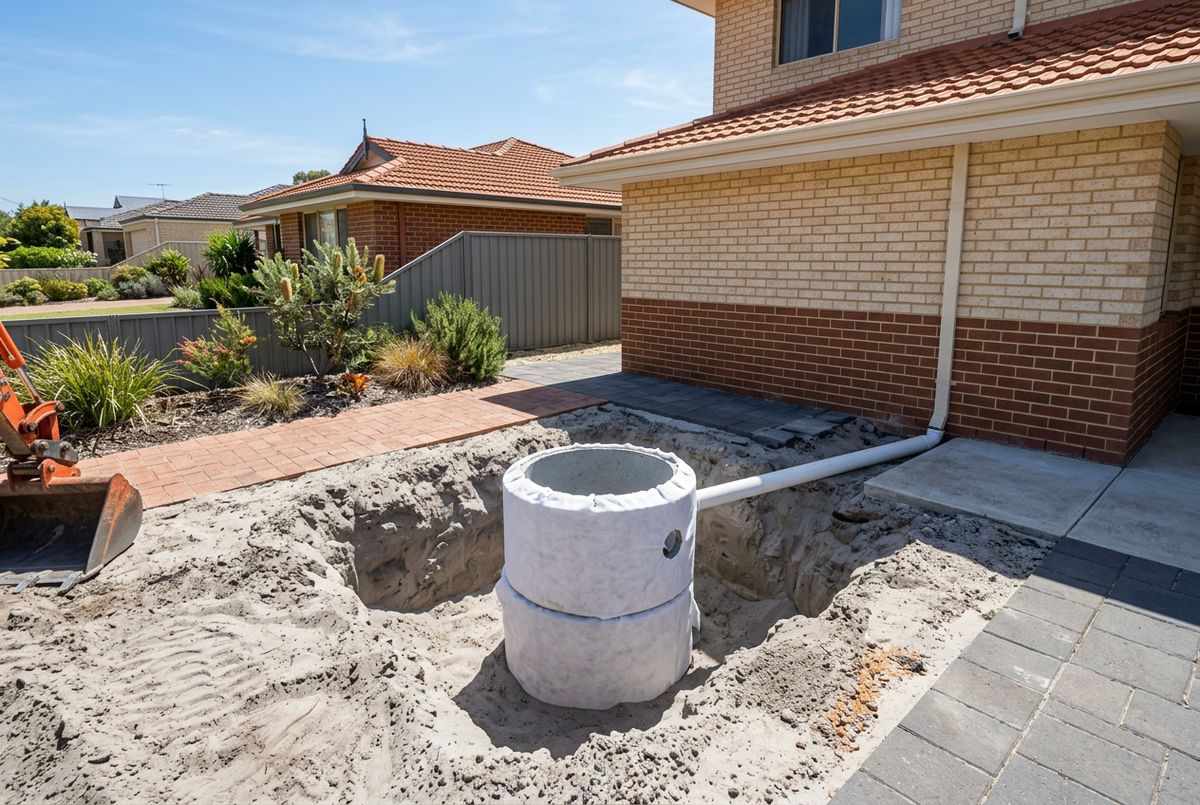
Concrete or polypropylene soakwells
Concrete soakwells are the traditional Perth unit. A 1200 x 1200 unit weighs about 1100 kg on the Wanneroo table, so it goes in by machine. They last for decades and some councils favour them: the City of Gosnells states that concrete soakwells are the preferred choice and are required under all paved areas, and WA Health publishes a list of approved concrete soakwells.
Polypropylene soakwells are lighter modular crates that fit through a side gate, so they are cheaper to handle on tight sites. Trafficable grades exist, but councils are specific about what goes under vehicles. The City of Stirling requires any drainage structure under a driveway, carport or garage to be designed to be trafficable, with an approved base to prevent subsidence of the well liners. The City of Swan requires trafficable lids on all soakwells in paved or concrete areas, the Town of Victoria Park requires a grated trafficable lid in driveway areas, and the Town of Claremont states that PVC soakwells are not acceptable in areas subject to vehicular traffic.
Our usual pattern: concrete under driveways and anywhere vehicles load the ground, polypropylene where access is tight and the unit sits under lawn or garden. See our guide to concrete versus polypropylene soakwells.
Where soakwells can go: setbacks and placement
Setbacks exist so soaking water does not undermine footings, retaining walls or the neighbour's ground. The verified rules for our area:
- City of Wanneroo and City of Joondalup: set back "a minimum of the width of the soakwell away from buildings and boundaries, providing that the width is greater or equal to the depth of the soakwell". Wanneroo adds that it is not recommended to install soakwells where clearances between buildings and boundaries are narrow, because there is not enough drainage area for the water to soak away.
- City of Stirling: at least 1 m edge to edge from structures and boundaries, or the manufacturer's specification if greater, unless a structural engineer certifies otherwise.
- City of Swan: no closer than 1.8 m to a footing or property boundary. See our City of Swan soakwell page.
Joondalup also requires overflow to be directed away from the building so it does not pond against it or enter adjacent properties. Retaining walls and fences count as structures, pool overflow counts as runoff, and one soakwell can serve several downpipes by pipe. On 2000s estates in Landsdale, Darch and Banksia Grove the usual problem is a narrow side setback, which pushes units to the front or rear yard.
Perth sand, clay, limestone and the water table
The Department of Water's water sensitive urban design sheet on soakwells says they "are very effective in sandy soils", that the base "must be above maximum or controlled groundwater level", and that installation "will be more difficult if rock or other hard material is present". That covers the three ground conditions in the northern suburbs.
Bassendean sand covers Landsdale, Wanneroo, Ballajura, Ellenbrook and most of the corridor east of Wanneroo Road: pale grey, deep and fast draining, so standard deep units work well. Spearwood sand over Tamala Limestone runs through Woodvale, Kingsley, Duncraig, Joondalup and the coastal strip: fast draining, but excavation can hit caprock. Guildford Formation clay appears in Dayton, eastern Aveley and around Midland: poorly drained, so soakwells there generally need geotechnical confirmation, shallow wide units or a council approved alternative.
The water table on the dune sands is generally several metres down, but rises in low ground beside lakes and wetlands such as Lake Joondalup, Lake Goollelal and Emu Swamp. Stirling triggers a drainage management plan where groundwater is within 1.2 m of the surface; Swan requires subsoil drains where the maximum groundwater level is less than 1.2 m below lot level; Gosnells requires 0.5 m clearance from the soakwell base to groundwater or clay, with sealed tanks in poorly draining clay; Nedlands advises shallow, larger diameter soakwells where the water table is high. DWER's Perth groundwater map estimates the depth to the water table under any property, and the state sheet adds one more rule: no ponding after 96 hours, because of mosquitoes. Read more in our guide to soakwells in clay, limestone and high water table areas, or the soil notes on our suburb pages.
Soakwells under paving and driveways
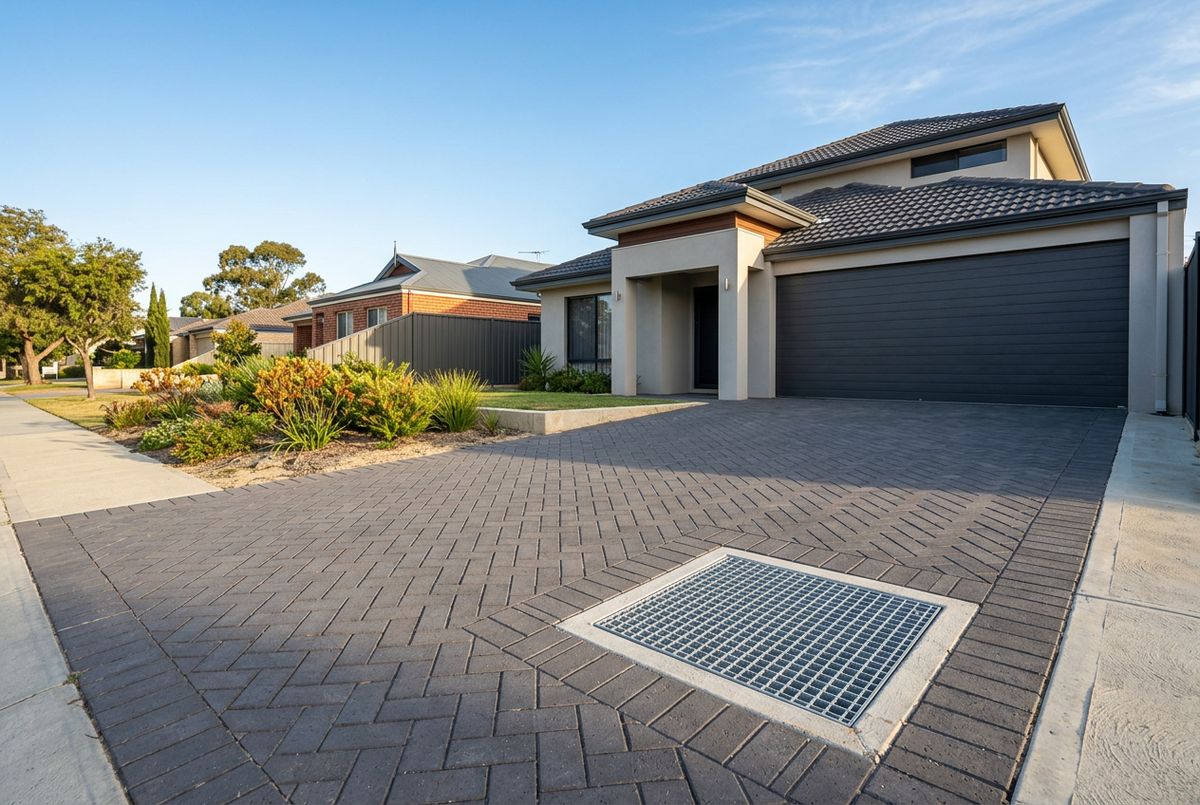
Most of our soakwell work happens inside a paving job, and that is the best way to do it. Paved area counts as impervious area in every council formula, so a new driveway or alfresco adds to the storage you need. Designing the paving and the soakwells together means the trafficable lid, the approved base and the fall of the pavers are set out as one system. Grated drains at the garage threshold, the alfresco edge and any low point feed the soakwell, with the access opening kept clear as Swan and Stirling require, and Stirling stores roof runoff separately from paving runoff. If your paving is coming up anyway, that is the moment to add or replace soakwells. See stormwater drainage for paved areas and our driveway paving page.
How we install soakwells
- Site check. We measure the impervious area, note downpipe positions, check setbacks against your council's rule and work out the number and size of units.
- Mark and excavate. Services are located and marked. Concrete units go in by machine; where access is tight we hand dig for polypropylene crates.
- Base and unit. We set a level base, place the unit and wrap it in geofabric so sand cannot wash through the slots. Unwrapped units silt up and leave voids that sink the paving above.
- Connect. Downpipes and drains are plumbed in with PVC stormwater pipe, overflow directed away from the house.
- Backfill and reinstate. Sand is compacted in layers, then the paving, lawn or garden goes back, with a trafficable lid wherever vehicles cross.
Approvals differ from council to council, so check with your council about approvals for your site before work starts. Wanneroo Building Services is on 9405 5000 and Joondalup Building Services on 9400 4000.
Soakwell repairs and replacement
The signs: water that will not drain after rain, pavers sinking in a ring around the unit, or water bubbling back out of a downpipe. The causes are usually sand and silt filling the chamber, an older unit with no geofabric, blocked gutters or downpipes, a unit undersized once a patio or extra paving was added, or a high winter water table.
We dig down, clean out the chamber, wrap or replace the unit, add capacity where needed, and re-lay the paving. Most soakwell repairs in Perth end with a lift and relay of the surrounding pavers, which is our core work. See sunken paving around soakwells and our paving repairs page.
What soakwells cost in Perth
There is almost no current public pricing for installed soakwells in Perth. The public figures, presented here as indicative Perth industry ranges and not as our price list: a PropertyChat forum thread from 2015 quoted $3,500 plus GST for four polypropylene 1500 x 900 soakwells installed, about $875 plus GST each, and showed a builder's provisional sum rising from $4,000 to $6,000 when council sizing called for four units rather than two. An undated strata maintenance guide from ESM Strata puts remediation or retrofit at $1,000 or more per soakwell.
Expect several hundred dollars for a small unit in open sand to well over $1,000 per unit where paving must be lifted and relaid. The drivers are size and number of units, concrete or polypropylene, machine or hand access, pipe runs, limestone excavation and paving reinstatement. Our soakwell cost and sizing page breaks these down; a site visit gives a fixed price.
Where we install soakwells
We are based in Landsdale, so the City of Wanneroo is our home council. We install and repair soakwells in Landsdale, Darch, Alexander Heights, Madeley, Marangaroo, Girrawheen, Hocking, Wanneroo, Tapping and Banksia Grove, and across the Cities of Joondalup, Swan, Stirling and Bayswater. For the full list of suburbs, see areas we service.