

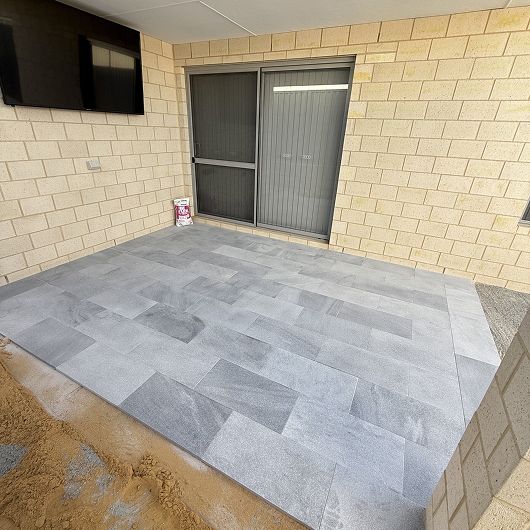
Should you seal pavers, and which ones
The honest answer is: it depends on what the pavers are made of.
- Clay brick: optional. Clay does not fade, so sealing is about stain and efflorescence control rather than colour.
- Concrete pavers: recommended. Concrete fades under WA ultraviolet and takes stains readily; a sealer slows both.
- Natural stone and reconstituted limestone: yes. Both are porous and mark easily, and a penetrating sealer is the normal protection. See limestone paving and travertine paving.
- Porcelain: no. It is dense enough not to need it.
Midland Brick's guidance is that sealing helps "protect against wear, staining and salt attack especially in coastal environments". Some supplier products are the exception: Freo Stone, for example, marks its travertine and DesignoPave ranges "DO NOT SEAL" with its own sealer. So we recommend per product, not per material.
The trade offs are real. Sealing buys stain, fade, weed and ant resistance and makes cleaning easier. It costs money, needs redoing, film sealers can be slippery or peel, and the wrong sealer on the wrong paver traps moisture underneath. Sealing done well is maintenance; sealing done badly is a stripping job. This page sits under paving repairs because that is how we see it: the last step that protects the work.
Source: Midland Brick sealing guidance; Freo Stone product notes.
Perth conditions: efflorescence, bore stains, salt and mould
Efflorescence is the white powder that appears on new clay and concrete pavers. Water moving through the paver carries soluble salts to the surface and leaves them behind as it dries. It is harmless and usually weathers off within months. Wait 4 to 8 weeks for it to work out before sealing, because a sealer applied over active efflorescence traps the salts under the film. Remove it with a dry brush, then household vinegar or a dedicated remover. Never use acid on limestone or travertine; both are calcium based and the acid eats them.
Bore water staining is a northern suburbs problem. Iron in the groundwater leaves orange brown marks wherever reticulation hits paving, and the north eastern corridor has the worst of it. The stains need treating before sealing or they are locked in.
Coastal salt. Within roughly 1 to 2 km of the ocean, salt laden wind drives efflorescence and surface weathering on pavers. This is where sealing earns its keep, in Hillarys, Sorrento, Mullaloo and the other beach suburbs.
Colour tells you the cause. White is efflorescence. Green is algae, which means shade and damp. Black is mould, and mould usually means a bed that stays wet. Black staining on a sunken area is not a cleaning problem; it is a drainage problem, and the fix starts at sunken paving repair rather than with a pressure washer. More in sealing limestone pavers in Perth.
How IBP cleans and seals paving
Clean and seal is a two visit job, because the paving has to be dry before anything goes on it.
- Visit one: clean. Pressure clean with a fan tip, kept under about 2,000 psi so the paver face and joints are not blasted. Treat stains by type: efflorescence, bore marks, mould and algae each get a different product, and nothing with bleach or chlorine goes near limestone or travertine. Then the paving is left to dry.
- Dry time. At least 48 hours of dry weather, then a moisture test before we come back. Sealing damp pavers is how sealers cloud and peel.
- Visit two: re-sand. Pressure washing strips joint sand out, so the joints are refilled first. Plain washed paving sand as the default; pave set or polymeric sand, or a dry sand and cement mix, where ants and weeds have been the problem.
- Seal. Two coats. A penetrating or impregnating sealer with a natural finish for limestone and travertine. An acrylic colour enhancing or wet look sealer for concrete and clay. Water based or solvent based depending on the product and the paver, always UV stable and non yellowing. We apply out of direct midday heat, because sealer flashing off in 38 degrees does not cure properly.
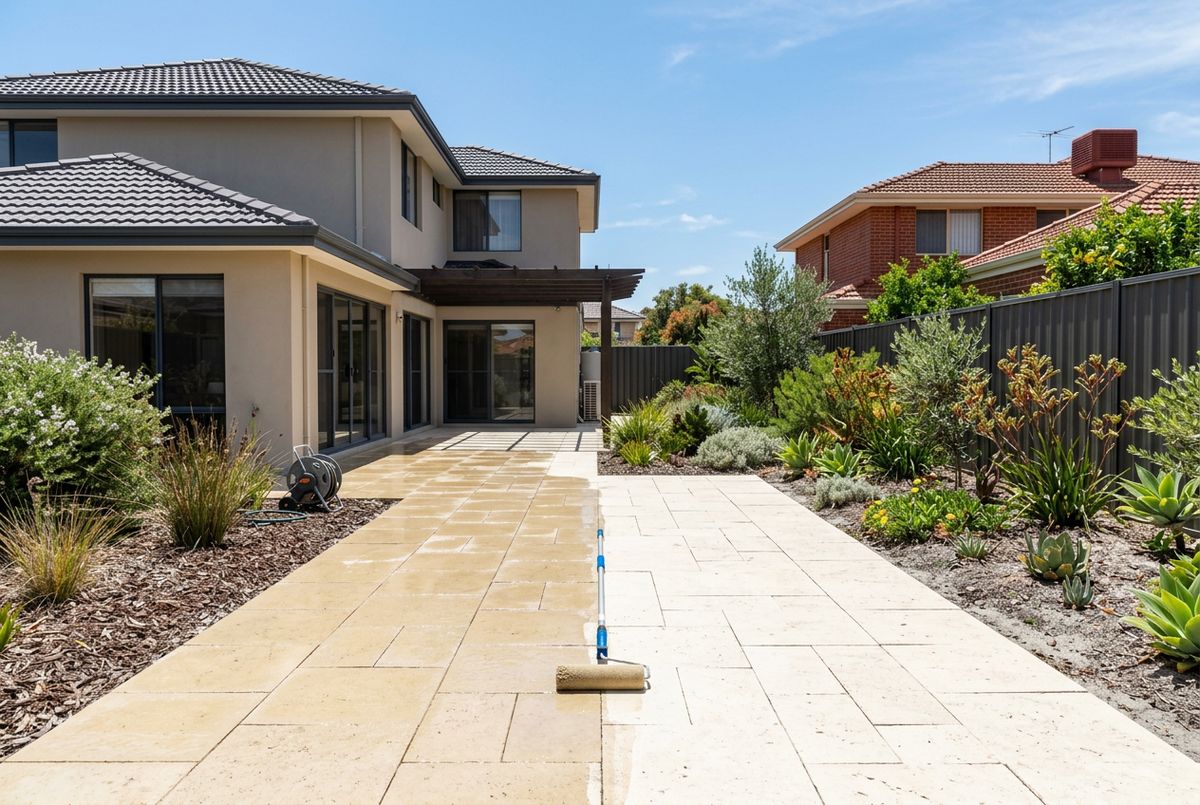
Wet look or natural finish is the question most people ask. Wet look gives a deeper colour and stronger stain protection, and suits concrete and clay. It also holds more heat in Perth sun, can be slippery when wet, and if it ever peels it has to be stripped. Natural finish penetrating sealers soak in, breathe, leave the stone looking like stone and never peel; they protect less against oil and food stains. Around a pool, natural finish wins on slip and heat.
We use water carefully and keep wash water out of the stormwater system where we can.
What cleaning and sealing costs in Perth
These are indicative Perth industry ranges from published sources, not an IBP price list. We quote after seeing the paving.
| Job | Indicative Perth industry range |
|---|---|
| Cleaning | About $3 to $6 per m2 |
| Sealing, on top of cleaning | About $5 to $10 per m2 |
| Sealing only | About $5 to $15 per m2 |
| Patio, 30 to 50 m2 | About $350 to $600 |
| Driveway, 50 to 80 m2 | About $550 to $950 |
| Pool surround, 20 to 40 m2 | About $300 to $500 |
Source: PPS Exterior Cleaning; perthpavers.com.au paver sealing guide (third party). Indicative Perth industry ranges only.
What moves the price: the area, how much stain treatment is needed, the sealer type (penetrating sealers for stone cost more per litre), whether an old failed sealer has to be stripped first, and access. On intervals, plan to reseal every 3 to 5 years for brick and concrete, and every 2 to 3 years for pool surrounds and natural stone, which see more water and wear. The test is simple: if water no longer beads on the surface, it is due. More context in paving cost in Perth.
Ants, weeds and joint sand
Ants nest in loose bedding sand on Perth's sandy soils, carry it up through the joints and leave a hollow underneath that eventually sinks. Weeds come the other way, seeding into the joints from above. Both live in the joint sand, and both are solved the same way: a bound joint sand such as polymeric or pave set, plus a sealer that stabilises the joint so neither can get a hold. Do not use salt as a weed killer; it damages the pavers and the soil around them. If ants have already sunk an area, the repair comes first and the sealing after.
Sealing after a repair or new paving
This is the part a cleaning company cannot offer. After a relay or a replacement, we wait for the efflorescence to work out and the pavers to dry, re-sand, then seal, as the final step of the same job rather than a separate trade visit. We laid it, so we know what the paver is and which sealer suits it. The same applies to new brick paving and to pool surrounds, where a penetrating sealer on stone or reconstituted limestone is standard, and to the capping and face of a limestone retaining wall. Whether brick needs it at all is argued out in should you seal brick pavers, and the yearly routine is in paving maintenance in Perth.
Where we clean and seal paving
Salt and efflorescence make the coastal suburbs the busiest for sealing: Hillarys, Sorrento, Mullaloo, Ocean Reef, Mindarie and Scarborough all sit within a kilometre or two of the ocean. We work from Landsdale across Perth's northern suburbs; see the full list of areas.