

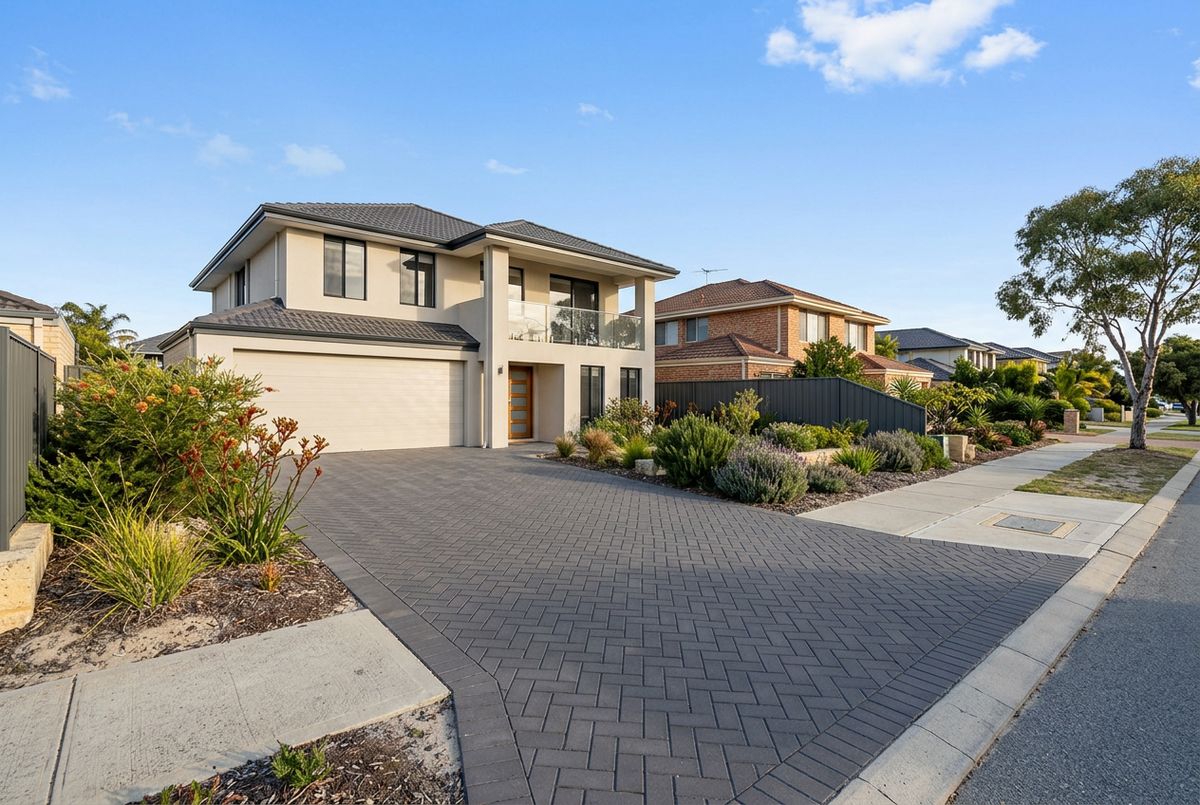
What herringbone paving is and why it holds
Herringbone is rectangular pavers laid in an L shaped zigzag, so every paver is crossed by the two beside it rather than sitting in a straight row. IBP Paving lays it as the main pattern in our brick paving in Perth and across our paving services in Perth.
The reason it matters is mechanical, not decorative. A tyre turning on paving pushes sideways. In a one direction pattern that push travels along the joint and a whole row can creep or rut. In herringbone the push meets a paver set across it, then another, so the field locks in two directions and spreads the load. Pattern is a structural choice first and a look second.
45 degree or 90 degree herringbone
Both are herringbone, both interlock in two directions, and the difference is how the pattern meets the edge of the area.
45 degree. The pavers sit diagonal to the border. No joint runs with the direction of travel, so this is the strongest interlock available. The cost is at the edges: every paver that meets the border is cut on the diagonal, which means more cutting time and more offcuts that cannot be reused.
90 degree. The pavers sit square to the border, so full pavers meet the edge along most of the run and cuts fall only at corners and where the run does not divide evenly. It still locks in two directions and still performs under cars.
| Factor | 45 degree | 90 degree |
|---|---|---|
| Interlock | Strongest, no joint in line with travel | Strong, two direction |
| Cuts | Every edge paver | Corners and uneven runs only |
| Waste | More, diagonal offcuts | Less, many offcuts reusable |
| Look | Dynamic, diagonal movement | Calmer, squared to the house |
| Best for | Turning areas, heavy vehicles | Straight driveways, paths, patios |
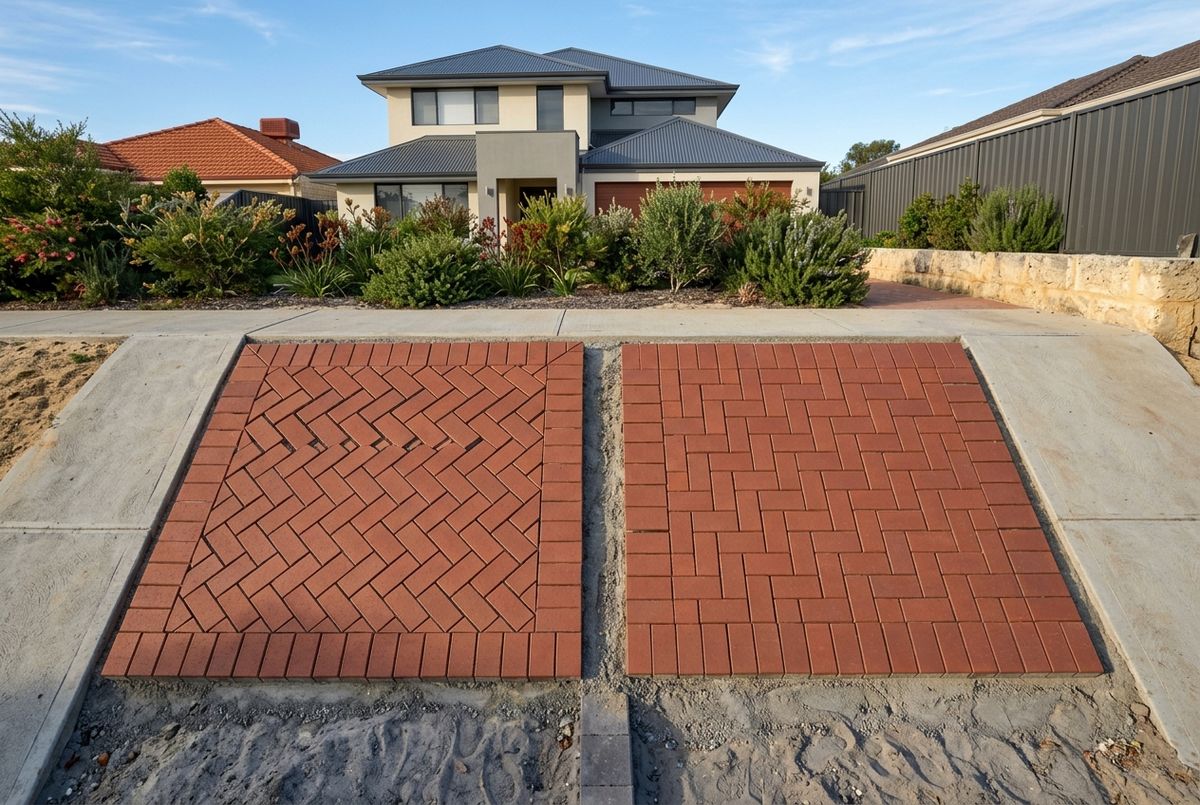
Either way the field is framed by a border course: a straight run of pavers around the edge, laid flat as a stretcher course or on end as a soldier course. The border takes the cuts and gives the edge restraint something straight to hold. We set the pattern out from the straightest edge on site, usually the garage slab or the crossover line.
Why herringbone suits Perth driveways
Perth driveways are laid flexibly on sand, not on a concrete slab. That means the pattern has to do the locking work a slab would otherwise do, and herringbone is the pattern that does it. Everything else in the build supports that interlock.
- 50 mm pavers minimum for cars, 60 mm preferred. 80 mm interlocking pavers in herringbone where boats, caravans or trucks park.
- Compacted road base under the bedding sand on any area that carries vehicles.
- An edge restraint on every free edge, either concrete haunching or a mortared border. Without it even herringbone spreads over time.
The northern corridor sits on deep Bassendean sand; the City of Wanneroo lists Wanneroo, Tapping and Wangara on this unit, and Landsdale and Darch are the same sand. It drains freely but needs compaction and road base before it will carry wheel loads. The 2000s estates in Landsdale, Darch and Madeley are now reaching first relay age, and the new estates in Banksia Grove, Butler and Alkimos are laying driveways for the first time. We also lift and relay herringbone driveways that have spread or sunk; see paving relaying.
The full base build and the crossover paperwork are on our driveway paving page, and there is more on sand types in our post on paving bases on Perth sand.
Which pavers suit herringbone
Herringbone needs a paver that is exactly twice as long as it is wide, because two widths have to equal one length for the zigzag to close. The two Perth formats that do this are 230 x 115 mm clay pavers, such as Midland Brick Heavy Duty Clay Pavers in Red and Golden Dune, and 200 x 100 mm concrete pavers. Square pavers and large format slabs cannot be laid herringbone; they go stretcher or stack bond.
For driveways in concrete, Midland Brick Masterpave Classic 60 is the 60 mm option, and Midland positions 60 mm for driveways and 40 mm for paths. Ranges change, so ask us for current samples. Our guide to paver brands in Perth covers who makes what.
What herringbone costs to lay
These are indicative Perth industry ranges, not IBP's price list. Published 2026 Perth cost guides put concrete pavers at about $75 to $110 per square metre supplied and laid and clay at $130 to $210, and report a labour uplift of 10 to 15 per cent for herringbone and other cut heavy patterns on top of that. 45 degree sits at the top of the uplift because of the edge cuts; 90 degree sits nearer the bottom.
Everything else in the quote is the same as any brick paving job: base and road base, bedding sand, edge restraints, removal of old paving, and soakwells where the site needs them. We keep the bands current in our Perth paving cost guide. For a figure for your driveway, request a free site measure or call 0449 020 336.
Herringbone or another pattern
Stretcher bond. Joints line up in one direction, like a brick wall. Fewest cuts of any pattern, so it is the economical choice for paths, patios and alfrescos, but it can rut under turning tyres.
Basketweave. Pairs of pavers alternating direction for a heritage look. It has the weakest interlock of the three, so it stays on patios and paths.
The rule of thumb: if a car drives on it, herringbone. Our illustrated pattern guide shows each layout with its cuts and waste.