

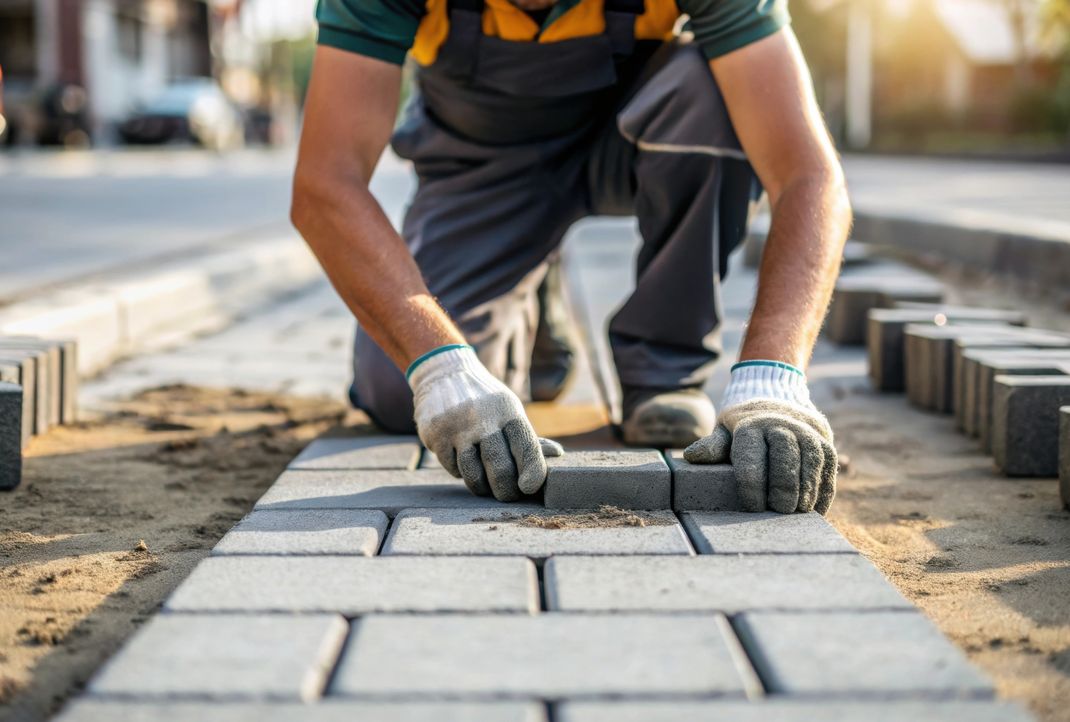
Why pavers sink in Perth
Clay and concrete pavers last 30 to 50 years, while the sand bed and joints they sit on give out somewhere between 10 and 20 years on Perth sand. So when a driveway or alfresco develops a dip, the paver is almost never the problem; the bed underneath has moved. That is why sunken paving is the most common job we take under paving repairs, and why a good repair starts with a question rather than a shovel: what moved the sand?
Some settlement in the first year after laying is normal and stops on its own. Sinking that continues, or starts years later, means something is still working on the bed. In Perth the causes run in a reliable order. Water washing out the bedding sand is first by a long way: downpipes discharging onto paving, a leaking tap or pool pipe, or a soakwell that is missing, undersized or full. Ants mining the sand come next. Then uncompacted fill on newer builds. Last is vehicle loading, where pavers were laid on sand alone with no road base and cars have pushed them down along the wheel lines. Each cause leaves a different footprint, and reading it is most of the diagnosis.
Reading the dip: what the shape of the sink tells you
Before anyone lifts a paver, the shape and position of the sunken area usually tells us the cause.
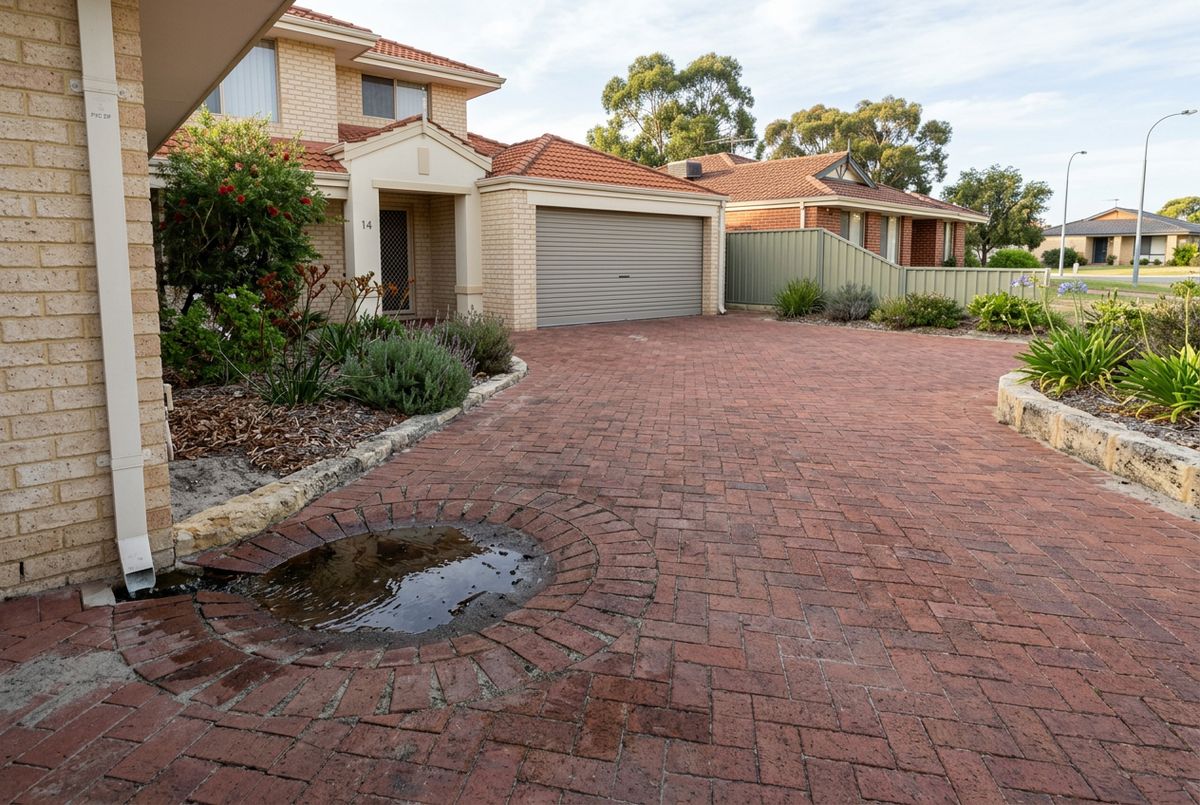
A dish beside a downpipe, tap or hose point. A round or oval low spot that holds a puddle after rain, often with dark staining on the pavers, means a wet bed. Water has been running into the sand and carrying it away, and the dark colour is mould from a bed that never dries. Fix the water first, or the relay sinks again. Where the water should be going is covered under soakwells.
Small craters with fine sand piled on top. Little cones of pale sand sitting on the paving, with a soft or hollow paver next to them, mean ants. They nest in the loose bedding sand and carry it up through the joints, leaving a void underneath.
A broad, even drop across a whole new driveway or alfresco. When the entire surface has settled together on a house that is only a few years old, the fill under it was never compacted. This is a specific problem on newer estates in Alkimos, Banksia Grove and Yanchep, where lots were cut and filled before building. The paving is fine; the ground under it is still finding its level.
Two parallel ruts. Dips along the wheel lines, often with cracked units where cars turn, mean vehicle loading on an undersized base. The pavers were laid on sand alone, or on too little road base, and the car has done the compacting the contractor should have.
A ring of sunken pavers around a pool. The backfill around a pool shell keeps settling for one to two years after the pool goes in, and the surround drops with it. Before relaying we also rule out a leaking pool pipe, because a leak keeps washing sand out indefinitely. Surround detail is on pool paving.
More on the patterns in why pavers sink in Perth.
Perth sand and why it matters for the fix
Most Perth brick paving is laid flexibly: a screeded bed of washed yellow paving sand over compacted natural sand, with no mortar. Brickies sand is not used for bedding because it holds too much clay and fines. Under Landsdale, Darch, Madeley, Wanneroo and Ellenbrook that natural sand is deep, pale grey Bassendean sand, leached and free draining. Under Joondalup, Woodvale, Duncraig and Kingsley it is yellower Spearwood sand over Tamala limestone caprock, which can sit close to the surface.
Free draining sand is a gift for soakwells and a curse for a bed with water running through it. Water does not pool on top and warn you; it goes straight down through the bedding sand and takes the fines with it, which is why fixing the water source always comes before a relay here. A specific Perth version is the overflowing or undersized soakwell beside a driveway: roof water backs up, spills into the paving and the bed goes with it. We cover that on stormwater drainage for paving and in what to do when a soakwell overflows.
How IBP repairs a sunken area
- Site look. We check the falls, every downpipe outlet, the soakwell condition, taps and pool plumbing, ant activity and the edge restraint, then match what we see against the dip pattern above.
- Lift. The affected pavers come up and are set aside in order where the pattern matters, so a herringbone or basketweave field goes back exactly as it was.
- Fix the cause. Redirect the downpipe, add or replace a soakwell, treat the ant nest, or dig out and compact the soft fill. Skipping this step is the difference between a repair and a delay.
- Re-bed. Compacted road base under driveways, then screeded washed paving sand with a fall of 1:60 to 1:80 away from the house so water leaves the surface rather than sitting on it.
- Relay, compact and re-sand. Pavers go back, the area is plate compacted, and the joints are re-sanded. Where ants were the cause we use a bound joint sand that they cannot mine. Any loose edge is haunched in concrete.
Small areas can be spot relayed in a visit. Where the settlement is wide, patching one dip just moves the problem sideways and the whole bed needs redoing, which is a full lift and relay. Every repair carries our lifetime workmanship warranty, which covers IBP's own work and the section IBP re-lays.
What sunken paving repair costs in Perth
These are indicative Perth industry ranges, not an IBP price list. Small patch jobs listed on Airtasker for Perth show a median of about $360 per job. Lift and relay work is priced per square metre and sits well below the cost of new paving because the pavers are reused; the extras are fresh bedding sand, a skip and any units that have cracked. No published Perth per square metre relay figure exists that we would put our name to, so we quote after seeing the site. If a soakwell turns out to be the fix, it is itemised separately, and soakwell cost explains that line.
What moves the quote: the area, the cause, access for a plate compactor and skip, and the pattern, since herringbone takes longer to relay than stretcher bond. See paving cost in Perth.
Sunken repair, full relay or replacement: which one
- Spot repair when one area has sunk and the cause is local, such as a downpipe or an ant nest. This page.
- Full lift and relay when the whole bed has gone or the sunken area is wider than a few square metres. See paving re-laying.
- Replacement when the pavers themselves are crumbling, salt affected or discontinued with no match. See paving replacement.
- Pavers pushed up rather than down are usually roots. See pavers lifted by tree roots.
Once the repair has dried out, a clean, re-sand and seal protects the work. That is covered under paving sealing and cleaning.
Where we repair sunken paving
Sunken driveways follow the age of the housing. Alexander Heights was built through the 1980s and 1990s and its first driveways and soakwells are due for renewal. Woodvale, built from 1979 to 1995 on Spearwood sand over limestone, shows the same mix. Landsdale and Darch are late 1990s and 2000s stock reaching the 20 to 25 year mark where first relays start, and Ellenbrook's earliest villages are at 25 to 30 years. See Alexander Heights, Woodvale, Landsdale, Darch, Ellenbrook and the full list of areas.