

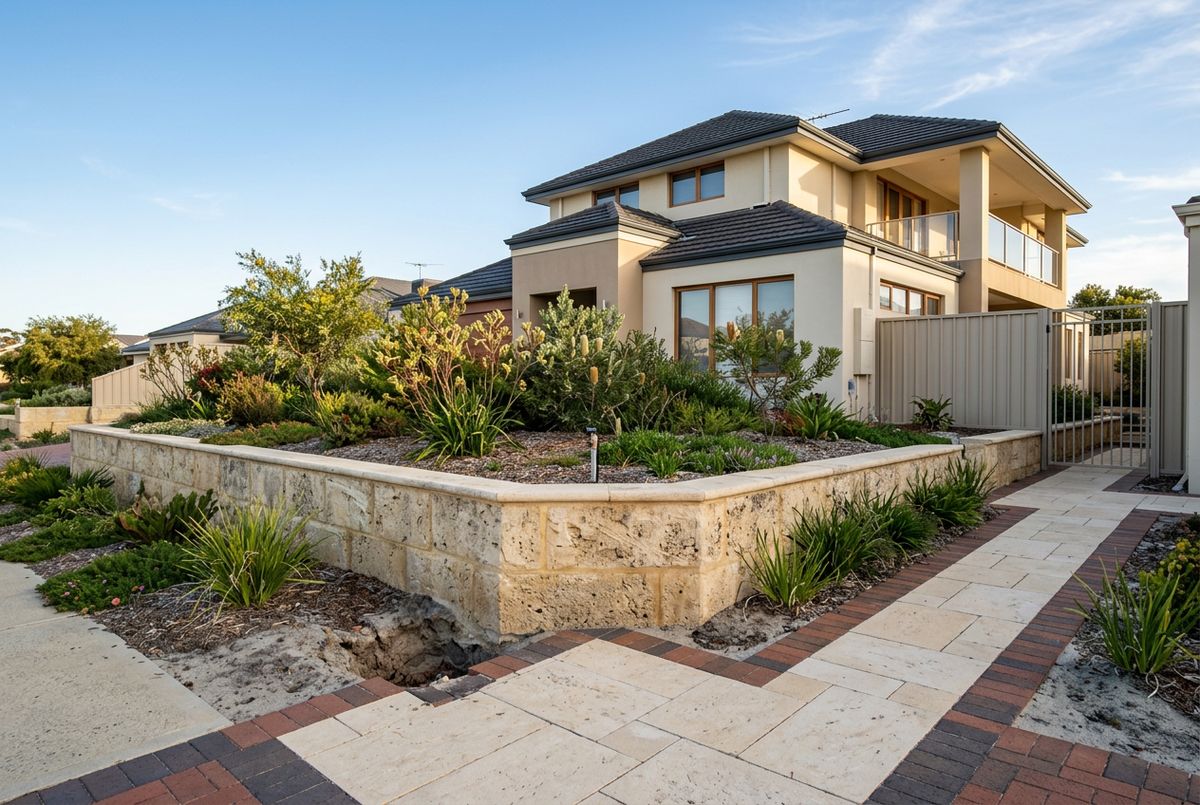
The two limestone block types
Every limestone wall we build under retaining walls uses one of two blocks, and the choice decides how the wall looks on day one and in year twenty.
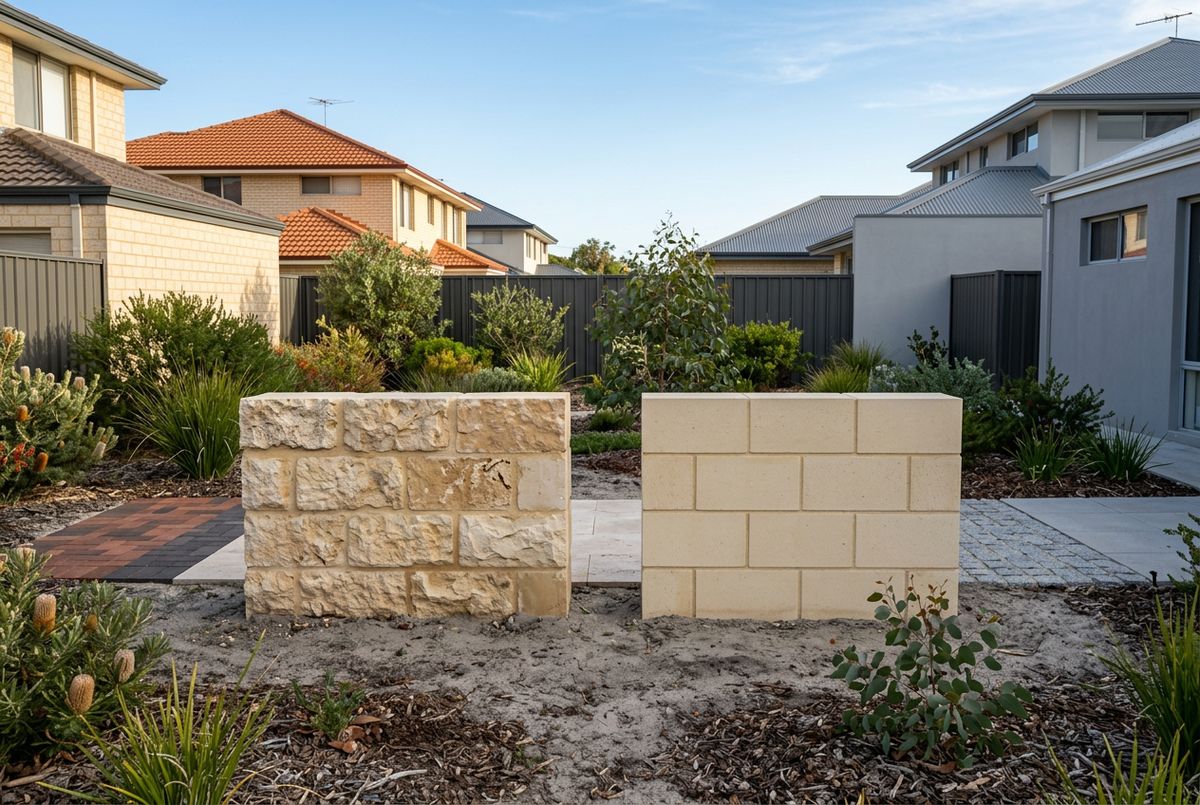
Natural Tamala limestone
Natural blocks are sawn from the Tamala limestone that underlies the coastal dune suburbs, so the wall is literally made of the ground it stands on. Two faces are sold. Quarry cut leaves the split face raw: pitted, shelly, with the fossil texture that reads as old Perth. Diamond cut is sawn smooth on the face for a flat, crisp block that suits a rendered or contemporary home without being rendered itself. Colour runs from pale cream to honey gold and shifts block to block, and so does density. Natural blocks are heavier to handle and usually dearer per unit. They weather by softening at the edges and gathering a little grey lichen in the shade, and most owners like them better for it.
Reconstituted limestone
Reconstituted blocks are crushed limestone bound with cement and pressed in a mould, supplied in cream or grey. Because they are made rather than cut, every block is the same size and colour, which gives fast, true courses with tight joints. They are lighter than natural stone, take render and paint well, and are the default on new estates where the wall will be capped with paving or disappear behind a fence. Left bare, they weather more evenly than natural stone and show less variation, which is either the point or the drawback depending on the house.
| Choose natural Tamala when | Choose reconstituted when |
|---|---|
| The wall will be seen every day and needs to read as stone | The wall will be rendered, paved over or hidden behind a fence |
| The house is coastal, riverside or older, and variation suits it | The house is on a new estate and uniformity suits it |
| Weight and a higher block price are acceptable | Budget and handling matter, or access is tight |
| You want the wall to age and soften | You want it to look the same in ten years |
Both blocks go on the same footing with the same drainage, so this is a decision about look and budget, not strength.
Block sizes and where the blocks come from
Limestone blocks are sold by nominal size, length by depth by height. The common Perth sizes listed by Meteor Stone are 500 by 350 by 240 mm, 500 by 350 by 350 mm and 1000 by 350 by 350 mm, with lower course heights, capping blocks and pier blocks alongside. The 350 mm depth is standard across the range; what changes is the height of each course and the length of the block. Taller walls use the longer, deeper blocks because each course then carries more weight and bonds further across the one below. A wall of three 350 mm courses sits a little over a metre high before capping, which is why so many Perth walls land at that height.
Meteor Stone is based in Landsdale, the same suburb as IBP, so block delivery across the northern suburbs is short. UrbanStone and Midland Brick also supply limestone blocks in Perth. To be clear: IBP supplies the blocks as part of the wall and builds it; we do not sell blocks on their own. Our home suburb page is at paving Landsdale.
Source: Meteor Stone product range, Landsdale. Confirm current sizes with the supplier.
Perth sand sites and why limestone suits them
Tamala limestone lies under the Spearwood dune suburbs from Joondalup down to Fremantle, so the stone is local and the sites it sits on are undulating sand over rock. That combination is why limestone became the Perth retaining wall: the stone is to hand and the sand drains.
The same geology sets two traps. In Duncraig, part of the suburb was once a sand and limestone mining lease and caprock sits near the surface; in Woodvale the limestone is karstic, with cavities. Excavating for a footing in either can hit rock, which changes the footing and drainage design, so we check before quoting. And free draining sand only helps a wall that has a drain. Sand washes out from behind a wall with no ag drain, which is the most common reason Perth limestone walls lean. Our build method, footing through capping, is set out step by step on the retaining walls page, and where the wall drain discharges is covered under soakwells.
Faces and finishes
- Natural face, left raw. Quarry cut Tamala, pointed and capped, nothing else. The classic.
- Diamond cut face. Sawn natural stone with a flat face and sharp arrises for a crisp, modern line that still varies in colour.
- Rendered and painted. Reconstituted block rendered smooth and painted to match the house, which turns the retaining wall into part of the architecture.
- Capping. Limestone capping blocks for a stone finish, or a paved cap in the same paver as the adjoining paving so the lines run straight through from driveway to wall.
- Sealing. A penetrating sealer slows staining, bore water marks and salt attack without changing the look, and matters most near the coast and around pools. Covered under paving sealing and cleaning.
For a consistent look, limestone paving in the same cream tone ties the wall, steps and terrace together.
Heights, engineering and permits in brief
Perth councils state the rule in these terms: a retaining wall that retains no more than 500 mm of ground, is not associated with other building work and does not protect adjoining land does not need a building permit. Over 500 mm, a building permit and a structural engineer's design are required. The City of Fremantle fences and retaining walls page and the City of Vincent retaining wall advice page both publish it that way. Engineering is also expected where a surcharge load sits near the top of the wall, such as a driveway, pool or building, because the wall is then carrying more than soil. IBP arranges the engineer's drawings where they are needed as part of the job.
Source: City of Fremantle fences and retaining walls page; City of Vincent retaining wall building advice page.
The full guide, including boundary and tiered walls, is at retaining wall approvals in WA, and retaining wall cost shows what engineering and permits add.
What a limestone wall costs in Perth
As indicative Perth industry ranges, not an IBP price list: a limestone block wall about 1 m high runs roughly $295 to $630 per lineal metre, typically around $440, plus about $52 per lineal metre for drainage behind it. Natural Tamala blocks usually cost more than reconstituted. Height, block type, access, caprock, the length of the drain run and whether the wall is rendered or capped move the figure, and the breakdown is on retaining wall cost in Perth. We quote each wall after a site visit, and every wall we build carries our lifetime workmanship warranty, which covers IBP's own work.
Source: whatsthedamage.com.au Perth retaining wall cost table. Indicative Perth industry ranges only.
Limestone wall, feature wall or repair: which page
- A new retaining wall and how it is built: retaining walls Perth.
- A leaning or cracked existing wall: retaining wall repairs.
- A wall as part of a paving and garden package: landscaping and paving.
- A wall beside a pool: a retaining wall within 500 mm of a pool barrier is non compliant under WA's Rules for Pools and Spas (Diagram 11), so the wall and fence are designed together. See pool paving.
Sloping Spearwood sand sites with mature retaining needs run through Duncraig, Greenwood and Kingsley, and the newer cut and fill lots of Clarkson and Butler. See the full list of areas.