

By IBP Paving. Published 9 October 2026.
Our Perth paving cost guide gives the supply and lay bands for each material. This post is about why a driveway sits at the top of those bands and what else lands on the invoice. Driveways are the biggest part of our driveway paving service, and the questions below are the ones we answer at almost every site measure in the northern suburbs.
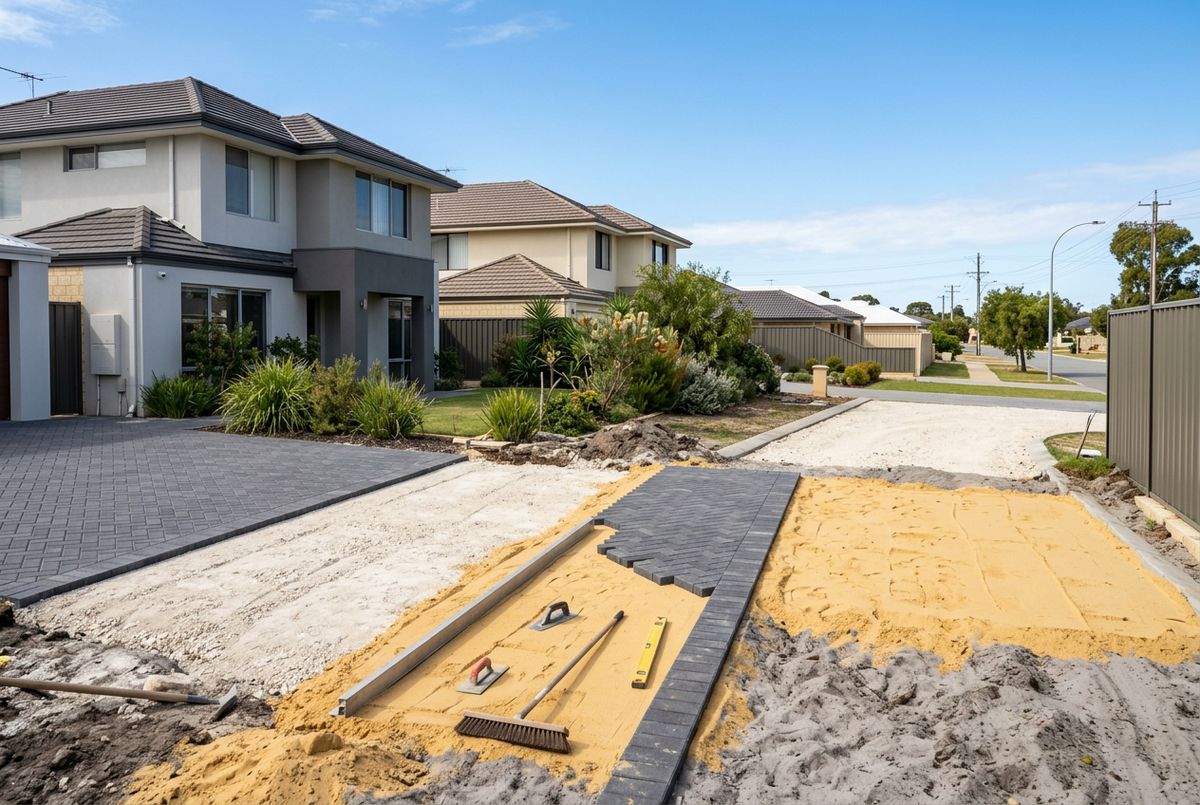
Why a driveway costs more per square metre than a patio
Five things separate a driveway from an alfresco laid in the same paver.
60 mm pavers instead of 40 mm
Midland Brick's guidance is 60 mm for driveways and 40 mm for paths, and the CMAA surface requirements factsheet sets residential driveway pavers at a 3 kN minimum breaking load, against 2 kN for pedestrian areas. The City of Wanneroo and City of Swan both require a minimum 60 mm paver on the crossover, so the sensible job runs 60 mm from the kerb to the garage rather than stepping down at the boundary. A 60 mm paver has half as much concrete again as a 40 mm one in the same range, so it costs more per square metre and the packs weigh more to deliver. Boats, caravans and trucks need 80 mm interlocking units.
Source: CMAA and Midland Brick, Surface Requirements for Pavers factsheet, July 2024; City of Wanneroo brick paved crossover information sheet, July 2025; City of Swan crossover specification, February 2022.
Road base under the whole driveway
A patio on compacted Perth sand goes straight to bedding sand. A driveway needs a layer of compacted road base first. The Wanneroo crossover specification calls for at least 100 mm of crushed limestone or rock, Swan's for 150 mm, and Perth Pavers' 2026 guide notes about 100 mm of base on the sandy loam of the northern suburbs, with more on reactive clay. That layer means deeper excavation, more tip loads, the base material itself, and more compaction passes before the sand goes down.
Heavier edge restraints
Every free edge of a driveway needs concrete haunching or a mortared border course, because a turning car pushes the field sideways and an unrestrained edge is where driveways start to spread. Wanneroo's crossover sheet specifies restraints 250 mm wide and at least 80 mm deep, and that is a fair picture of what the rest of the driveway should get.
Herringbone
Stretcher bond lines the joints up and ruts under tyres, so driveways get herringbone, which interlocks in both directions. Perth Pavers' guide puts the labour uplift for herringbone and other cut heavy patterns at 10 to 15 per cent. Laying at 90 degrees rather than 45 keeps the cuts down without losing the interlock.
Removal, drainage and the crossover
Most driveway jobs replace something: old pavers, a cracked slab or a bitumen crossover. Removal is quoted separately and a slab costs more to break and tip than pavers. Driveway runoff then needs somewhere to go: it cannot run over the crossover onto the road or onto a neighbour, so it goes to a grated drain and its own soakwell. The City of Stirling requires soakwells under driveways to be trafficable with an approved base, and Victoria Park requires a grated trafficable lid, which adds to the unit cost. See stormwater drainage for paved areas. The crossover itself is the subject of the next section.
Source: City of Stirling On Site Drainage Criteria, June 2024; Town of Victoria Park drainage requirements; City of Swan stormwater guidance.
The crossover: what it adds and what the council gives back
The crossover is the strip between the kerb and your front boundary. It sits on council land, must be built to the council's drawing with new materials, and in the northern suburbs the councils all accept brick paving. It also adds area to the job: a 3 m wide crossover across a 3 m verge is 9 square metres, and a 6 m wide double crossover is 18.
The good news is the contribution. The Local Government (Uniform Local Provisions) Regulations 1996 oblige a council to bear 50 per cent of the cost, as estimated by the local government, of a standard crossing. The key word is standard. The City of Stirling defines it as 3.0 m wide in grey pre mixed concrete, so a brick paved crossover gets the same contribution as a concrete one and you pay the difference.
| Council | Contribution | Claim window |
|---|---|---|
| City of Joondalup | One off $375, first crossover or replacement of an old bitumen crossover; none for a second crossover | Within 6 months, with invoice or delivery docket |
| City of Swan | $400 residential, $550 commercial or industrial, first crossover only | Crossover Contribution Form |
| City of Stirling | 50 per cent of a standard 3 m grey concrete crossover, first concrete or brick crossover or bitumen replacement | Within 12 months of completion |
| City of Wanneroo | Council may contribute to a first crossing; amount not published in the documents we have read | In writing within 6 months, with proof of payment |
| City of Bayswater | Per the Fees and Charges Schedule, one standard crossover per lot; bitumen rebuilt in concrete or brick is subsidised | See the City's crossover booklet |
Source: City of Joondalup Crossover Guidelines, May 2026; City of Swan crossover specification, February 2022; City of Stirling Crossover Policy and Guidelines; City of Wanneroo brick paved crossover information sheet, July 2025; City of Bayswater Crossovers Policy. Correct at the time of writing.
Two more line items to expect. Wanneroo requires a Street and Verge Bond Permit with the building permit, and its WD11 specification says a bond equal to the cost of a standard concrete crossover may be required before the building licence issues; bonds come back when the verge is left as it should be. The approval steps, drawings and street tree clearances are in what is a crossover.
Worked examples: single and double driveways
The assumptions: a single driveway 3 m wide by 8 m long inside the lot (24 square metres) plus a 3 m by 3 m crossover (9), total 33 square metres; a double driveway 6 m by 8 m (48) plus a 6 m by 3 m crossover (18), total 66 square metres. The bands are the published 2026 Perth supply and lay ranges: concrete pavers $75 to $110, limestone $80 to $160, clay brick $130 to $210 per square metre.
| Driveway | Concrete pavers | Limestone pavers | Clay brick pavers |
|---|---|---|---|
| Single, 33 m² | $2,475 to $3,630 | $2,640 to $5,280 | $4,290 to $6,930 |
| Double, 66 m² | $4,950 to $7,260 | $5,280 to $10,560 | $8,580 to $13,860 |
Source: arithmetic on Perth Pavers 2026 material comparison bands. Indicative Perth industry ranges only, not IBP Paving quotes.
From there, add removal of the old surface, the herringbone uplift on the labour share, a soakwell if the runoff needs one, and any bond; then take off the council contribution once the claim is paid. On a single driveway in Joondalup, for example, the $375 contribution is worth roughly 10 per cent of the concrete paver figure. On a double driveway in clay it is a small fraction, which is the honest way to think about the contribution: it helps, it does not decide the material.
Exposed aggregate and liquid limestone
These are the usual alternatives in Perth driveway quotes and no local guide gives a clean like for like comparison, so compare on repair rather than price. A sunken section of pavers is lifted and relaid with the same units; a cracked or stained slab is cut and patched, and the patch never matches. On sand that settles, and on side driveways over water and sewer runs, that repairability is the stronger argument. We lay pavers only.
How to keep a driveway quote down without weakening it
- Choose concrete pavers over clay if colour retention matters less than budget; the band is roughly half.
- Keep the shape simple. Straight edges and 90 degree herringbone cut waste and labour.
- Ask whether the old base is sound enough to keep under the new road base.
- Do the soakwell in the same visit as the driveway, while the ground is open.
- Claim the council contribution inside the window, with the invoice and delivery docket we give you.
Do not save money on paver thickness, base depth or edge restraint. Those are the three things that decide whether a driveway is still flat in fifteen years, and relaying one is on our paving relaying page for a reason. For a priced measure of your own driveway, see driveway paving in Perth or call 0449 020 336.