

By IBP Paving. Published 9 October 2026.
Perth homeowners search for the best pavers more often than for any one material, and the honest answer is that there is no best paver, only the right one for each area of the block. The driveway, the alfresco, the pool surround and the side path all ask different things of a paver. This guide works through thickness, material, finish, salt and colour in that order, then puts it all in one table. The ranges we lay are on our brick paving and stone paving pages.
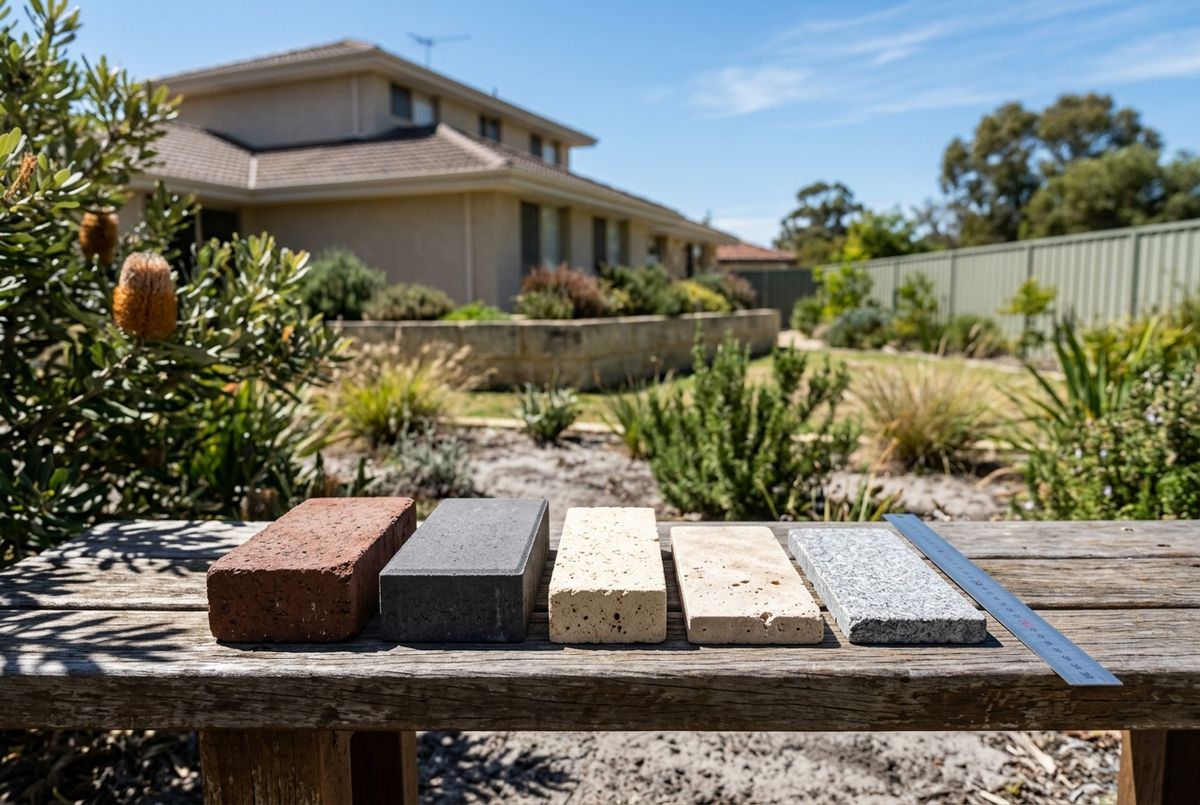
Start with thickness: 40, 50, 60 or 80 mm
Thickness is the one choice you cannot fix later. It is set by the load, not the look. The CMAA and Midland Brick surface requirements factsheet gives the breaking loads: residential pedestrian pavers at least 2 kN and 40 mm, residential driveways 3 kN and 40 mm, and commercial vehicle areas 5 kN and 60 mm. Perth practice and the councils sit above those minimums for driveways: 50 mm is the floor for cars, 60 mm is the standard, and the City of Wanneroo and City of Swan both require a minimum 60 mm paver on a brick paved crossover, which is why we run 60 mm from kerb to garage.
| Thickness | Use | Typical products |
|---|---|---|
| 30 mm | Travertine and thin natural stone, always on a mortar bed over concrete | 610 by 305 by 30 mm travertine |
| 40 mm | Paths, patios, alfrescos, courtyards, pool surrounds on compacted sand or mortar | Masterpave Classic 40, Promenade Classic 40, Cambridge Classic 40, 40 mm reconstituted limestone, pool coping |
| 50 mm | Minimum for a car driveway; granite setts on a compacted base | Masterpave Classic 50 |
| 60 mm | Driveways and crossovers, the Perth standard | Masterpave Classic 60, Promenade Classic 60, Heavy Duty Clay Pavers, Masterpave 60 Permeable |
| 80 mm | Boats, caravans, trucks, strata and commercial car parks, forklift areas | Interlock 80, Easilock 80 |
Source: CMAA and Midland Brick, Surface Requirements for Pavers factsheet, July 2024; Midland Brick WA product ranges, 2026; City of Wanneroo and City of Swan crossover specifications.
Clay, concrete or stone
In Perth, "brick pavers" usually means clay, but most of what is sold here is concrete. The three families behave differently.
- Clay. Kiln fired, so the colour runs all the way through and does not fade. Harder and denser than concrete, 50 years or more for the paver itself. The trade offs are a higher price, a format that is mostly 230 by 115 mm, edges that chip if dropped, and an efflorescence bloom on new clay that washes out over the first months. The WA made range is Midland Brick Heavy Duty Clay Pavers in Red and Golden Dune.
- Concrete. Cheaper per square metre, with far more sizes, colours and finishes, from 200 by 100 mm brick formats to 400 by 400 mm and larger. The colour sits in the surface layer, so it can fade and wear over 25 to 40 years unless sealed. Midland Brick pressed ranges and UrbanStone wet cast ranges cover most Perth homes.
- Stone. Limestone is cool and local but porous; travertine is the coolest barefoot surface when light and tumbled and goes on mortar; granite is the hardest wearing but dark granite gets hot; sandstone is soft and belongs on low traffic patios and paths. Each has its own page under stone paving.
Both clay and concrete work on Perth's sand bases, so between those two the choice is look and budget. Published 2026 Perth bands put concrete pavers at about $75 to $110 per square metre supplied and laid and clay at $130 to $210, indicative industry ranges only; the full breakdown is in our Perth paving cost guide.
Finish and slip: P4 for walkways, P5 for ramps
Slip resistance is measured by the wet pendulum test under AS 4586 and reported as a P rating. The CMAA and Midland Brick factsheet sets a minimum P4 for external walkways and P5 for ramps, and pool surrounds should be treated as wet walkways. Smooth faced concrete can be slippery when wet, so for pools and wet paths choose shot blast, milled or textured concrete, tumbled unfilled travertine or flamed granite. Polished finishes are for indoors. Ask for the P rating of the exact product and finish, because the same paver can be sold in a sawcut, shot blast and milled face with different ratings.
The same factsheet gives two numbers worth checking on a finished job: lippage between adjacent pavers over 5 mm is defective, and joint gaps should not exceed 12 mm under AS 1428.4.1. Both matter more on a pool surround walked barefoot than on a driveway.
Source: CMAA and Midland Brick, Surface Requirements for Pavers factsheet, July 2024.
Salt grades for coastal suburbs
Salt laden wind drives efflorescence, crusting and spalling in pavers within a kilometre or two of the ocean, and chlorine or salt water pools do the same from the other side. Clay masonry has published durability classes. The Midland Brick and Think Brick durability factsheet grades units as General Purpose or Exposure, and sets the zones: Marine is 100 m to 1 km from a non surf coast or 1 to 10 km from a surf coast; Severe Marine is within 100 m of a non surf coast or within 1 km of a surf coast, where Exposure grade is required. Hillarys, Sorrento, Mullaloo, Ocean Reef, Mindarie and Scarborough all sit inside that 1 km band of surf coast.
That table is written for bricks in walls. Paver durability sits under AS/NZS 4455.2 and no Perth supplier publishes a paver salt grade; UrbanStone lists its pool pavers as General Purpose. So the practical specification for coastal and bore water sites is Exposure grade clay or dense wet cast concrete, washed bedding sand, sand swept joints rather than mortar, and a penetrating sealer once the paving has dried out.
Source: Midland Brick and Think Brick, Brick Durability factsheet, August 2025; UrbanStone WA pool paver listings; Master Builders WA note on salt attack.
Colour, heat and fade
Perth sun does two things to paving: it heats it and it bleaches it. Light colours stay cooler, which is why limestone, cream and pale travertine are the barefoot choices, and Midland Brick markets its neutral limestone, cream and charcoal blends as suited to WA sun and heat. Dark granite and charcoal concrete look sharp on a driveway and are too hot for a pool surround in January.
On fade, clay wins outright because the colour is fired through. Concrete carries its colour in the top layer, so a through colour product and a sealer slow the change; Atlas Paving's own FAQ addresses colour through the body and fading for that reason. Sealing choice follows the material: an acrylic colour enhancing sealer suits concrete and clay, a penetrating sealer suits limestone, travertine and sandstone, porcelain is not sealed, and some suppliers mark particular travertine lines as not to be sealed with their product, so check per product. Our sealing and cleaning page covers reseal intervals.
Decision table by area
| Area | Thickness | Material | Finish and notes |
|---|---|---|---|
| Driveway and crossover | 60 mm (80 mm for boats, caravans, trucks) | Clay or concrete; granite setts or reconstituted limestone at 50 mm plus for a stone look | Herringbone on compacted road base; no soft sandstone or thin travertine under tyres |
| Alfresco and patio | 40 mm | Concrete, clay, limestone or travertine on mortar | Light colours for heat; large format makes a small area feel bigger; falls away from the slab |
| Pool surround | 40 mm pavers, 40 mm bullnose coping | Tumbled travertine, honed limestone, shot blast concrete | P4 minimum wet barefoot; coastal or salt pool sites sealed; finished levels keep the 1.2 m barrier height |
| Garden path | 40 mm | Clay brick, concrete, limestone slabs or stepping pavers in gravel | 900 to 1,200 mm wide; stretcher bond is economical |
| Side path over water and sewer runs | 40 mm | Clay or concrete | Pavers lift and relay where a slab must be cut |
| Courtyard | 40 mm | Large format concrete or stone | Drainage first, because there is no lawn to take the runoff |
| Strata and commercial | 80 mm | Interlocking concrete | 5 kN breaking load; herringbone for forklift and vehicle loads |
Two closing rules. First, the paver is the part that lasts; the bed and the joints are what fail on Perth sand, so the base specification matters more than the brand. Second, bring the samples home and look at them wet, in the afternoon, on the ground where they will go. For the materials we lay and how we build the base under each, see brick paving in Perth and stone paving in Perth, and for pool specifics, pool paving and coping.