

Wattle Grove paving and soakwells by arrangement
Wattle Grove is about 23 km from IBP Paving's base in Landsdale in a straight line. Because that is beyond our regular area, we take jobs here by arrangement, and we ask for the details up front: the address, the approximate area and a handful of photos. That way you get a straight answer on whether we can help before anyone books a visit. In Wattle Grove the work is mostly driveway relays, new paving, crossovers and soakwells, done with over 20 years of experience and a lifetime workmanship warranty.
How the City of Kalamunda sizes retention here
Wattle Grove is one of the sandy foothill areas the City of Kalamunda names in its stormwater guidance. Its stormwater guidelines say on site retention is usually used in the sandy foothill areas, including Forrestfield, High Wycombe and Wattle Grove.
Residential retention is sized for the 5% AEP critical duration storm (1 in 20 ARI) where the lot sits above road level, and for the 1% AEP storm (1 in 100 ARI) where it sits below. The base of a soakwell needs an infiltration rate between 1.0 and 5 metres per day and 500 mm of clearance above the maximum groundwater level.
Source: City of Kalamunda, Stormwater Design Guidelines for Infill Small Subdivision and Property Development (Ver 3.2).
So the first thing we check on a Wattle Grove lot is whether it sits above or below the road, because that changes the storm the soakwells have to hold. A lot below the road needs noticeably more storage. Our soakwell cost and sizing page explains how volume turns into units, and Perth soakwell requirements explains how councils across Perth approach soakwells.
Cell 9 and the Save our Foothills campaign
About two thirds of Wattle Grove is semi rural and one third suburban. The suburban part is 'cell 9', the land between Welshpool Road, Tonkin Highway and Roe Highway. It was rezoned for urban use and first subdivided in 1999, after the Save our Foothills campaign, and it explains why the suburb mixes regular suburban lots with much larger semi rural blocks.
Relay age in the estates, acreage drives outside them
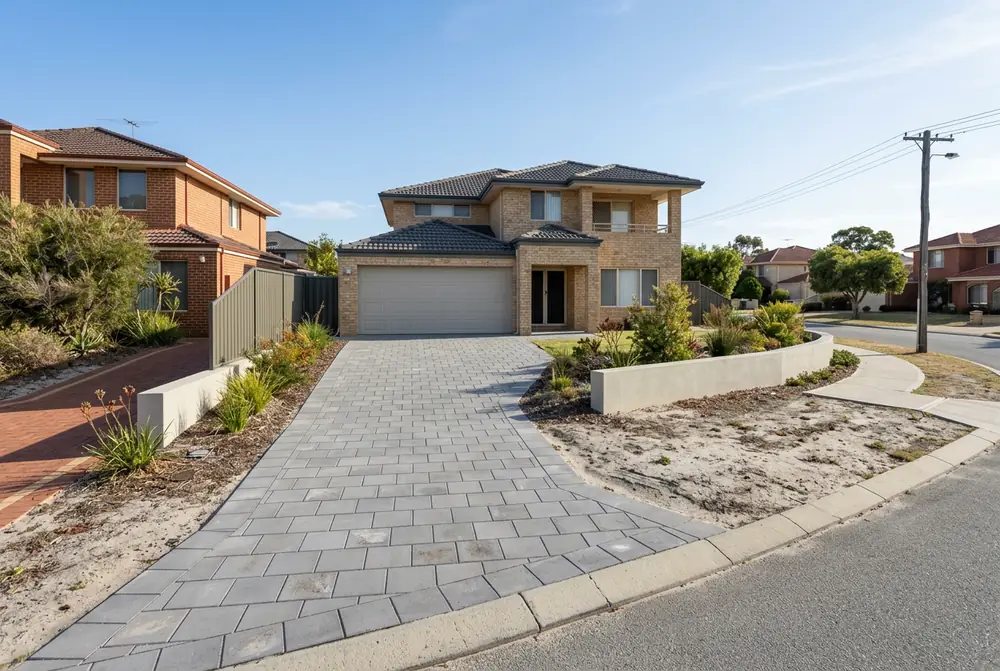
The oldest cell 9 homes may now be over 20 years old, and their driveways can show it. The usual symptoms are dips along the wheel tracks, a sunken patch beside the soakwell lid and edge pavers drifting into the garden. We fix that with a lift and relay: pavers up, base recompacted and topped up, edges restrained, original pavers back down. Where only a patch has dropped, a sunken paving repair may be enough.
When a cell 9 crossover is redone, the City of Kalamunda's rules apply. A Crossover Application must be approved before work starts, and the plan must show at least 3 m from any existing tree. On frontages of 12.5 m or less the crossover can be no wider than 3 m, or 4.5 m where the R-Codes allow a double garage. The City's first crossover contribution, the lesser of half the cost or $498 (2024/25), does not cover repairs or reconstruction.
Source: City of Kalamunda, Crossover Guideline (Ver 3.2).
On the semi rural lots the job is usually a long new driveway with a turning area, built on a deeper base for heavier vehicles.
Sand, lakes and the bushfire map
The City lists Wattle Grove among its sandy foothill areas, which is why soakwells generally work here and why driveway bases settle over time if they were not compacted properly at the start. Some of the newer subdivisions include artificial lakes, and lots close to them may have shallower groundwater, so we confirm the 500 mm clearance before setting a soakwell depth. The coast is around 21 km away, too far for salt to affect pavers.
With much of the suburb semi rural, some addresses may be in bushfire prone mapping; check yours on the DFES map. Around the house, clay or concrete pavers are a better choice than mulch or timber.
Next door to Wattle Grove
Forrestfield lies just north east of Wattle Grove, with Maida Vale and High Wycombe beyond it and Lesmurdie and Kalamunda up the scarp to the east. We handle those suburbs the same way; see areas we service.