

By IBP Paving. Published 9 October 2026.
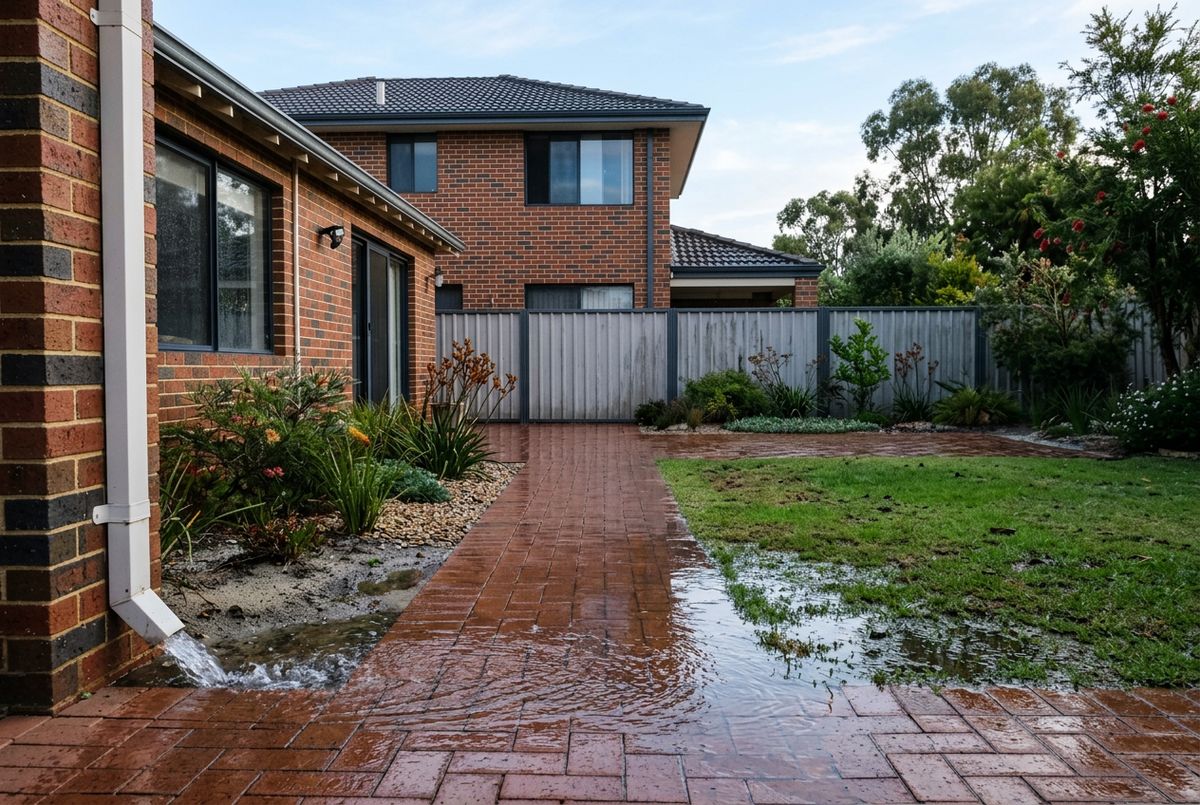
Find where the water is coming from before you spend anything
Most of Perth sits on sand that drains fast, so a backyard that floods is a useful symptom: the water is not pooling because the ground cannot take it, but because something is stopping it getting there. Before you buy a drain, a soakwell or a new lawn, spend one wet afternoon outside and watch where the water comes from and where it stops.
Look at three things. Where each downpipe ends and whether it is connected to anything. Which way the paving falls, by lying a straight edge or a hose across it. And whether the water is yours at all, or is running in under the fence from a higher block. Nearly every flooding job we see in our soakwell and stormwater work in Perth comes back to one of the five causes below, and the fixes differ widely in price, so diagnose first.
The five common causes
Paving that falls the wrong way, or has nowhere to drain to
Paving needs a fall, and the fall needs a destination. The usual working figures in Perth are 1:60 to 1:100, which means the surface drops 10 to 17 mm for every metre, always away from the house. The National Construction Code expects ground next to a wall to fall at least 1:100 for the first metre. When paving is laid flat, or settles over years on a thin sand bed, it holds a sheet of water with no way out. Just as common is paving laid with a good fall that ends at a wall, a raised garden bed or a fence, so the water runs to the low corner and sits there. Our stormwater drainage for paved areas page explains the falls and drain types in detail.
Downpipes discharging onto the ground
The cheapest fault to fix and one of the most common. A downpipe ending above the paving or lawn dumps its whole roof catchment into one spot. A single downpipe is expected to serve roughly 15 square metres of roof under the City of Wanneroo and City of Joondalup guidance, so even a small roof section delivers hundreds of litres into that corner in a winter front. One Perth building inspection firm reports finding downpipes discharging straight to the ground in 22.1 per cent of the properties it inspects, a figure that is the firm's own and not a council one, but it matches what we see on older homes and on new builds where drainage was never finished after handover.
Soakwells that are undersized or full of silt
A soakwell that was sized for the house as built does not know about the alfresco, the shed and the extra paving added since. Paved area counts as impervious area in every council formula, so each square metre you add needs storage. Wanneroo's table rates a 1200 by 1200 mm soakwell at 1,300 litres, serving about 111 square metres, and a 900 by 600 at 385 litres for about 31 square metres. If the roof and paving feeding a well have grown past those numbers it will overflow in exactly the storms you need it for. The other failure is silt. Leaves, roof grit and sand drawn through an unwrapped liner fill the chamber from the bottom up, and a half full soakwell has half the capacity. We cover the signs in why is my soakwell overflowing and the fixes in soakwell maintenance.
Runoff from a neighbour or a higher block
On sloping lots in the northern suburbs, and on any lot where a neighbour has built up their levels, water can arrive under the fence faster than your yard can absorb it. You will usually see it as a wet strip along one boundary that stays wet after everything else has drained. This is not yours to store. Every Perth council requires a property to confine its own runoff, so the first step is a polite conversation and, if that fails, the council's building services section. In the meantime a shallow spoon drain or an ag pipe along the fence line feeding your own soakwell keeps it out of the house.
Clay lenses, peaty pockets and compacted sand
Sand is not uniform. The Bassendean sands under Landsdale, Wanneroo and most suburbs between Wanneroo Road and the hills drain deeply, but low swales near the wetland chains carry shallow winter water tables and pockets of peat and clay. East of Ellenbrook the Guildford Formation is sandy clay that drains poorly, and closer to the coast Tamala limestone caprock can sit near the surface. A lawn walked and mown on the same sand for 30 years is also compacted enough to pool a running hose. None of this stops a soakwell working, but the well may need to be shallower and wider or sit where the ground is better, and a lawn problem can be a soil problem rather than a drainage one.
Fixes in order of cost
Stop when the yard stays dry.
- Clean the gutters and clear every downpipe outlet. Costs nothing but a Saturday. A blocked gutter overflows at the eaves and lands beside the footing, and a downpipe choked with leaves backs up and spills at the top.
- Connect downpipes that run onto the ground. Extend them in 90 mm PVC to the nearest soakwell, or to a new one. On a house with no soakwells at all this is the job that changes everything.
- Regrade the lawn and garden edges. Fill the low spots, cut a fall towards a garden bed or drain, and aerate compacted turf so it takes water again.
- Add a grated drain or ag pipe at the low edge of the paving. A strip drain at a threshold or along the alfresco edge, or a socked 65 mm ag line in a gravel trench under the paving edge, feeding a soakwell. This collects the water the paving is already shedding.
- Add or replace soakwells. Size them for the whole roof and paved area, wrap the liner in geofabric, keep them the council setback from walls and boundaries, and put the new one at the low point where the water already wants to go. The soakwell cost and sizing page has the council tables and indicative Perth industry ranges.
- Relay the paving to new falls. The most expensive fix, and the only one that works when the paving itself is the problem. See the next section.
When the paving has to come up
Three situations need the pavers lifted. Paving laid flat or towards the house, because you cannot change a fall by patching. Paving sunk in a dish around a soakwell or trench, because the bedding sand has washed into a void below and will keep going until it is closed. And a soakwell that has to go under the paving, because that is where the low point is. In each case the pavers are lifted, the base is recompacted, the drainage goes in and the same pavers go back down on fresh sand to the right falls. On a sound base a relay reuses most of the original pavers, and a sunken paving repair deals with the dish without disturbing the rest of the area.
If you are already planning to repave, add the soakwells and drains then, while the paving is up. A year later means paying to lift the new paving again.
Your obligation to keep stormwater on your own block
The City of Wanneroo puts it plainly: "Property owners have a statutory obligation under common law precedents and the Local Government Act 1995 to confine water runoff within their property boundaries." The City of Joondalup uses the same wording and adds that soakwell overflow must not pond against a building or enter an adjacent property.
That is why flooding is worth fixing properly rather than pumping over the fence. Water that leaves your lot is a neighbour dispute and a council matter; water ponding against your own footings is a building problem. Councils expect the fix to be sized for the whole impervious area, roof and paving together, and the City of Stirling requires roof and paved area runoff to be stored separately. Rules differ between councils and are revised, so check your council's current sheet before you build.
Sources: City of Wanneroo, Stormwater runoff information sheet (July 2019), wanneroo.wa.gov.au; City of Joondalup, Residential soakwells (stormwater runoff), joondalup.wa.gov.au; City of Stirling, On-site drainage criteria (June 2024), stirling.wa.gov.au.
Getting it fixed
If the yard still floods after the list, IBP Paving installs soakwells, drains and ag pipe and relays paving to correct falls across Perth's northern suburbs, with a lifetime workmanship warranty. Send a photo of the wet patch and the nearest downpipe with your quote request and we can usually name the cause before we visit.