

By IBP Paving. Published 9 October 2026.
How often a soakwell needs attention
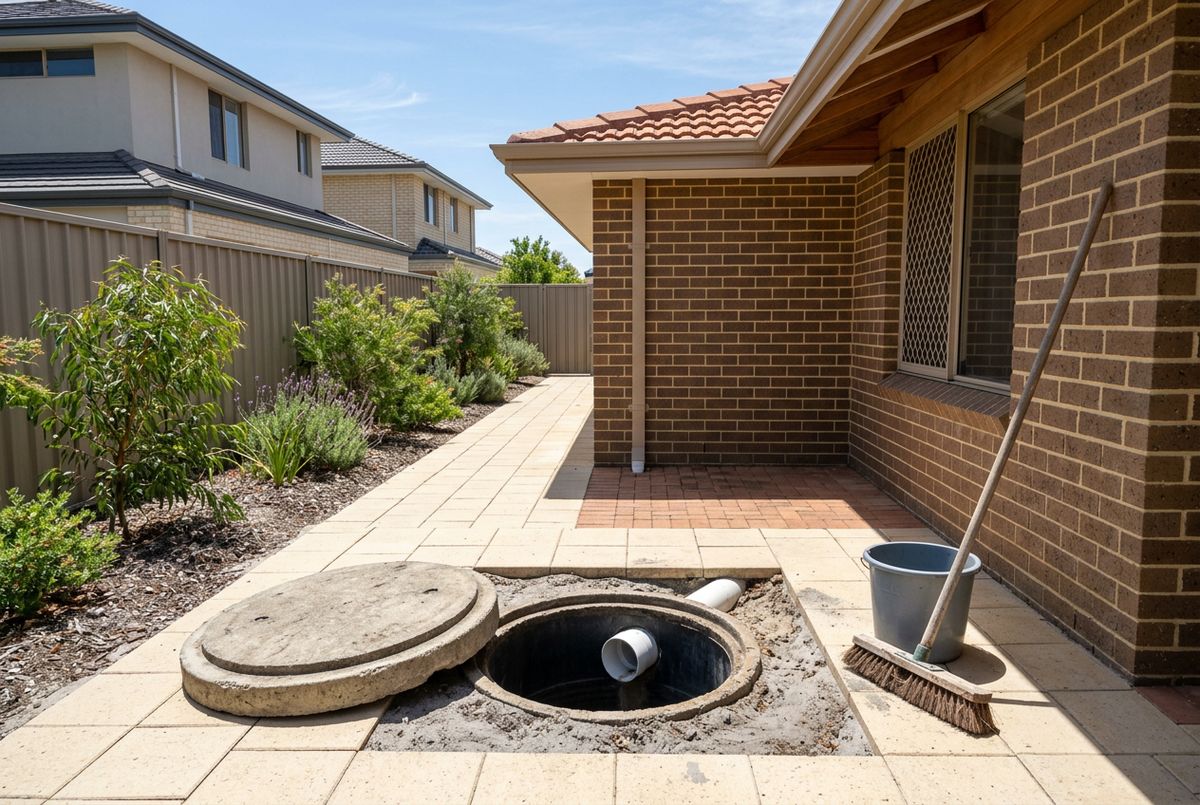
A soakwell is a buried chamber with holes in it, sitting in sand, fed by everything that lands on your roof. It has no moving parts, so it does not wear out. What it does is fill up. Fine sand migrates in through the slots if the liner was never wrapped in geofabric, and leaves, roof grit and moss arrive down the pipe no matter how it was built. Once the bottom third of the chamber is silt, you have lost a third of the storage you paid for, and the overflow shows up in the first serious winter front.
Two intervals cover it. Look at every well once a year, ideally in autumn before the rain. And budget for a proper clean out roughly every ten years if the well is geofabric wrapped, which is the figure a Perth strata maintenance guide uses; an older unwrapped well in Bassendean sand may need it in half that time. If you are not sure what you have under the lawn, the soakwells hub explains the types, and this guide tells you what to look for.
What to check: a pre winter list
None of this needs tools beyond a ladder, a torch and a screwdriver to lift a lid.
- Gutters. Clear them, and look for sags where water sits. Overflowing gutters drop water beside the footing instead of into the well.
- Downpipe outlets. Each downpipe should enter a pipe or a grated pit, not end above the ground. Count the downpipes against the roof: Wanneroo and Joondalup guidance expects about one for every 15 square metres of roof, no more than 12 metres apart.
- Inlet pits and grates. Lift the grate and scoop out the leaves. A pit half full of debris is already restricting flow.
- The lid and access. Find every well. A lid that has been paved over with no access point is a maintenance problem waiting for a wet August.
- Water level after rain. After a decent fall, lift a lid the next morning. A working well in sand is empty within hours. One that still holds water the next day is either silted, sitting in a high water table or undersized.
- The ground around it. A dish forming in the lawn or paving above the well means sand is being drawn into the chamber. That is the earliest warning of an unwrapped or cracked liner.
- The overflow path. If the well does fill, where does the excess go? It must not pond against the house or run onto a neighbour.
Silt traps, leaf guards and gutter guards
The cheapest maintenance is the kind that stops material reaching the well. Three things do most of the work. A leaf guard or mesh ball at the top of each downpipe catches gum leaves before they enter the pipe. A grated inlet pit between the downpipe and the well, which the City of Stirling criteria require downpipes to discharge into, acts as a silt trap: heavy grit settles in the pit where it can be scooped out, instead of in the chamber where it cannot. And geofabric around the chamber itself, standard on any well we install, keeps the surrounding sand out through the slots.
Gutter guard across the whole roof is optional. On a block with a big gum tree over the house it pays for itself; on a treeless new estate in Banksia Grove it mostly collects dust. A grated pit at each well is the one we would not skip anywhere.
Signs a soakwell is failing
- Water bubbling up from a downpipe or inlet pit during rain. The well is full, blocked at the inlet or the pipe between them is choked.
- Pooling that stays. The WA Department of Water's soakwell design sheet expects no ponding to remain after 96 hours, because standing water that long breeds mosquitoes. In Perth sand a healthy well empties far faster than that.
- Pavers sinking in a ring around the well. Bedding sand is leaching into an unwrapped chamber. The paving will keep dropping until the liner is wrapped or replaced and the void filled. Our sunken paving repair page covers this fix.
- Overflow against the footings or under a wall. This is the one to act on quickly. Wet footings are a building problem, not just a garden one.
- A well that is fine in autumn and fails every July. Usually the winter water table rising into the chamber on low lots near the wetland chains, which is a sizing and placement question rather than a cleaning one. See why is my soakwell overflowing.
Cleaning a soakwell yourself or calling a contractor
The method is the same whoever does it. Lift the lid, or the pavers over the access point. Scoop, shovel or vacuum out the silt, which on an old well can be a surprising amount of wet grey sand. Check the inlet pipe is clear by running a hose from the downpipe. Check the liner for cracks and the slots for blockage. Put the lid back and reinstate the paving on fresh sand.
Do it yourself when the well has a lid you can reach, the chamber is small enough to clean from above with a shovel and a wet vacuum, and the pavers around it are sound. Call a contractor when the well is under a driveway with a trafficable lid, when it is deep enough that someone would have to climb in, when the liner is cracked or collapsed, when the paving above has already sunk, or when you cannot find the wells at all. A collapsed chamber is a replacement, not a clean, and in a driveway it means lifting paving, craning in a new concrete unit and relaying to the council's trafficable requirements. We do that as part of our soakwell installation and replacement work, with the paving put back by the same crew.
In a strata complex, check who owns the well before you lift anything. The City of Stirling makes maintenance access the owner's responsibility, and the same principle applies across Perth: the council maintains the street drain, you maintain what is inside your boundary.
What maintenance costs
There is no reliable published Perth figure for a routine soakwell clean, because the price depends entirely on access: a lidded well in a lawn is a short job, a well under a paved driveway is a half day with paving to relay. What the public sources do give is the cost of leaving it too long. A Perth strata maintenance source puts remediation of a collapsed or blocked soakwell at $1,000 or more per well, before any paving is reinstated, and that is an indicative Perth industry figure rather than our price. Against that, an autumn hour with a ladder and a bucket is cheap, and a grated pit at each inlet is cheaper still. If a well does need replacing, the soakwell cost and sizing page has the council capacity tables and indicative Perth industry ranges for new units.
Sources: City of Wanneroo, Stormwater runoff information sheet (July 2019), wanneroo.wa.gov.au; City of Stirling, On-site drainage criteria (June 2024), stirling.wa.gov.au; WA Department of Water, Water sensitive urban design: soakwells, wa.gov.au.
The short version
Clean the gutters, fit a grated pit and a leaf guard at each downpipe, lift every lid once a year in autumn, and watch for water that lingers or paving that dishes. Do that and a geofabric wrapped soakwell in Perth sand will go a decade between proper clean outs. If yours is already ponding, sinking the paving or impossible to find, IBP Paving can locate it, clean or replace it and put the paving back, across Perth's northern suburbs from our base in Landsdale. If the water problem is bigger than one well, start with our guide to backyard flooding in Perth or go straight to the soakwells hub.