

By IBP Paving. Published 9 October 2026.
Two ways to build the same hole
Every soakwell does the same job: hold a storm's worth of roof and paving water underground and let it seep into the sand. The difference between concrete and polypropylene is how the hole is held open. A concrete soakwell is a precast ring, usually with slots cast into the wall and a concrete lid on top. A polypropylene soakwell is a crate of plastic panels clipped into a box, wrapped in geotextile, and buried. Both work in Perth sand. The decision is about weight, traffic, council rules and the site, not about which one drains better. Our soakwell installation and repairs page covers the service; this post is the comparison.
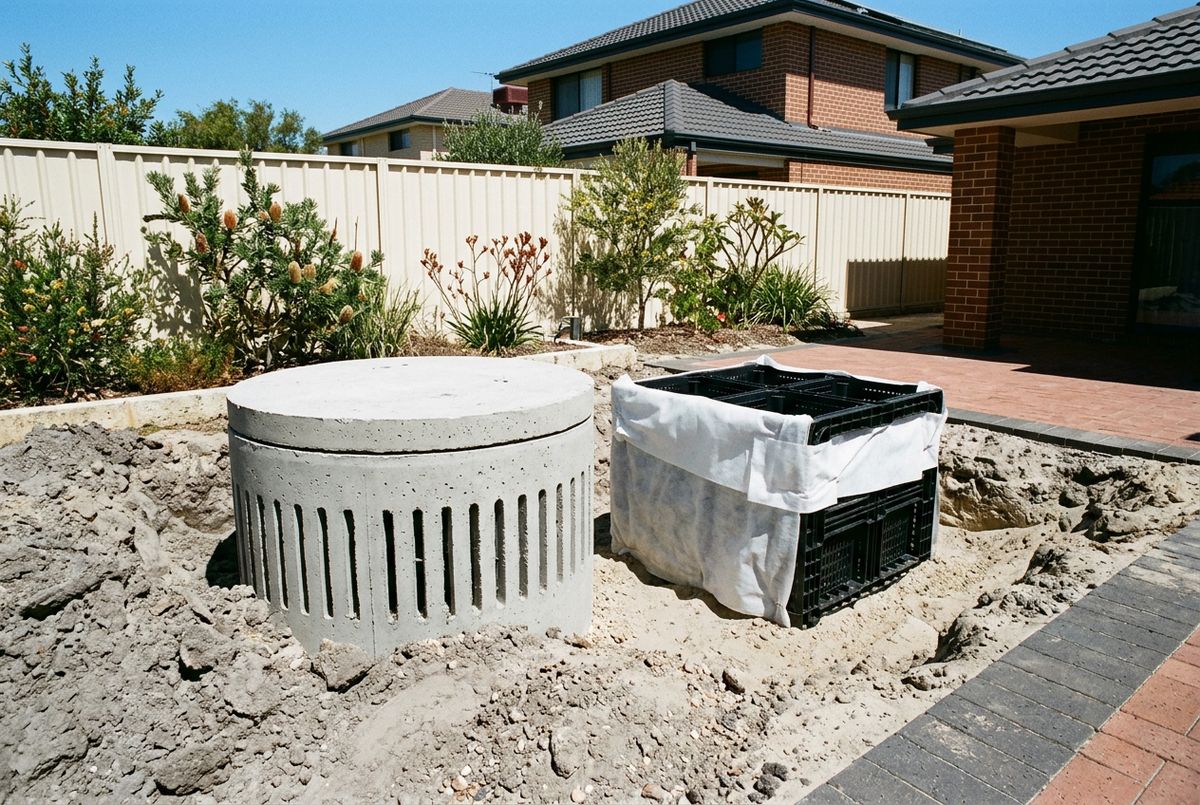
Weight and installation
This is the practical difference you feel on the day. A concrete 1200 x 1200 unit weighs about 1,100 kg. It arrives on a truck and is lifted into the hole by an excavator, which means the excavator needs a path to the hole. On a new build with open ground that is easy. On an established home with a 900 mm side gate, a pool and a finished alfresco in the way, it is not.
Polypropylene crates come flat packed. A 1,000 L unit can be carried through the house if it has to be, clipped together beside the hole and dropped in by two people. They can also be stacked and joined to make long, shallow storage where a round concrete ring will not fit. For a retrofit in a narrow back yard, that is often the deciding factor.
Both go through the same steps otherwise: excavate, set the base, wrap or line with geotextile so sand cannot migrate in through the slots, connect the stormwater pipe, backfill and compact. The geotextile matters on both. Older unwrapped concrete units are the usual reason pavers sink around a soakwell, because the sand under the paving has found its way into the chamber.
Trafficability and what councils say
Under a lawn or garden bed either material is fine. Under a driveway, carport, garage or paved area the councils have views, and they lean toward concrete.
- City of Gosnells: "Concrete soakwells are the preferred choice" and "they are required under all paved areas."
- Town of Claremont: "PVC soakwells are not acceptable in areas subject to vehicular traffic."
- City of Stirling: all drainage structures within or under driveways, carports and garages "shall be designed to be trafficable and shall be provided with an approved base to prevent any subsidence of well liners."
- Town of Victoria Park: "All stormwater soakwells located in driveway areas are to have a grated, trafficable lid," and the grate must not be covered by paving. Its minimum roof water soakwell is listed with concrete as the approved material.
- City of Swan: all soakwells in paved or concrete areas are to have trafficable lids and be accessible for maintenance.
Trafficable polypropylene units exist, and where a council's rule is about rating and base rather than material, they can be used under paving. But the base has to be compacted and approved, the lid has to be the one the council asks for, and the unit has to be rated for the load. A standard garden crate under a driveway is how you end up with a collapsed soakwell and a bowl in the paving. WA Health also publishes a list of approved concrete soakwells, which is the list councils refer to when they ask for an approved product in writing. Our paving drainage page explains how a driveway soakwell is laid out with its grate and base.
Source: City of Gosnells, Stormwater FAQ; Town of Claremont, Requirements for on site stormwater drainage; City of Stirling, On Site Stormwater Drainage Criteria (June 2024); Town of Victoria Park, Onsite Stormwater Drainage Requirements Sheet; WA Health, Approved concrete soakwells.
Lifespan
Concrete suppliers claim 50 year service lives and there is no reason to doubt it for a precast ring sitting in sand. Polypropylene is a newer product in the ground but it does not rust or rot, and the crates are rated for burial. The honest answer is that the material is rarely what fails. Soakwells die of three things: silt and sand filling the chamber, a crushed unit under traffic, and a pipe that was never connected properly. Wrap the unit, rate it for the load above it and keep the gutters clean, and either material will outlast the roof it serves.
One difference worth noting is the clean out. A concrete ring has a solid lid you lift to get a shovel or a vacuum hose into the chamber. A crate soakwell is a lattice, so cleaning means lifting the lid section and working between the panels, which is slower. On a site where you expect to be cleaning regularly, concrete is the easier unit to live with.
Cost context
There is no current public Perth price list for installed soakwells of either type, so any figure is an indicative Perth industry range rather than a quote. The public numbers that exist are a 2015 forum thread quoting $3,500 plus GST for four polypropylene 1500 x 900 units installed, and an undated strata guide putting remediation at $1,000 or more per soakwell. What those do not show is where the money goes. The unit itself is a minor line; the excavation, the machine for a concrete unit, the pipe run, and lifting and relaying any paving are the rest of the bill. Polypropylene usually wins on installation cost where access is tight because it avoids the machine. Concrete usually wins under paving because it avoids the rating argument and the second visit. The arithmetic is on our soakwell cost and sizing page.
Which one, by situation
| Situation | Our usual recommendation | Why |
|---|---|---|
| New build, open ground, under lawn or garden | Either; concrete if a machine is on site anyway | Access is easy, the council has no traffic rule to apply, and concrete is simpler to clean later. |
| Under a driveway, carport or paved area | Concrete, or a trafficable rated unit on an approved base with a grated trafficable lid | Gosnells requires concrete under paving, Claremont rejects PVC under traffic, Stirling and Victoria Park require trafficable design and lids. |
| Retrofit in an established yard with narrow side access | Polypropylene | Carried in by hand, no excavator path needed, can be shaped to fit. Note the City of Wanneroo does not recommend soakwells in narrow clearances, so the unit should still sit where there is soil around it. |
| High water table beside a lake, river or wetland | Shallow, wide units of either material | The City of Nedlands advises shallow soakwells with a larger diameter so the base stays above groundwater. Crates make shallow wide storage easily; wide concrete units such as the 1800 x 600 do the same. |
| Clay ground | Neither, until the council has said what it will accept | Gosnells moves to sealed tanks where soil will not take water. See our post on soakwells in clay, limestone and high water table areas. |
| Replacing a failed unit under existing paving | Concrete | The paving is coming up anyway, the old unit probably failed under load, and the council rule for paved areas applies to the replacement. |
The short version: if it is going under something you drive on, use concrete or prove the rating. If it is going under a lawn behind a narrow gate, use a crate. If it is going into clay or groundwater, ask the council before you buy anything. IBP Paving installs both types of soakwell across Perth's northern suburbs and will tell you which one your site and your council call for before we quote.