

By IBP Paving. Published 9 October 2026.
Why Perth's ground matters more than the soakwell
A soakwell is a hole that holds water until the soil around it takes the water away. On deep sand that happens in hours. The Department of Water and Environmental Regulation's soakwell brochure says they are "very effective in sandy soils" and that size depends on the soil's infiltration capacity. It sets two limits that matter on difficult ground: the base must be above the maximum groundwater level, and water should not pond for longer than 96 hours, because standing water breeds mosquitoes.
Three kinds of Perth ground break those limits. Clay does not let the water out. Limestone caprock gets in the way of the hole. A high water table fills the hole from below. The City of Wanneroo's information sheet warns that excessive stormwater "can cause overflow depending on the soil type, eg: clay, limestone, etc." Our soakwell installation and repairs page covers the standard job on sand; this post is about sites where that is not enough.
Source: DWER, Water sensitive urban design: Soakwells; City of Wanneroo, Stormwater Runoff Information Sheet.
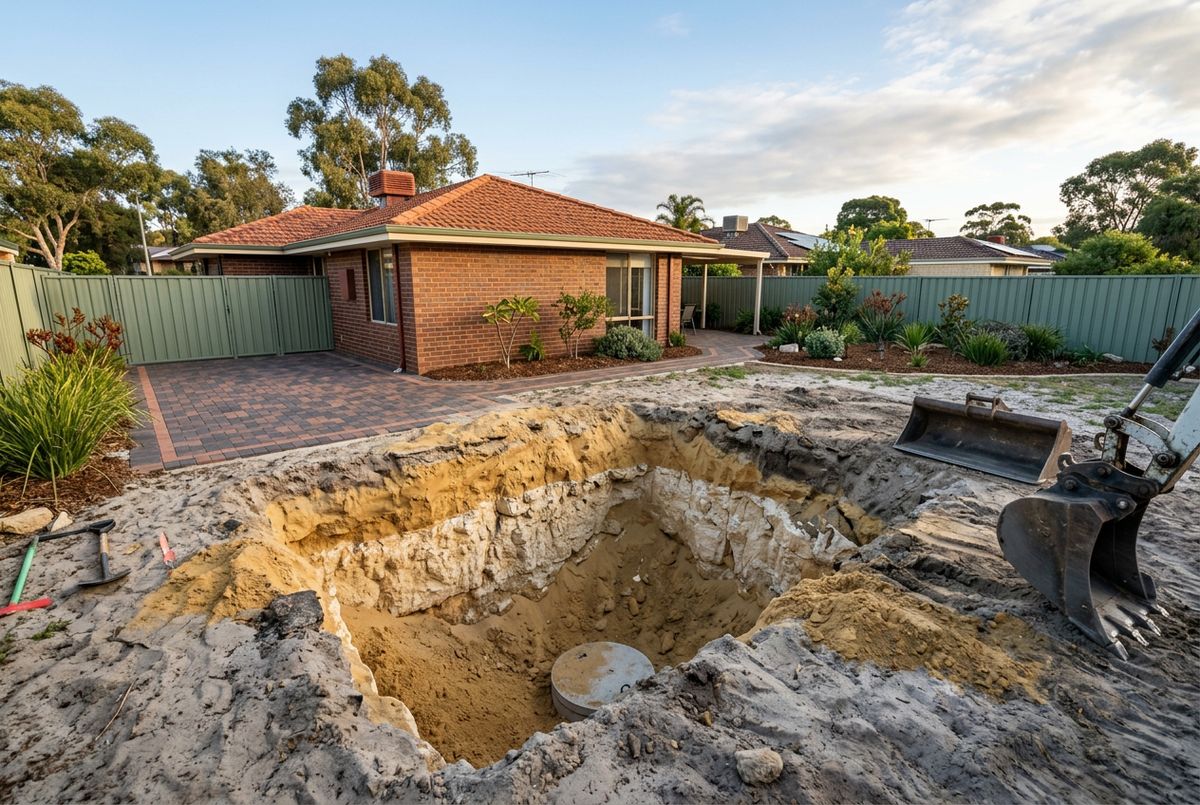
Where each condition occurs in Perth
The Swan Coastal Plain is three bands of old dunes running parallel to the coast, with clay behind them and the Darling Scarp behind that. The suburb notes below are regional patterns from the geological mapping, not a survey of your block, so treat them as a prompt for a site check rather than a verdict.
Deep sand: the easy ground
The Bassendean sand belt is pale grey leached sand that drains freely and sits over a water table that is generally several metres down. The City of Wanneroo lists Wanneroo, Wangara, Tapping and Ashby on it, and Landsdale, Darch, Madeley, Alexander Heights, Girrawheen, Ballajura and Ellenbrook sit on the same unit. Here a standard soakwell at the council's table size works, and deep units are fine.
Limestone: the north western and coastal ridge
Between the Bassendean belt and the beach is the Spearwood system: yellow and brown sand over Tamala limestone, which the Perth Groundwater Atlas describes as the ground of the north western urban corridor. Where the limestone is close to the surface, excavation hits rock. Duncraig had a sand and limestone mining lease over part of the suburb, and Woodvale is on karstic limestone where a back yard sinkhole once swallowed a swimming pool overnight. Kingsley, Padbury, Joondalup, Greenwood, Warwick, Currambine and Kinross generally sit on the same unit, and so do the coastal suburbs from Hillarys and Sorrento up through Mindarie and Quinns Rocks, where limestone was quarried for lime kilns.
Clay: the north eastern corridor and the hills
East of the sand belt is the Guildford Formation, a sandy clay the Groundwater Atlas describes as the ground of the north eastern urban corridor. Midland and Guildford sit on it; Bassendean is a thin veneer of sand over it; Dayton, Brabham and the eastern side of Aveley and The Vines grade into it. Further east, hills suburbs such as Kalamunda, Lesmurdie and Forrestfield are gravelly sand over laterite on the crests and poorly drained clay on the valley floors. Byford is on the same clay plain. On all of this ground a soakwell needs a geotechnical opinion before it needs a quote.
High water table: beside lakes, wetlands and the river
The dune swales hold chains of wetlands, and the lots around them have the shallowest groundwater in Perth. Edgewater, Joondalup and the lake side of Wanneroo fringe Lake Joondalup. Kingsley is split by Lake Goollelal, Carine sits beside its swamps, and Osborne Park and Innaloo were built on peaty swamp soils between Lake Monger and Herdsman Lake. Canning Vale is described as swampy terrain, and Bayswater has pockets of peat, heavy clay and river silt in its wetlands. Along the river, the City of South Perth bars soakwells for new buildings in its foreshore precincts unless the base sits at least 0.5 m above the annual maximum groundwater level.
What councils require on these sites
The councils with written rules for difficult ground all say roughly the same thing: keep the base well above groundwater and clay, prove it if asked, and use something else where it cannot be done.
City of Gosnells: soakwells are permitted only where the geotechnical report supports them. "There shall be minimum 0.5m clearance from the base of the soakwell to the maximum groundwater level" or a low permeability clay layer. Where the site is unsuitable, "sealed tanks shall be used." A council connection is required for sandy clay and clayey sand soils and for all lots smaller than 350 m2.
- City of Stirling requires a drainage management plan where groundwater is within 1.2 m of the surface, with storage for a 1 in 20 year storm rather than the standard 15 mm event. It allows holding tanks and infiltration basins as approved alternatives, and permits a private connection to its drains only where the owner shows that high groundwater defeats infiltration.
- City of Swan requires subsoil drains where the maximum groundwater level is less than 1.2 m below the proposed lot levels, and notes that soakwell capacity is reduced where the groundwater table rises above the base, in which case soakwells may not be suitable.
- City of Nedlands advises that where the water table is high, shallow soakwells with a larger diameter need to be used to provide adequate storage.
- City of South Perth requires the soakwell base to sit more than 500 mm above the historical maximum groundwater level in the Perth Groundwater Atlas.
Our council soakwell requirements page compares the standard rules council by council; the pages for the City of Swan and City of Stirling carry the groundwater triggers in full.
Source: City of Gosnells, Stormwater drainage; City of Stirling, On Site Stormwater Drainage Criteria (June 2024); City of Swan, Handbook of Stormwater Drainage Design (April 2022); City of Nedlands, Stormwater drainage FAQs; City of South Perth, Stormwater Drainage for Proposed Buildings Design Guidelines.
What works: high water table
Go shallow and go wide. The Nedlands advice is the practical rule everywhere: a soakwell 600 mm deep and 1800 mm across holds more than a 1200 x 1200 unit, 1,550 L against 1,300 L on the Wanneroo table, with its base 600 mm higher. Polypropylene crates laid in a single shallow layer do the same. Check the DWER Perth groundwater map, then dig a test hole in winter, because the level you need to clear is the seasonal high. Where the base still cannot clear groundwater, the councils above move to detention: a sealed tank that holds the storm and releases it slowly to an approved outlet, with the council's written approval.
What works: clay
Do not put a standard soakwell in sandy clay and hope. It will fill in the first front and stay full past 96 hours. On clayey sand, where infiltration is limited rather than absent, a larger, shallower unit can sometimes be justified by a geotechnical report. On sandy clay, the City of Gosnells rule is the model: a sealed tank with a controlled outlet and a connection to the council system. Gosnells also sizes the job around whether there is an overland flow path, with the sand pad at least 200 mm above the back of kerb: with that path the design storm is 1 in 20 years, without it the site must store and release a 1 in 100 year event. The City of Swan's answer on its clay side is subsoil drainage. Either way the council decides before anyone digs, and the geotechnical report is what it decides on.
What works: limestone
Limestone is a digging problem more than a drainage problem. The Tamala limestone is porous and the yellow sand over it drains fast, so a soakwell that is in the ground usually works. The difficulty is a hard caprock band at the depth the unit wants to sit. The DWER brochure notes that installation will be more difficult if rock or other hard material is present; on a quote that means rock breaking, a longer day with the excavator, or a shallower, wider unit that stops above the rock. Around Woodvale it also means checking the hole for voids. Ask the installer what happens to the price if the bucket hits rock.
Before you buy anything
Three checks in order. First, the DWER Perth groundwater map. Second, your council's drainage sheet, to see whether a geotechnical report or drainage management plan is triggered. Third, a test hole on site in the wet months, the only way to know what is under your block.
IBP Paving installs soakwells across Perth's northern suburbs, most of them on deep sand where the standard unit works, and tells you when your site is one where it will not. If you are in a lake side, river side, limestone or clay suburb, say so when you ask for a quote and we will plan the site check first.