

Dianella paving from Landsdale, about 9 km away
Dianella is the one City of Bayswater suburb among our closest twenty, about 9 km south of IBP Paving's base in Landsdale. It is big, with more than 24,000 residents, and it covers the whole spread of Perth housing: subdivided in the 1880s but mostly built from the 1960s onward, with the St Andrews and Dress Circle estates adding large two storey homes in the early 2000s. We replace the oldest driveways, relay the 20 year old ones, lay stone and brick entertaining areas, rebuild retaining and install soakwells to the City's formula, with a lifetime workmanship warranty and over 20 years of experience.
The City of Bayswater's 12.5 mm soakwell rule
Where the northern councils publish tables, the City of Bayswater publishes a formula. Its subdivision clearance information sheet states that stormwater must be contained on site with downpipes directed to soakwells of adequate combined volume, and that the required combined soakwell volume in cubic metres equals the total impervious area in square metres multiplied by 0.0125. The figure is based on retaining 12.5 mm of rainfall on site, consistent with the Stormwater Management Manual for Western Australia. Impervious area means any hard surface that sheds water: roofs, paving, driveways and patios. Accessways must be constructed, graded and drained with soakwells and trafficable drains so all runoff stays within the accessway, and car bays must be paved or concreted with drainage provided.
| Impervious area | Soakwell volume at 0.0125 |
|---|---|
| 100 m² | 1.25 m³ |
| 200 m² | 2.5 m³ |
| 240 m² (City's example) | 3 m³ |
| 300 m² | 3.75 m³ |
| 400 m² | 5 m³ |
Source: City of Bayswater, Clearance of Subdivision Conditions Information Sheet. The sheet is written for subdivision clearances; it is the City's published residential sizing rule.
The City does not publish setback distances for soakwells, so we apply the manufacturer's clearances and keep units away from footings. Our Perth soakwell requirements page compares Bayswater's formula with the northern councils' tables.
Yellow sand west, grey sand east
Dianella straddles the change between the Spearwood and Bassendean dune systems. Streets on the western side towards Yokine sit on yellow Karrakatta sand over deeper limestone; the eastern side towards Morley is on the grey leached Bassendean sand. Both drain well, there is no major wetland in the suburb and the water table is generally several metres down, so soakwells sized to the City's formula work without fuss almost everywhere. The practical difference is in the digging: the yellow sand on the west can hide limestone at depth on the higher ground, while the grey sand on the east is soft and needs the excavation walls supported while the unit goes in.
The coast is about 10 km away, so salt attack on pavers is not a Dianella issue, and the suburb has no bushland interface of note. What it does have is slope: parts of Dianella rise towards the Dianella Heights ridge, and many 1960s front gardens are held by low limestone or brick walls that have leaned over sixty years, which is why retaining walls and driveways are often rebuilt together here.
Sixty year old driveways and twenty year old estates
The bulk of Dianella was built from the 1960s, which puts its original driveways at the end of their life. Cracked concrete, worn early pavers and bases that have washed into undersized soakwells are the standard presentation, and the answer is a full paving replacement on a compacted crushed limestone base with the soakwell replaced at the same time. Subdivision is common on the larger old lots, and a rear battle axe block often needs a new shared driveway built as a drained accessway to the City's requirement.
St Andrews and the Dress Circle are different. Their early 2000s two storey homes have driveways and alfresco areas that are 20 to 25 years old, with sound pavers on a sand bed that has moved. A lift and relay brings them back, and owners frequently upgrade the alfresco to stone while the crew is there. The smaller neighbours of Yokine, Nollamara and Mirrabooka have the same mix of eras and are serviced from this page.
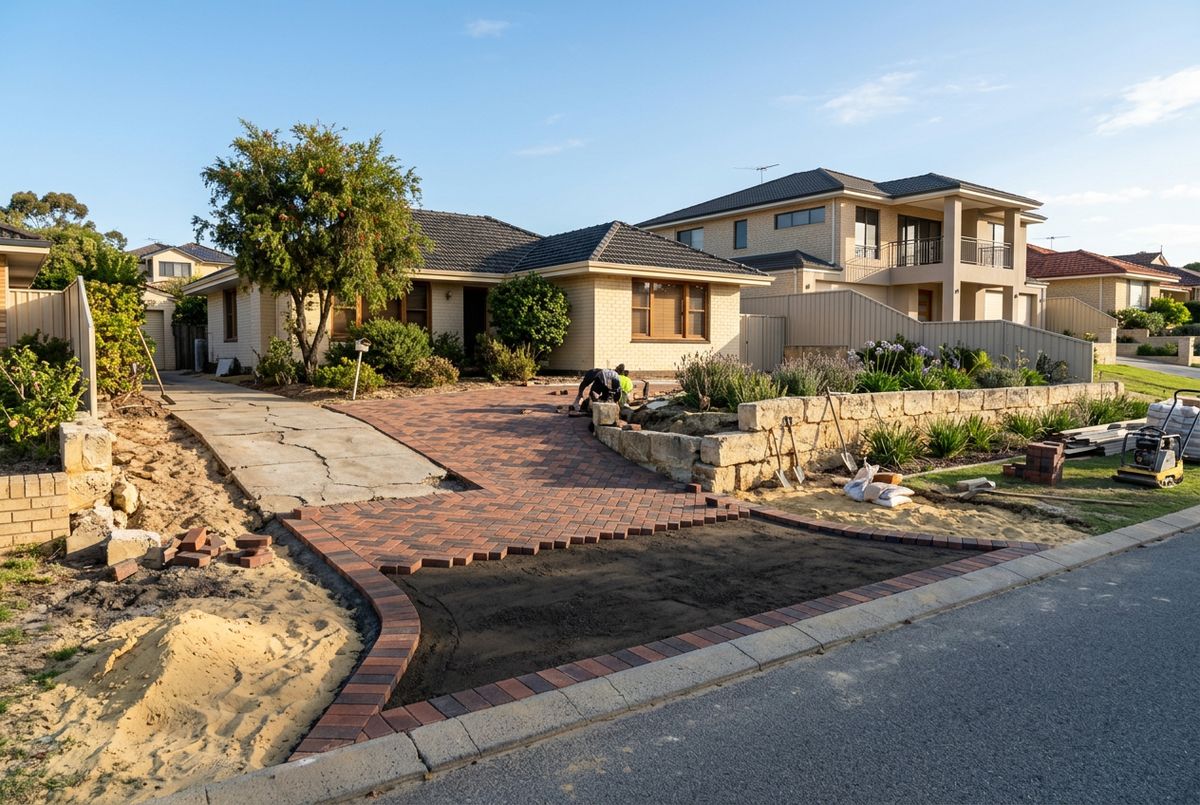
Dianella verges: the 30 percent rule and the shade tree
The City of Bayswater's Street Verges Policy lets owners brick pave up to 30 percent of the verge area, excluding driveways and pathways, without an application, on the condition that the paving is accompanied by one or more trees capable of shading the full paved area when fully mature. Above 30 percent, the City points out that its road drainage is designed for a blanket runoff coefficient of 50 percent across all verges, so a larger hardstand has to consider its effect on stormwater capacity, and concessions may be agreed in exchange for extra soakwells. Synthetic lawn is not permitted under any circumstances, raised garden beds are capped at 350 mm high and set back 0.5 metres from paths, crossovers and street trees, and any existing street tree must be retained. Planting within 1.5 metres of a crossover is kept under 750 mm.
Crossovers must be approved before work starts and built to the City's specifications. The City subsidises one standard crossover per lot and the reconstruction of a bitumen crossover in concrete or brick paving, but it will neither maintain nor subsidise bitumen. Dianella is outside the City's three Character Protection Areas in Maylands, Mount Lawley and Bayswater, so the 3.0 metre single crossover width limit that applies there does not apply here.
Sources: City of Bayswater, Street Verges Policy (reviewed 23 July 2024); City of Bayswater, Verge Greening Guidelines (COB0439 V3); City of Bayswater, Crossovers Policy (reviewed 23 June 2026); City of Bayswater, Character Protection Areas Policy.
Suburbs near Dianella
From Dianella we service Morley to the east, Ballajura to the north east and Girrawheen to the north west, along with Yokine, Noranda, Mirrabooka, Nollamara and Inglewood. See areas we service for the complete list.