

Morley: 1960s homes, 2020s subdivisions
Morley is the largest suburb in the City of Bayswater and the furthest south IBP Paving goes on a regular run, about 9.7 km from our base in Landsdale. The land was subdivided after the First World War, but most of the houses went up in one burst of building through the 1960s, so the typical Morley lot is a big quarter acre with a brick and tile home at the front and a lot of lawn behind it. Those lots are now being split, and that is where most of our Morley work comes from: a shared driveway down the side to a new rear home, a courtyard for the unit at the back, a limestone wall where the levels change, and soakwells sized to the City's formula. We also replace the original driveways that have reached the end of their life. Every job carries our lifetime workmanship warranty, backed by over 20 years in the trade.
The City of Bayswater's 12.5 millimetre soakwell rule
Bayswater is one of the few councils that states its residential soakwell sizing as a plain formula. It comes from the City's subdivision clearance sheet, which is also the rule the City applies when a new rear lot is created on a Morley block.
"Required combined soak well volume (m3) = total impervious area (m2) x 0.0125", which the City describes as "retaining 12.5 mm of rainfall on site, consistent with the Stormwater Management Manual for Western Australia". Impervious area means "any hard surface that sheds water e.g. roofs, paving, driveways and patios". The sheet's own example: 240 square metres of hard surface needs 3 cubic metres of storage.
Source: City of Bayswater, Clearance of Subdivision Conditions Information Sheet.
Two further points matter on a subdivided lot. The shared accessway must be "constructed, graded and drained", which the City says includes soakwells and trafficable drains so that all runoff from the driveway stays inside it, and car bays are to be paved or concreted with drainage provided. In practice a 40 metre battle axe driveway at 3 metres wide is 120 square metres of hard surface on its own and needs 1.5 cubic metres of trafficable soakwell beneath it before the house roof is counted. We size the lot as a whole and put the soakwells where the ground is best. General rules for Perth councils are on our soakwell requirements page; Bayswater does not publish a setback distance, so we follow the manufacturer's clearance.
Grey sand, and the low ground towards Bayswater
Morley sits on Bassendean sand, the pale grey, leached sand that also underlies Landsdale and Ballajura. It is deep, it drains quickly and it is easy to dig, which is why the 12.5 millimetre rule works without any fuss on most Morley lots. The one place to be careful is the southern edge of the suburb, where the ground falls away towards the Bayswater wetlands and the Swan River flats. Low lots there can have a shallow winter water table and pockets of peat or clay, and a soakwell whose base sits in groundwater holds nothing. On those blocks we probe first and use wider, shallower units if needed. The coast is about 13 km away, so salt plays no part in paver selection, and there is no bushland interface in Morley.
Battle axe blocks and shared driveways
The jobs Morley generates follow directly from its age. Original 1960s driveways, whether poured concrete or early pavers, are past relaying and come out for full replacement on a fresh compacted base. When a lot is subdivided we lay the shared driveway in 60 mm pavers to take two households' traffic, pave the rear home's courtyard and side access, and build limestone retaining walls where the new lot has been cut or filled. Noranda to the north, which is 1970s and 1980s stock, and Beechboro to the east, built from 1979 through the late 1980s, are covered from this page: their jobs are mid-life relays and soakwell replacements rather than subdivisions.
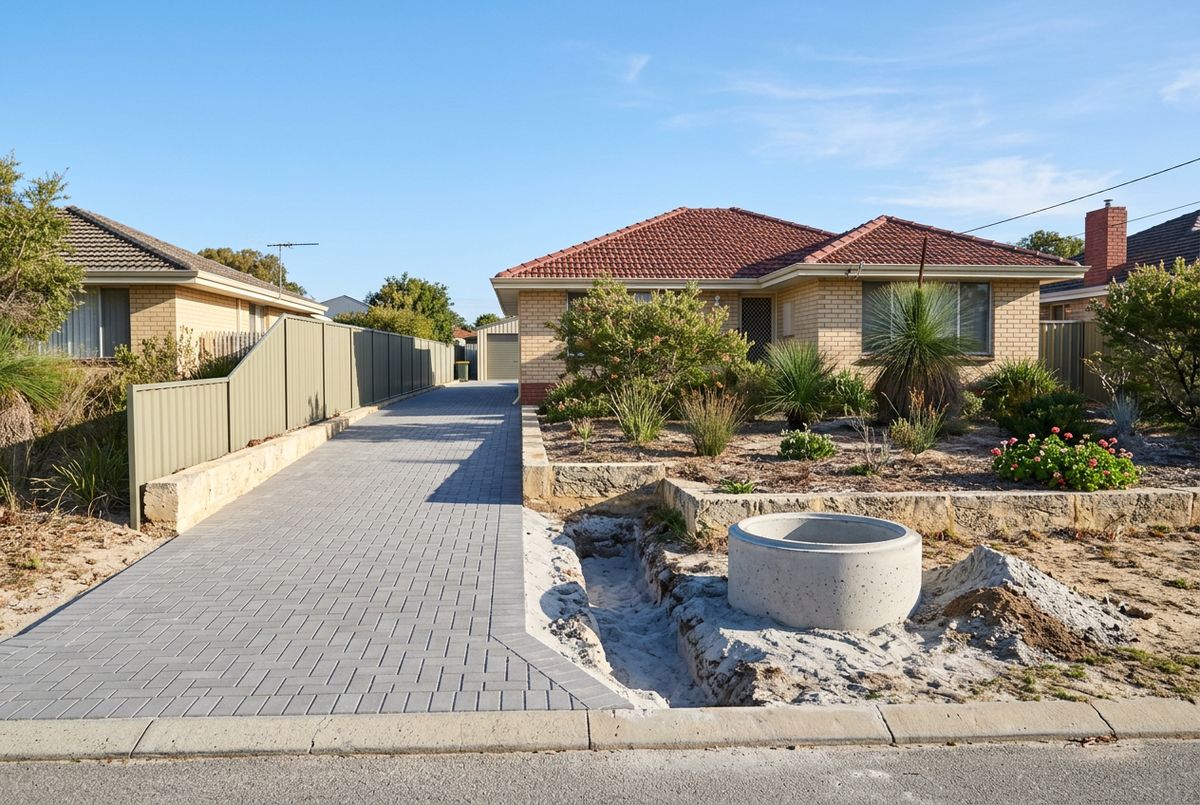
Verges in Morley: 30 per cent brick paving and a shade tree
The City of Bayswater's Street Verges Policy lets owners brick pave part of the verge without an application, as long as the paving does not exceed 30 per cent of the verge area excluding the driveway and footpath and is paired with one or more trees capable of shading the whole paved area once grown. The City explains why the cap exists: its road drainage is designed for a blanket runoff coefficient of 50 per cent across all verges, so anyone wanting more hardstand must show how the extra runoff is handled, and the policy allows concessions through additional soakwells. Synthetic lawn is not permitted "under any circumstances". Raised beds are limited to 0.35 metres high and must sit 0.5 metres back from footpaths, crossovers and street trees, and planting within 1.5 metres either side of a crossover stays under 0.75 metres.
At the crossover, the City pays a subsidy under its fees and charges schedule for one standard crossover per lot, and separately subsidises rebuilding an old bitumen crossover in concrete or brick paving, which it will not otherwise maintain. Approval is required before crossover works start, footpaths take priority over crossovers and are built in plain grey concrete, and every existing street tree in the verge must be retained.
Sources: City of Bayswater, Street Verges Policy (reviewed July 2024); Verge Greening Guidelines (COB0439 V3); Crossovers Policy (reviewed June 2026).
Suburbs around Morley
From Morley the run back north passes Dianella to the west and Ballajura on the way to Landsdale, with Noranda, Beechboro, Embleton and Bayswater itself in between. All of them appear on areas we service.