

Repairs, relays and replacements, 6 km from our yard
Balga is about 6.2 km south of IBP Paving in Landsdale, close enough that we can look at a cracked path or a sunken driveway section the same week you call. The suburb's paving is old. Most of it went down with the 1960s State Housing Commission homes or with the first wave of private renovation in the 1980s, and it now needs one of three things: a repair where a single area has failed, a relay where the pavers are fine but the base has gone, or a full replacement where concrete or bitumen has reached the end. We do all three with a lifetime workmanship warranty and over 20 years of experience.
The Mirrabooka Project streets and what they left behind
Balga was built as part of the State Housing Commission's Mirrabooka Project, with streets and homes laid out from the 1960s on generous lots. The suburb is now changing in two directions. Original owners and renovators want the existing house tidied up: a new driveway in brick pavers to replace broken concrete, side paths that no longer trip anyone, a paved area off the back door. Developers want the big lots split, and every duplex or triplex needs a shared driveway, a new crossover, individual courtyards and bin pads. The second kind of work is now the larger share of our Balga jobs.
Infill paving has its own rules of thumb. Shared driveways take two cars crossing each other, so we use 60 mm heavy duty pavers on a full limestone base rather than the 50 mm units sold for patios. Courtyards behind a rear unit are small and enclosed, so falls, a grated drain and a soakwell have to be planned together before the first paver goes down.
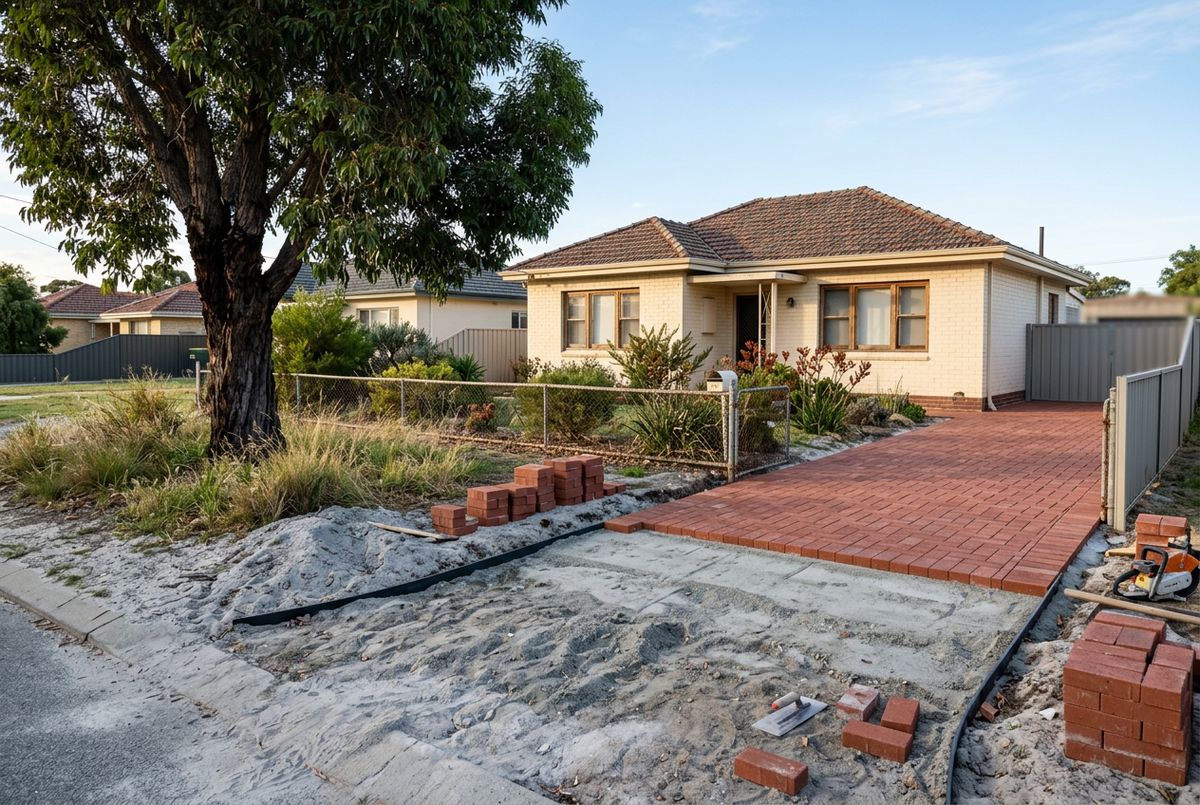
Half the cost of a standard crossover, paid by the City
Because so many Balga homes still have a bitumen or broken concrete crossover from the 1960s, the City of Stirling's subsidy rule is worth knowing before you plan a driveway.
The City contributes a subsidy equivalent to 50 percent of the cost of a standard 3 m wide crossover built in grey pre mixed concrete, where the crossover is constructed to the City's guidelines and the claim is received within 12 months of completion. It applies only to the first crossover service to the property, which the City's web page describes as the first concrete or brick paved crossover or the replacement of an existing bitumen one.
Source: City of Stirling, Crossover Policy; Crossover Guidelines Residential and Non Residential.
The property owner lodges a Crossover Installation Application before any work, and an approval lasts two years. Only one crossover per street frontage is generally allowed, a single residence may be 3.0 to 6.0 m wide and a duplex or multi residential site may share one crossover of 3.0 to 7.5 m. Brick crossovers must use heavy duty clay or concrete pavers suited to commercial traffic, laid with 2 to 4 mm gaps, and the crossover must stand 30 mm above the road at the gutter.
Big verge trees and the one third verge limit
The Mirrabooka Project streets were planted early, and many Balga verges carry trees with trunks well over 400 mm across. The City of Stirling sets the crossover setback from a street tree by trunk diameter at breast height: 1 m for trunks up to 200 mm, 2 m for 201 to 400 mm, 3 m for 401 to 600 mm and 4 m beyond that. On a duplex frontage that can decide where the shared crossover goes, and a reduced setback is only possible after a City inspection. Tree protection must be in place before crossover works start, and the City's trees must not be interfered with. Inside the boundary, our lifted pavers and tree roots page covers root damage.
Paving on the verge needs prior approval, is limited to one third of the verge area excluding the crossover and footpath, must sit 2 m from a street tree and must contrast visibly with the path and crossover.
Source: City of Stirling, Crossover Policy (street tree setbacks); Verge Treatment Policy and Verge treatment guidelines (August 2022).
Grey sand, easy soakwells, Stirling's 15 mm rule
Balga sits on Bassendean sand, the pale grey free draining unit that runs under most of the inner north. There is no wetland or shallow water table in the suburb and the coast is about 9 km away, so soakwells work exactly as intended and salt is not a concern. The City of Stirling requires every lot to hold its own rainfall, sized at 15 mm across the site: impervious area in square metres times 0.015 equals the cubic metres of storage, with a 900 mm by 600 mm unit the smallest allowed for roof water, at least 1 m between any soakwell and a boundary or structure, and trafficable units with an approved base wherever they sit under paving. Roof water and paved area runoff are kept in separate systems. Details are on our City of Stirling soakwell requirements page, and soakwell installation covers how we do the work.
Source: City of Stirling, On Site Stormwater Drainage Criteria (June 2024).
Mirrabooka, Nollamara and the surrounding suburbs
Mirrabooka and Nollamara share Balga's housing era and council, and we cover both from this page. Girrawheen is across the northern boundary in the City of Wanneroo, Marangaroo is a little further up, and Balcatta and Dianella are to the south west and south east. Westminster and Hamersley are covered as well. The full list is on the areas we service page.