

Canning Vale, by arrangement from Landsdale
Canning Vale is about 30.8 km south of IBP Paving's base in Landsdale, and it is the furthest south we travel. We take it on by arrangement, and a minimum job size may apply, because the drive needs a proper job at the end of it. Its 1990s estates are reaching relay age and its later stages are still handing over new homes. We lay brick, stone and concrete paving and install soakwells and drainage, with a lifetime workmanship warranty and over 20 years of experience.
The suburb is split between the City of Canning and the City of Gosnells, whose stormwater, crossover and verge rules differ; both are covered below.
Shallow groundwater and the half metre clearance
Canning Vale sits on Bassendean sand over the Jandakot Mound, and its history describes swampy terrain with an unusually high abundance of permanent fresh water. The sand drains well, but on the low lots the water table is close enough to the surface to limit how deep a soakwell can go, and both councils write their rules around that.
City of Gosnells: soakwells are permitted only where a geotechnical report supports them, with "minimum 0.5m clearance from the base of the soakwell to the maximum groundwater level" or to a low permeability clay layer; unsuitable sites must use sealed tanks, and a connection to the City's system is required on sandy clay and clayey sand soils and on all lots smaller than 350 square metres. City of Canning: where an overland flow path exists, which the City defines as 300 mm of clearance from road level to lot level, the lot manages a 1 in 20 year storm using a coefficient of 0.0150 multiplied by the impervious area; where there is no overland flow path the design storm rises to 1 in 100 year with a certified engineer's plan.
Source: City of Gosnells, Stormwater drainage and Stormwater Design Calculator pages; City of Canning, Information Sheet, Stormwater Drainage (October 2020).
Canning's 0.0150 coefficient is 15 litres of storage per square metre of roof and paving, and on lots under 300 square metres the whole lot area counts. On the wet lots we use shallow, wide soakwells so the base clears the groundwater, or we design a detention pit and piped connection to the street where the council requires it; Canning caps such discharges at 4 litres per second through a lot connection pit. Our Perth soakwell requirements page compares the councils.
Estates from 1994 at relay age, and new stages still building
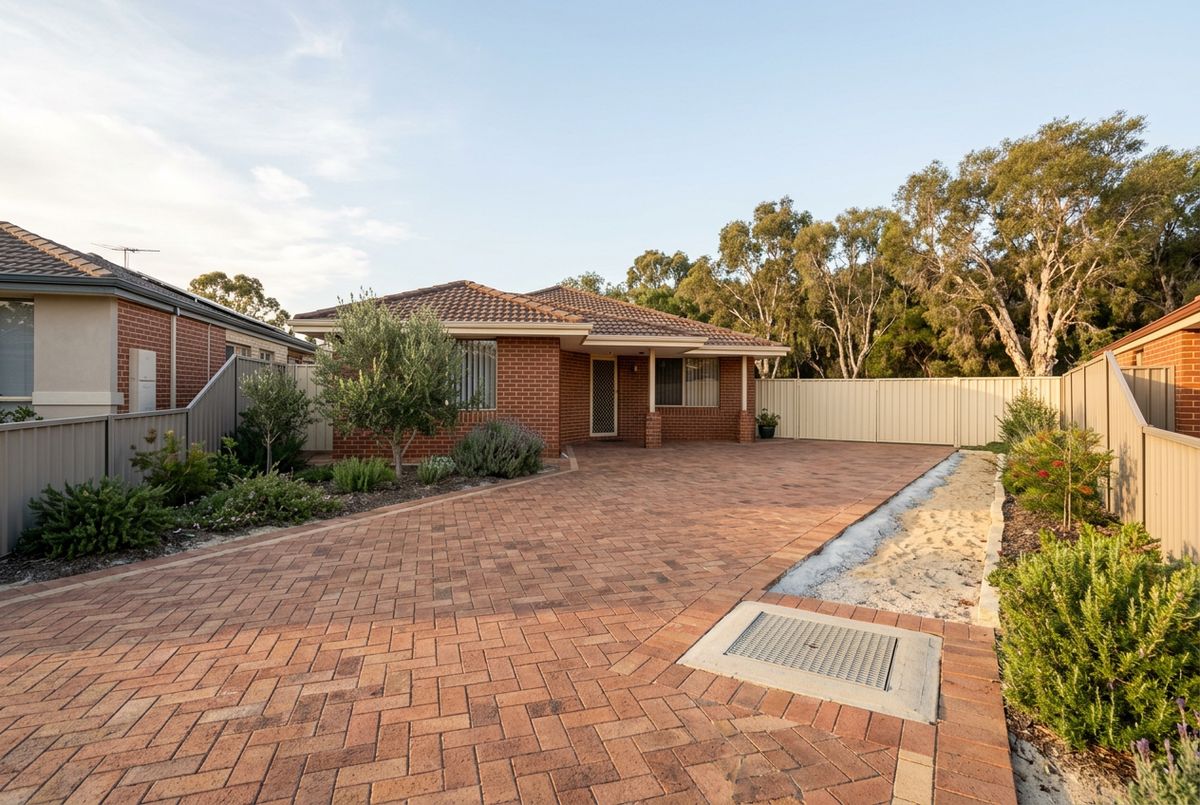
Canning Vale stayed rural until it was rezoned in 1994, then built out fast through the late 1990s and 2000s in a string of estates. The earliest of those homes have driveways 25 to 30 years old, laid in 50 mm pavers on a sand bed, and most have dipped along the wheel tracks and beside the soakwell lid. That is a lift and relay on a new compacted base, reusing the sound pavers, or a sunken section repair where only part has failed. The later stages on the suburb's edges are still being completed, and there the work is a first driveway and crossover and an alfresco with its own soakwell capacity. On both we wet and compact the grey sand in layers, put limestone under traffic areas and set falls to a drain, since the ground is close to saturated in winter.
Two crossover regimes, two subsidies
In the City of Canning a residential crossover may be brick paved, grey concrete or exposed aggregate concrete; liquid limestone is not accepted. Approval is lodged through My Canning at least 10 business days before work, the application fee is $594 for 2026/27. Building without approval can bring a $5,000 fine. The City contributes a maximum of $599.90 toward a first crossover built to its requirements.
In the City of Gosnells approval comes from Engineering Operations at no fee, lodged at least four weeks ahead, and the City warns of a $1,000 fine for failing to apply. The City subsidises 50 percent of its calculated cost of a first standard crossing, defined as a 3.0 m wide concrete crossing widening to 5.0 m at the kerb, with brick paved crossings accepted but the subsidy capped at the concrete value, claimed within six months.
Source: City of Canning, Crossover Information Sheet (August 2022) and Crossovers web page; City of Gosnells, Crossings and driveways page and crossover application and subsidy information sheet (May 2025).
Verges, street trees and the wetland remnants
The City of Canning's verge policy allows a limited area of brick, concrete or reconstituted limestone unit pavers with prior written approval, to a maximum of 33 percent of the verge including any footpath and crossover, with no paving within 2 m of the trunk of an existing street tree. Artificial turf, loose gravel and crushed brick are not approved. The City of Gosnells refers residents to its waterwise verge guidelines and asks that driveways and trees be sorted out with its Tree Services section; it publishes no hard surface percentage, so we do not quote one for the Gosnells side.
Canning Vale still holds remnants of the Jandakot wetlands and bushland in its reserves, and houses that back onto them do well with non combustible brick or stone paving between the building and the reserve fence.
Source: City of Canning, Council Policy ET.529 Streetscape Management, Verge Landscape Treatments (December 2022); City of Gosnells, Street trees page.
Willetton, Southern River and the suburbs around
Willetton, Southern River, Harrisdale, Jandakot and Thornlie border Canning Vale and we can quote them on the same arrangement when a trip south is booked. Our regular service area is in Perth's north around Landsdale, with Midland and Alkimos the other outer suburbs we travel to. The full list is on the areas we service page.