

Midland paving by arrangement, 16.4 km east of Landsdale
Midland is about 16.4 km from IBP Paving in Landsdale, east along Reid Highway and across the Swan, and it is the one eastern suburb we list. We service it by arrangement, and a minimum job size may apply, because it is a different trip from our northern run. The ground is different too: Guildford Formation clay instead of sand, which drives every decision from base depth to where the water goes. We lay brick, stone and concrete paving and build drainage to suit, with a lifetime workmanship warranty and over 20 years of experience.
A soakwell formula written for sand, applied to clay
The City of Swan has no homeowner soakwell sheet; its rules come from engineering guidelines, and they are candid about where they do and do not apply.
"As a general guide soak well volumes are based on the formula Volume Required (m3) = 0.0122 x Ac", where Ac is the impervious area in square metres, a figure the guideline states is "based upon sandy soil of high permeability". The same document says "Capacity will be reduced accordingly where the groundwater table rises above the base, in which case soak wells may not be suitable", requires soakwells to be no closer than 1.8 m to a footing or property boundary, and requires trafficable lids on any unit under paving or concrete.
Source: City of Swan, D12 Property Development Design Guidelines (August 2016); Handbook of Stormwater Drainage Design (April 2022).
Midland is neither sandy nor dry. The Groundwater Atlas describes the north eastern corridor as Guildford Clay with low bore yields and staining and salinity problems, and the flats toward the Helena and Swan Rivers have a shallow water table. So on most Midland lots we test infiltration before sizing anything. Where the clay will not take water we design to the City's other option, collection and disposal into Council's stormwater system through an approved connection, with grated drains and pipework under the paving rather than soakwells that would sit full. Midland is inside the City's drainage contribution policy area, and no stormwater may be discharged over a crossover or verge onto the road. Our Perth soakwell requirements page sets Swan's rules beside the other councils'.
Red crossovers in Guildford and the City's contribution
Guildford, the heritage town on Midland's western boundary, has a crossover rule found nowhere else in Perth: the City of Swan's specification requires every crossover in the Guildford area to be built in red asphalt, red concrete or red brick paving. We build those in red clay pavers to the City's residential schedule, which calls for solid clay or concrete pavers at least 60 mm thick on 25 mm of bedding sand over 150 mm of limestone or rock base, with a concrete beam between the road and the first course and edge restraints to the City's drawing.
Across the City, a residential crossover is 3.0 to 6.0 m wide or 40 percent of the frontage, whichever is less, 0.5 m clear of light poles and services and 3.5 m clear of any verge tree, and the location is assessed with the building licence. The City contributes $400 toward a first residential crossover and $550 toward a first commercial or industrial one built to specification, claimed on its Crossover Contribution Form.
Source: City of Swan, Specification for the Construction of Vehicle Crossovers (February 2022); Application to Add or Alter Vehicle Crossovers.
Townsite cottages, the workshops and new infill
Midland grew as a railway town in the 1890s and 1900s, and the old townsite still carries cottages on narrow lots with side access and small yards. Those homes want brick paving that matches the period, usually red or tan clay in a simple bond, laid as side paths, rear courtyards and short driveways, and repairs to paths that clay heave has lifted over the decades. The former railway workshops have been redeveloped, and around them the suburb is adding commercial premises and townhouse infill. For those sites we lay commercial paving on a heavy base designed for the clay subgrade, with the drainage planned first.
Clay base preparation, Woodbridge Lakes and the verge
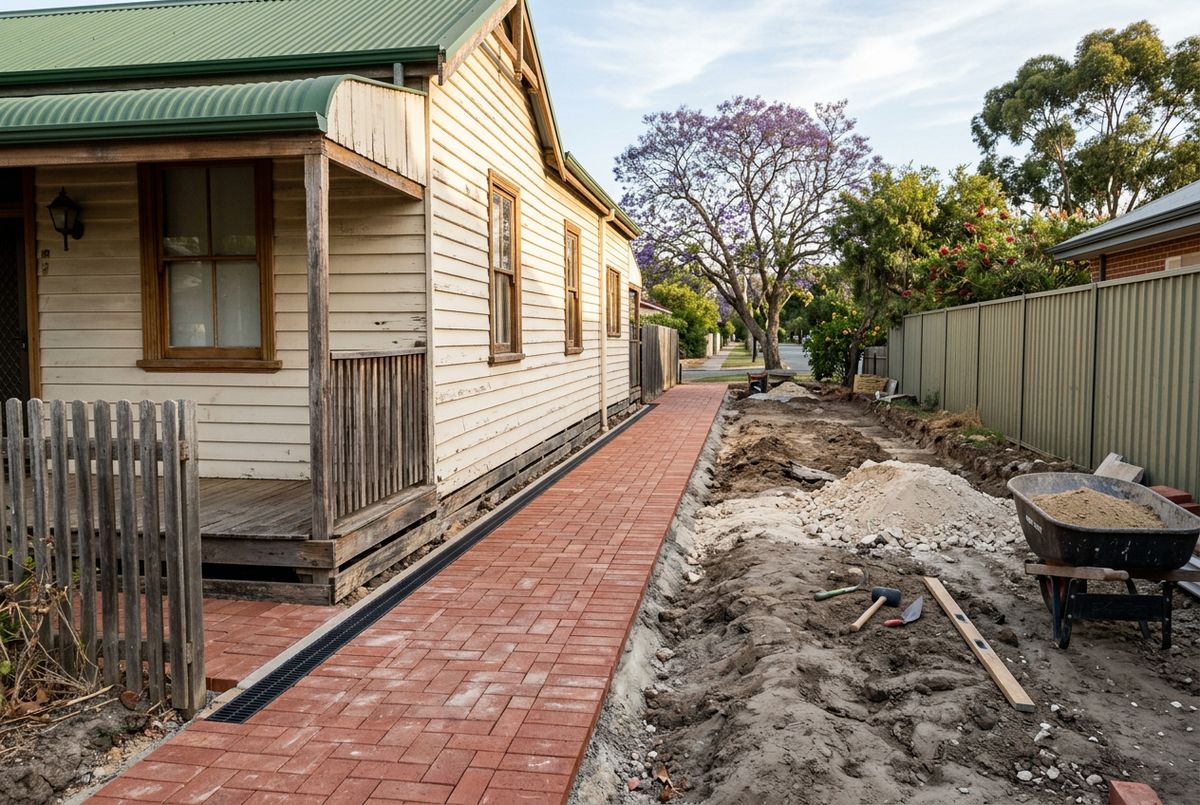
Paving on clay is a different trade from paving on sand. We cut deeper, lay a thicker compacted limestone or rock base to spread loads and isolate the pavers from the subgrade, and give every area a positive fall to a drain so water never ponds on the surface and soaks the clay beneath. Near Woodbridge Lakes, the ornamental lakes formed from a former coal dam on the suburb's edge, and across the river flats, the water table is close and we keep paving and any drainage structure above it.
On the verge, the City of Swan says hardstand treatments other than paths and crossovers are not normally encouraged and that paving needs written permission through an Application to Alter Verge. Any verge paving must leave at least one opening of 1 m by 1 m for a tree or garden bed per frontage, be delineated clearly from the crossover paving, and where possible be laid to direct water into the tree well. Asphalt, concrete and loose gravel on the verge are refused outright.
Source: City of Swan, Verge Guidelines and Application to Alter Verge form; Tree Planting Guidelines (version 6, November 2025).
Guildford, Woodbridge, Bellevue and the Swan suburbs
Guildford, Woodbridge, Viveash, Bellevue and Midvale surround Midland and are serviced from this page on the same arrangement. North along the river, Dayton, Aveley and Ellenbrook are back on sand and part of our regular runs, and Morley is on the road between Midland and Landsdale. See the areas we service page for the complete list.