

Paving Inglewood from Landsdale, about 13 km north
For paving in Inglewood, IBP Paving lays brick and stone driveways, front paths, back courtyards and entertaining areas, and installs soakwells sized to the City of Stirling's drainage criteria. Our yard in Landsdale is about 13 km north in a straight line, so Inglewood sits well within our inner north service area. Every job carries a lifetime workmanship warranty and the experience of over 20 years laying pavers around Perth.
The Avenues and the 1895 Inglewood Estate
Inglewood grew in pieces. The Avenues was the first part to be subdivided, by Gold Estates of Australia, and in 1895 E.W. Hammer named part of the land Inglewood Estate. Houses followed in two bursts, roughly 1904 to 1920 and again from 1935 to 1940, which is why one street can hold a Federation cottage, a Californian bungalow and an interwar brick home side by side. Around 5,800 people lived here at the 2021 census.
Lot sizes vary more than most visitors expect. Blocks near Mount Lawley are around 730 square metres, while east of Beaufort Street they run up to about 1,400 square metres. On the bigger lots a driveway is often a long strip down the side of the house to a rear garage or carport, and that length changes both the paver count and how the base has to be built.
What pre war homes ask of new paving
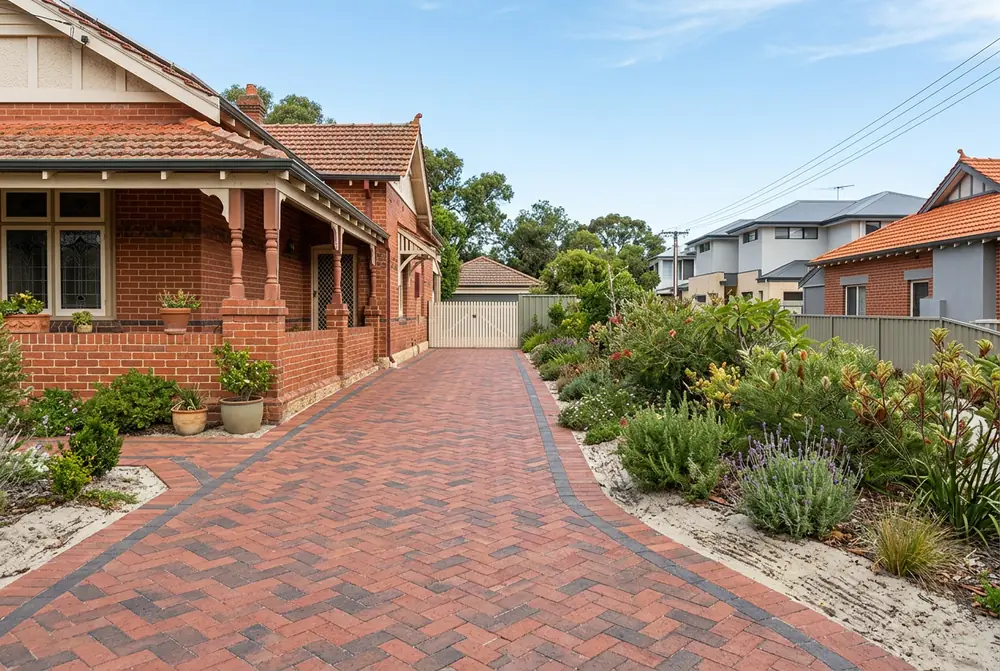
Most Inglewood houses predate the Second World War, and the paving that suits them is quieter than the large format stone found in new estates. Red and brown clay pavers in a herringbone or basketweave pattern sit well beside the face brick of the period. Our brick paving page covers the heavy duty clay options, which also satisfy the City's crossover material list. Jobs that suit these homes:
- a long side driveway on the larger lots, laid over a compacted base so wheel tracks stay level
- a front garden path from gate to verandah, often replacing cracked concrete
- a rear courtyard or entertaining area behind a renovation
- new soakwell capacity for an extension roof
The 1960s apartment blocks and newer units in parts of the suburb bring a different kind of work, mostly shared driveway and path replacement, and we quote those as well.
Heritage Protection Area rules at the front of the lot
The City of Stirling's Heritage Protection Area covers the majority of Inglewood, along with most of Mount Lawley and Menora. Inside it a development application is needed for demolitions, renovations, extensions and new buildings, so paving that forms part of an extension often waits on that approval. Two further rules touch paving directly. Hardstand verge treatments, meaning paving, concrete and synthetic turf, are not permitted on verges in the protected area. And a request for an extra crossover is assessed under the Local Planning Scheme and the relevant Local Planning Policies. The City has character retention guidelines for the area; we have not seen the adopted wording on driveways, so we ask owners to check with the City before changing a driveway or front garden layout.
For the crossover itself the City's normal process still applies. A Crossover Installation Application goes in before any crossover is built or changed, generally only one is allowed per street frontage, and a single residential crossover is 3.0 to 6.0 m wide. Concrete, coloured concrete, heavy duty clay or concrete pavers, exposed aggregate and liquid limestone (the last two subject to AS 1379) are accepted; asphalt is not. A street tree pushes the crossover away by 1 m for a trunk up to 200 mm across, rising to 4 m for a trunk over 600 mm.
Sources: City of Stirling, Heritage and development; Verge Treatment Policy and Verge treatment guidelines; Crossover Policy and Crossover Guidelines Residential and Non Residential.
Free draining sand and the 15 mm soakwell rule
Most of Inglewood is thought to sit near the boundary between the Bassendean and Spearwood sands, and the ground should usually drain freely, so standard soakwells are likely to do the job. There is no major wetland or high water table to design around, and at roughly 11 km from the coast, salt on pavers should not be a concern. The City of Stirling requires all rain that lands inside the lot to stay there, held in soakwells or another approved system such as a holding tank. Storage is sized for a 15 mm storm across the site: multiply the hard surface area in square metres by 0.015 to get cubic metres. Roof water and paving runoff go to separate systems, so a bungalow with 180 square metres of roof and 60 square metres of paving needs about 2.7 cubic metres for the roof and 0.9 for the paving. The smallest roof water soakwell the City accepts is 900 mm wide by 600 mm deep, set at least 1 m from buildings and boundaries, and any unit under a driveway must be trafficable. Our City of Stirling soakwell requirements page has the full criteria.
Source: City of Stirling, On Site Stormwater Drainage Criteria (June 2024).
Around Inglewood
Close by are Mount Lawley and Menora, which fall under the same heritage controls, plus Bedford and Maylands in the City of Bayswater and Dianella to the north. See areas we service for the full list.