

Pavers and paving in Joondalup, about 11.7 km from Landsdale
Joondalup is about 11.7 km from IBP Paving's base in Landsdale, and "pavers Joondalup" means two different things depending on who is typing. Homeowners along Lakeside Drive and in the northern streets towards Currambine want late 1980s driveways relaid or replaced and alfresco areas done in stone. Strata managers and businesses around the city centre want common property paving repaired and crossovers brought up to the City's specification. We do both: supply and lay of clay, concrete, limestone, travertine and granite pavers, driveways and crossovers, relays and soakwells, with a lifetime workmanship warranty and over 20 years behind the crew.
Street trees come first in the City of Joondalup
Joondalup was planned with tree lined streets, and the City protects them firmly. The Crossover Guidelines require a new or altered crossover to avoid street trees with a minimum offset of 1 to 1.5 metres, more for a large tree. The Tree Management Guidelines go further: trees will not be pruned or removed for the installation of non essential crossovers or verge paving, nor for perceived damage to infrastructure, and any unauthorised pruning or removal by anyone other than the City or its contractor is an offence that can be prosecuted. Where a hardstand verge treatment is installed, a 2 metre by 2 metre clearance must be left accessible so a tree can be planted.
Practical rule for Joondalup driveways: measure from the trunk of the street tree first, then design the crossover. Shifting a crossover 1.5 metres sideways is cheap; applying to remove a tree is not, and the City says it will refuse.
Sources: City of Joondalup, Crossover Guidelines Residential and Non-Residential (May 2026); City of Joondalup, Tree Management Guidelines.
The crossover itself follows the City's general rules: 3.0 to 6.0 metres wide, two crossovers combined no more than 9 metres, pavers permitted, apron and kerb in grey pre-mix concrete, no application needed to modify an existing one, and a $375 subsidy towards a first or bitumen replacement crossover.
Soakwells, setbacks and the lake
The City of Joondalup's residential soakwells page sets the on site retention rule for every house in the suburb: owners have a statutory obligation under common law and the Local Government Act 1995 to confine runoff within their boundaries, one downpipe is needed for roughly each 15 square metres of roof at no more than 12 metres apart, and a soakwell should be set back from buildings and boundaries by at least its own width. The page gives six standard concrete sizes from a 600 mm by 600 mm unit at 180 litres to an 1800 mm by 1200 mm unit at 3,100 litres, noting the figures assume normal rainfall. We go through them on our City of Joondalup soakwell requirements page.
Source: City of Joondalup, Residential soakwells (stormwater runoff) web page.
Geology decides how those rules play out. Joondalup sits on the Spearwood dune system, yellow brown sand over Tamala Limestone, which the Perth Groundwater Atlas describes as the north western corridor's limestone and sand. The sand drains fast, but caprock can sit within soakwell depth, so we probe before quoting an excavation. Lake Joondalup and Yellagonga Regional Park form the eastern boundary and belong to the same dune system, so lots along Lakeside Drive and the park edge can have winter groundwater close to the surface; there the soakwell base has to stay above the water, which usually means shallower, wider units. The coast is about 5 km west, far enough that salt bloom on pavers is uncommon. The park and the bushland corridor near the university campuses are the bushfire interface, where non combustible paving against the house makes sense.
Late 1980s homes, apartments and commercial frontages
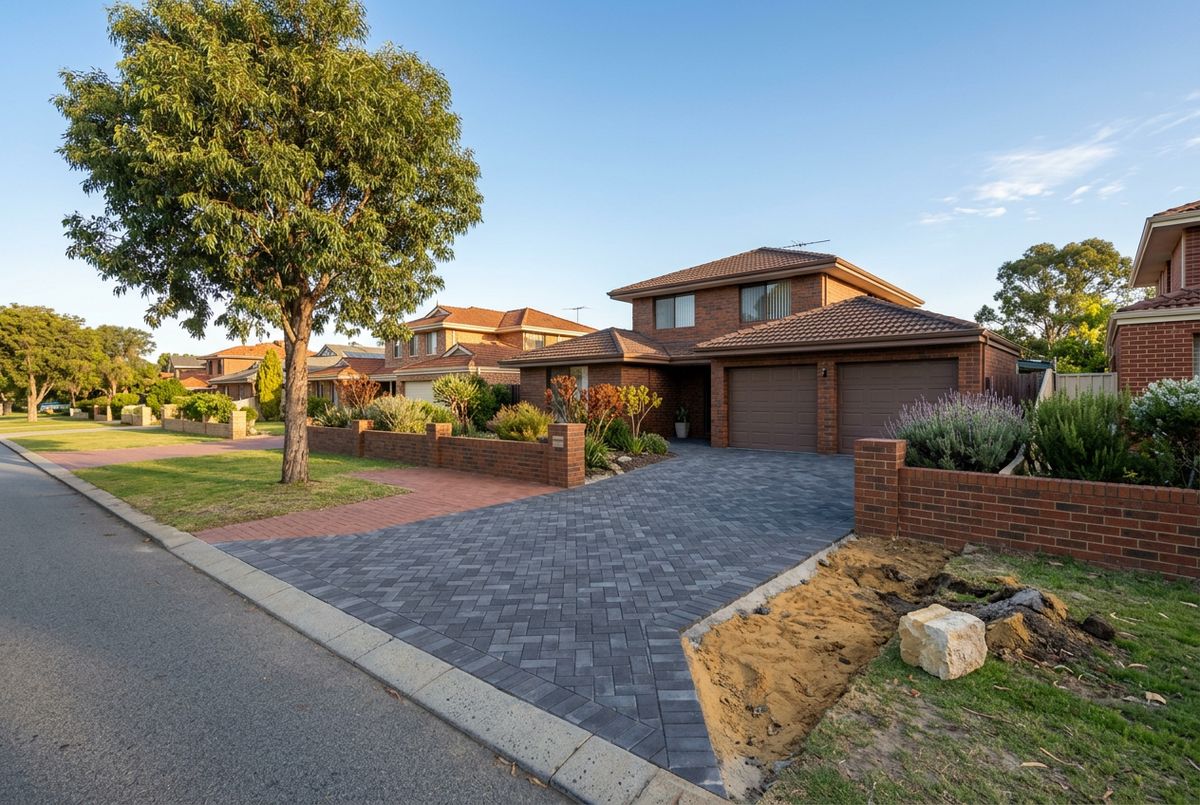
Joondalup's residential streets date from the late 1980s and early 1990s push to build the city of the north, so the original driveways are now 30 to 35 years old. Most are candidates for a lift and relay: the pavers are usually sound but the base has settled along the wheel tracks and the edge restraint has gone. Where the pavers themselves have worn through, we replace them, and owners frequently take the chance to switch from the original red clay to a charcoal concrete paver or to stone.
What sets Joondalup apart from its neighbours is the amount of medium density and commercial paving. Apartment buildings along Grand Boulevard and the streets around the city centre have common driveways, bin bays and courtyards in unit paving that strata councils need repaired or renewed, and shops and offices have crossovers and car park edges that must meet the City's specification. We handle those under commercial and strata paving, scheduled around tenants and trading hours. Edgewater on the lake's western shore and Connolly to the north are 1970s to 1990s suburbs with the same geology, and we cover both from this page.
Choosing pavers for a Joondalup job
Because the suburb mixes house, strata and commercial work, paver choice matters more here than in a purely residential suburb. For driveways and crossovers we use 60 mm heavy duty units, clay or concrete, in brick paving patterns that lock under wheel loads such as herringbone. For alfresco areas and courtyards the choice opens up to limestone, travertine and granite, each with a different answer to the damp and leaf litter Yellagonga delivers every autumn: granite shrugs it off, limestone needs sealing, travertine sits between. For strata common property we lean towards concrete unit pavers in a colour that can still be bought in five years, because a repair that cannot be matched gets noticed. Whatever the material, the base is ours: compacted crushed limestone, screeded sand, restrained edges.
Suburbs around Joondalup
We service Currambine to the north, Wanneroo across the lake to the east, Woodvale and Kingsley to the south, and Edgewater, Connolly, Kinross, Iluka and Burns Beach from the same trips. The complete list is on areas we service.