

Your obligation in the City of Joondalup
The City's Residential soakwells (stormwater runoff) page states that property owners have a "statutory obligation under common law and the Local Government Act 1995" to confine water runoff within their property boundaries. It adds a second requirement that Wanneroo's sheet leaves implicit: any overflow must be directed so that it does not pond against the building or enter adjacent properties.
In practice that means every downpipe and every paved surface that sheds water has to be collected and soaked into your own lot, with the overflow path leading away from the house and never towards the neighbour. The City's rule is one of eight compared on our council soakwell requirements page.
The City's soakwell capacity table
Joondalup publishes the same six common concrete sizes as Wanneroo, with diameters from 600 to 1800 mm, lengths from 600 to 1200 mm and capacities from 180 to 3100 L. The approximate area each one serves:
| Size (diameter x length, mm) | Capacity (L) | Approximate area served (m²) |
|---|---|---|
| 600 x 600 | 180 | 14 |
| 900 x 600 | 385 | 31 |
| 900 x 900 | 580 | 47 |
| 1200 x 1200 | 1300 | 111 |
| 1800 x 600 | 1550 | 125 |
| 1800 x 1200 | 3100 | 250 |
The City's caveat is that "the calculations provided above are recommended based on normal rainfall conditions". Two things are worth saying clearly. Joondalup publishes no litres per square metre formula and no design storm for single houses, so the table is the rule. And the table is about storage; it does not tell you how many downpipes you need, which is the next rule. The same table is worked through for 150, 250 and 400 m² on our soakwell cost and sizing page.
Downpipes and spacing
"One downpipe is required for approximately 15 square metres of roof area", and downpipes should be no more than 12 m apart, which the City ties to the Building Code of Australia. Downpipes do not each need their own soakwell. They are piped underground to shared units, so the downpipe rule decides how many collection points the roof has and the table decides how much storage those points feed.
Setbacks and overflow
Soakwells must be set back from buildings and boundaries by at least their own width, provided the width is greater than or equal to the depth, and the City does not recommend soakwells where clearances between buildings and boundaries are narrow. Overflow must not pond against the building or enter adjacent properties.
The housing stock in Joondalup makes this a replacement question as often as a new build question. Greenwood was developed from 1969, Duncraig was largely built in the mid 1970s and Kingsley through the 1970s and 1980s. Original units on those homes are often unwrapped and undersized for the patios and paving that have been added since, and sand washing into them is what sinks the pavers above. Replacing them is a lift and relay job as much as a drainage job, which is why our paving repairs team handles most of them.
Worked example: a 120 m² roof in Kingsley
Take a single storey 1980s home in Kingsley with a 120 m² roof, where the paving drains to lawn and adds no paved catchment to the system.
- Storage from the table. One 1800 x 600 unit serves about 125 m² (1550 L). Or one 1200 x 1200 (111 m²) plus one 600 x 600 (14 m²) gives 125 m². Unit counts are estimates and we confirm them on site.
- Downpipes. 120 m² divided by 15 gives 8 downpipes.
- Setback. The 1800 x 600 unit is 1.8 m wide and 0.6 m deep, so width exceeds depth and the setback is 1.8 m, which needs a rear or front yard position. The 1200 x 1200 unit needs 1.2 m, which fits more places.
- Site. Kingsley sits on Spearwood sand over Tamala Limestone, with Lake Goollelal running through its eastern side. Excavation can hit caprock and low lots near the lake can have shallow groundwater. Both are inferred from the regional pattern and checked on site. The state's soakwell sheet is clear that the base must be above the maximum groundwater level.
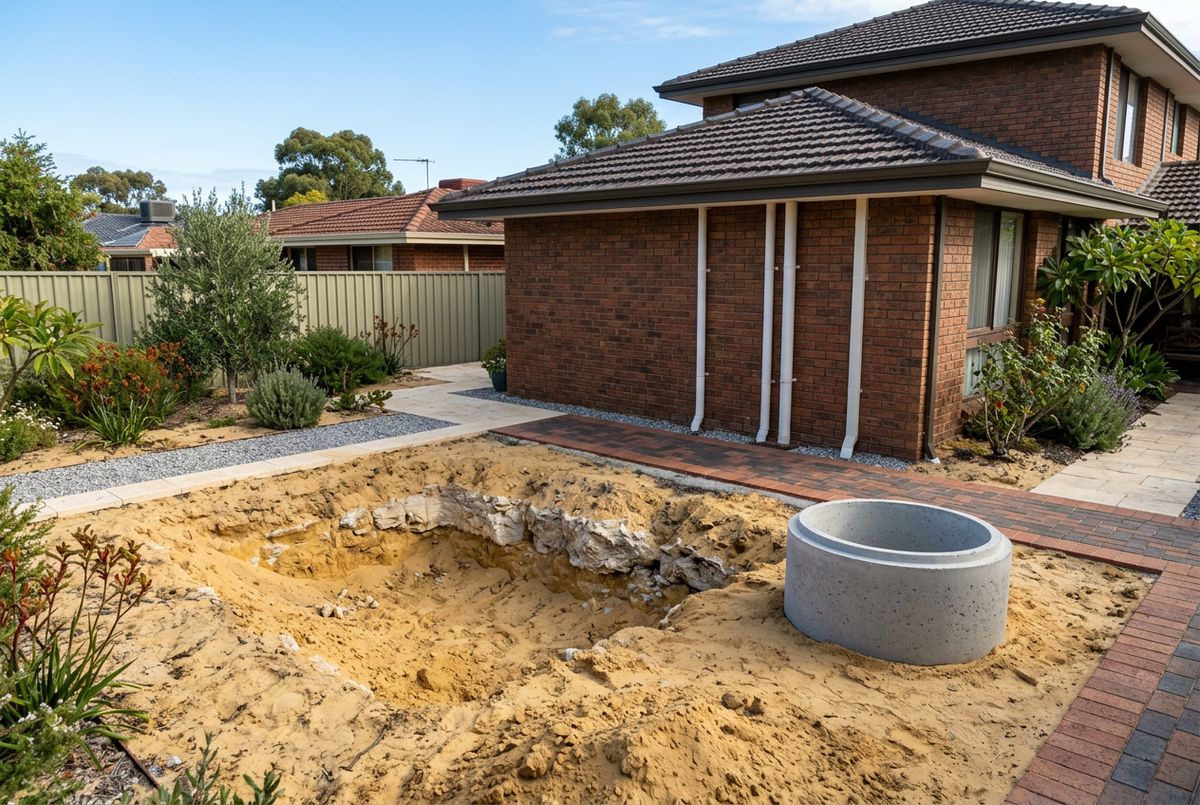
Limestone and lake side lots in Joondalup suburbs
Two ground conditions set Joondalup apart from the sand country east of Wanneroo Road. The first is rock. Woodvale sits on karstic Tamala Limestone, where a backyard sinkhole once swallowed a swimming pool, and part of Duncraig was a sand and limestone mining lease, so some excavations meet rock. The second is water. Edgewater and Woodvale lots beside Lake Joondalup, and Kingsley lots beside Lake Goollelal, can have shallow water tables in low ground. If water sits in a chamber for days after rain, the unit is either too deep for the water table or too small for its catchment. Our guide to soakwells in clay, limestone and high water table areas explains what works instead.
What the City's page does not say: check with the City
The City's page is silent on several points, and we do not fill them in. It does not say whether a building permit is needed for soakwells on their own. It gives no trafficable or under driveway rule, no litres per square metre rule and no high water table rule. On any of these, check with the City of Joondalup Building Services on 9400 4000 or [email protected] about approvals for your site.
Soakwells in City of Joondalup suburbs
Landsdale is about 6 to 12 km from the Joondalup suburbs we work in most. We install and replace soakwells in Greenwood, Kingsley, Woodvale, Duncraig, Joondalup and Hillarys, usually alongside a driveway or alfresco relay. Over 20 years of experience and a lifetime workmanship warranty. For the full list, see areas we service.
Source: City of Joondalup, "Residential soakwells (stormwater runoff)" web page (undated, accessed 9 October 2026), joondalup.wa.gov.au residential soakwells. The City revises its pages, so confirm the current version before you build.