

Koongamia paving, about 20 km from our Landsdale base
Koongamia is a small foothills suburb of fewer than 1,000 residents, about 20 km in a straight line from IBP Paving in Landsdale. It is outside our normal run, so we take work here by arrangement: describe the job, send us some photos, and we will let you know how and when we can help. Every job carries a lifetime workmanship warranty and the benefit of over 20 years laying paving across Perth.
State Housing Commission homes and their tired paving
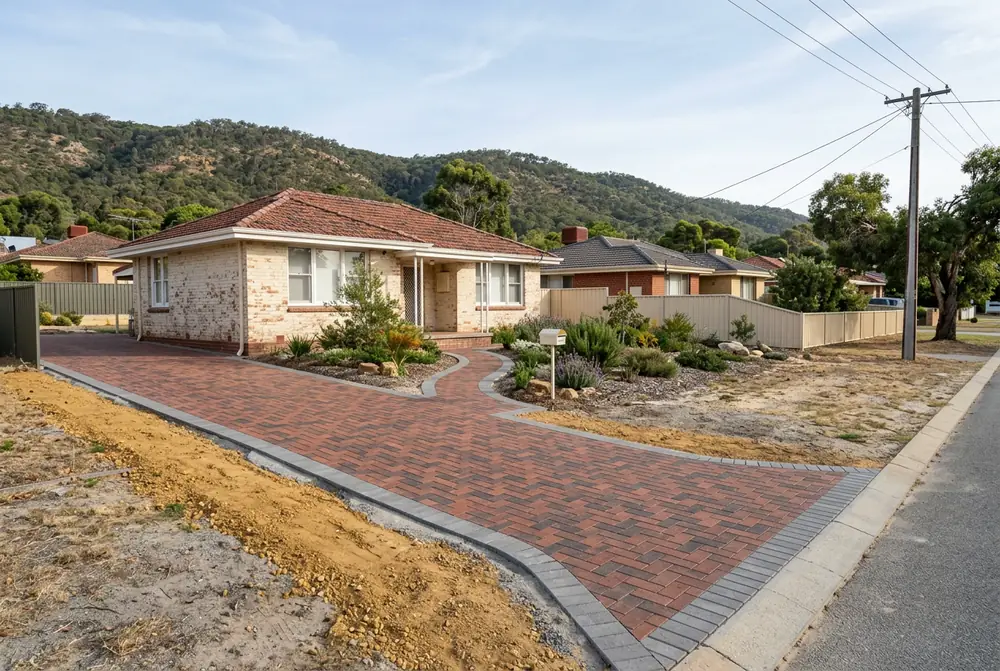
Koongamia was developed as a State Housing Commission suburb, and much of what we expect to be asked for here is renewal of paving that has been down a long time. Typical problems on mature lots are driveways that have sunk at the wheel tracks, paths that rock underfoot and pavers that have cracked where cars have parked on a thin base.
Some of that can be lifted and relaid; some needs full replacement. Where pavers have only settled in patches, a sunken paving repair is the smaller job. Where the whole surface has failed, a new driveway on a deeper compacted base is the lasting fix. Front and side paths are often replaced at the same time so the levels and colours match. Our paving repairs page explains how we decide between the options.
Drainage and crossover rules from the City of Swan
Koongamia is in the City of Swan, and two parts of the City's guidance matter most for local paving: where the water goes and how the crossover is built.
All site stormwater must go to Council's system or to on site retention such as soakwells, as approved by Council, and Koongamia is named among the areas covered by a Council drainage contribution policy. The general soakwell guide is 0.0122 cubic metres per square metre of impervious area, about 12.2 litres per square metre, based on sandy, high permeability soil. Soakwells in paved areas need trafficable, accessible lids.
Source: City of Swan, D12 Property Development Design Guidelines (August 2016); Handbook of Stormwater Drainage Design (April 2022).
At the street, residential crossovers must be at least 3.0 m wide and no more than 6.0 m or 40 percent of the lot width, whichever is less, kept 3.5 m from verge trees and 0.5 m from services. Concrete or clay solid pavers of 60 mm or more are permitted, from new materials, with a concrete beam between the road and the paving, and the City contributes $400 toward a first approved residential crossover. A street tree will not be removed just because it is near a crossover unless there is no alternative, and residents must not prune or remove street trees themselves. The City of Swan soakwell requirements page has the full drainage picture.
Source: City of Swan, Specification for the Construction of Vehicle Crossovers (February 2022); Application to Add or Alter Vehicle Crossovers; Street trees and verges; Tree Planting Guidelines (version 6, November 2025).
Foothill gravel, clay and the slope below Greenmount Hill
Koongamia sits on the foothills just uphill from Bellevue, rising toward Greenmount. The ground here is likely to be the gravel and clay of the Ridge Hill Shelf, which drains unevenly: one corner of a lot may soak up water while another holds it. Groundwater in the foothills is limited, so a high water table is rarely the concern, but slow ground still fills a soakwell that has been sized for sand. We test before we size, and on slow ground we plan grated drains and falls instead.
The suburb also lies on the scarp edge below Greenmount Hill, and parts of it are likely to be in a bushfire prone area. Check your address on the DFES map. If it is, paving rather than mulch or timber against the house keeps fuel away from the walls.
A short lived station and the suburbs around it
Koongamia had its own railway station from 1960 to 1962, on a stretch of the former Mundaring Loop uphill from Bellevue. Its neighbours are Bellevue below it, Greenmount above, and Swan View, Midvale and Helena Valley close by. We cover each by arrangement; see areas we service.