

Bellevue paving from Landsdale, about 19 km away
Bellevue sits at the foot of the Darling Scarp, about 19 km in a straight line from IBP Paving's yard in Landsdale. That puts it beyond our regular northern run, so we take Bellevue work by arrangement and ask for the job details, ideally with photos, before we book a visit. When the job suits, we bring the same crew and standards as anywhere else: brick and stone paving, driveway replacement, industrial hardstand and drainage, backed by over 20 years in the trade and a lifetime workmanship warranty.
Filled claypits and river flats under the surface
Bellevue was a clay town. Extensive claypits were dug here in the early 1900s and most of them have since been filled, which means two neighbouring lots can sit on very different ground. Most of the suburb is likely to be Guildford Formation clay, the material found across Perth's north eastern corridor, with pockets of fill where the pits used to be. Neither drains like the sand of the northern suburbs.
The Helena River forms Bellevue's southern boundary, with riverside parkland along it, and the lower river flats are likely to carry a shallower water table. On those lots and on any filled ground we probe before quoting, cut deeper than we would on sand and lay a thicker compacted base so the pavers are not riding on a soft or wet subgrade. Every paved area gets a positive fall so water leaves the surface rather than soaking into the clay under it.
City of Swan drainage rules on the Bellevue side
Bellevue is split between the City of Swan and the Shire of Mundaring, so the first question on any quote is which council covers the lot. On the Swan side the rules come from the City's engineering documents, and they shape how we plan drainage for every driveway and yard.
All stormwater from a site must be taken to Council's system or held in on site retention such as soakwells, as approved by Council. The general soakwell guide is 0.0122 cubic metres per square metre of impervious area, sized for the 5 year, 10 minute storm and based on sandy, high permeability soil. Bellevue is named among the areas covered by a Council drainage contribution policy, and subsoil drains are required where maximum groundwater is less than 1.2 m below lot levels.
Source: City of Swan, D12 Property Development Design Guidelines (August 2016); Handbook of Stormwater Drainage Design (April 2022).
The soakwell figure works out to about 12.2 litres per square metre of roof and paving, but the City states it assumes sand, and much of Bellevue is not sand. So we test infiltration before relying on it. If water will not drain away we design grated drains and pipework to an approved connection instead. Stormwater may not be discharged over the crossover or verge onto the road, and brick paving must not be laid over gully grates. Our City of Swan soakwell requirements page covers these documents in more detail.
Older homes and industrial yards
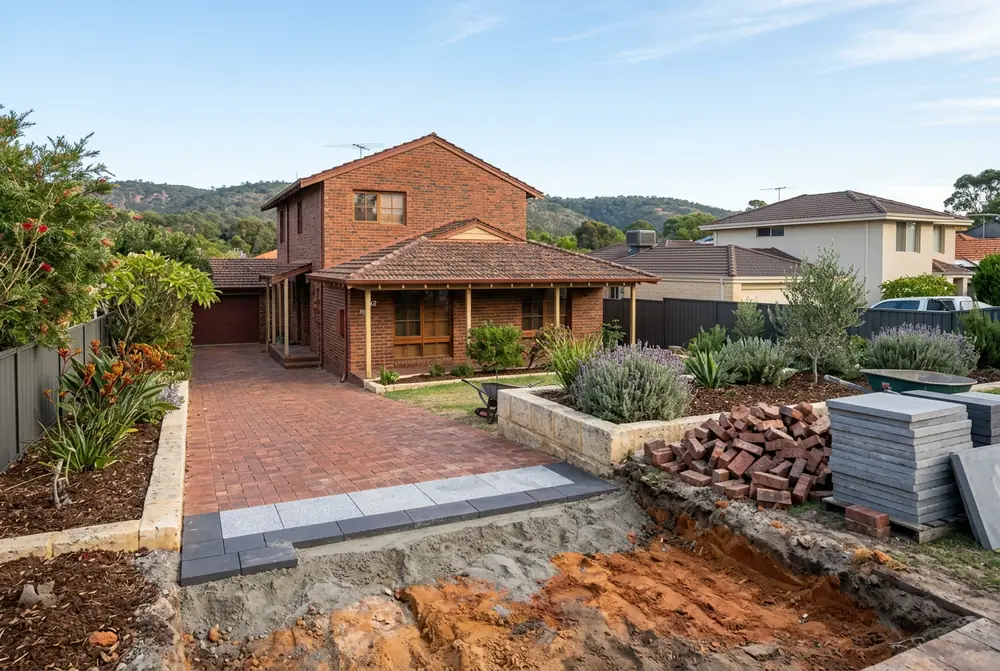
Bellevue has an even mix of homes, industry and parkland, and its railway siding dates from 1896. The residential streets are established, and the paving we see enquiries for is mostly replacement: driveways and paths that have dipped, cracked or lifted over the years, often laid on a thin base straight onto clay. A new driveway in clay brick pavers on a properly compacted base, with drainage worked out first, is the usual fix.
The industrial lots are a separate kind of job. Yards that take delivery trucks and forklifts need commercial grade hardstand with a heavier base, thicker pavers and falls to collection points. Crossovers on the Swan side must be at least 3.0 m wide and no wider than 6.0 m or 40 percent of the lot width, whichever is less, and the City contributes $400 toward a first approved residential crossover.
Source: City of Swan, Specification for the Construction of Vehicle Crossovers (February 2022); Application to Add or Alter Vehicle Crossovers.
From the 24 mile siding to a train factory
The locality was known as the 24 mile siding until it was named Bellevue on 24 May 1897. More than a century on, the railway is still the suburb's defining feature: a railcar facility opened here in 2021 to assemble the Metronet C series trains. For anyone paving near the line or in the industrial strip, that means heavy vehicles on local streets and yards built for load, which is why we treat base depth as the first decision rather than the last.
Midland, Koongamia and the Helena River neighbours
Midland and Midvale are Bellevue's neighbours on the plain, Koongamia is just uphill toward Greenmount on the scarp, and Helena Valley shares the Helena River. Each is covered on the same by arrangement basis; see areas we service for the full list.