

Salt, sand and strata: paving on the Scarborough coast
Scarborough is about 13.6 km from IBP Paving's base in Landsdale. The suburb gives us a different kind of job to the inland estates: small lot courtyards behind beach cottages, shared driveways and bin areas on strata sites, pool surrounds that cop salt spray, and the soakwells that the City of Stirling requires under all of it. We lay clay, concrete and natural stone paving and carry a lifetime workmanship warranty on everything we install, backed by over 20 years in the trade.
Beach cottages, 1980s units and the apartment rebuild
The housing here comes in three layers. Fibro and brick cottages from the 1930s to the 1960s still stand on the back streets, many of them on deep lots that have since been split. From the 1980s onward the suburb has been redeveloping into units and apartments, and that process has sped up around the foreshore. Each layer asks for something different from a paver.
- Cottages on single lots: full replacement of cracked concrete paths and old slab driveways, usually in a clay or limestone look paver that suits the era.
- Strata and grouped housing: common property driveways and visitor bays laid in heavy duty units, plus private courtyards where a 20 to 40 square metre space needs falls, a drain and a soakwell squeezed into very little room.
- Rebuilds near the beach: pool surrounds and terraces in dense stone or wet cast concrete, sealed against spray.
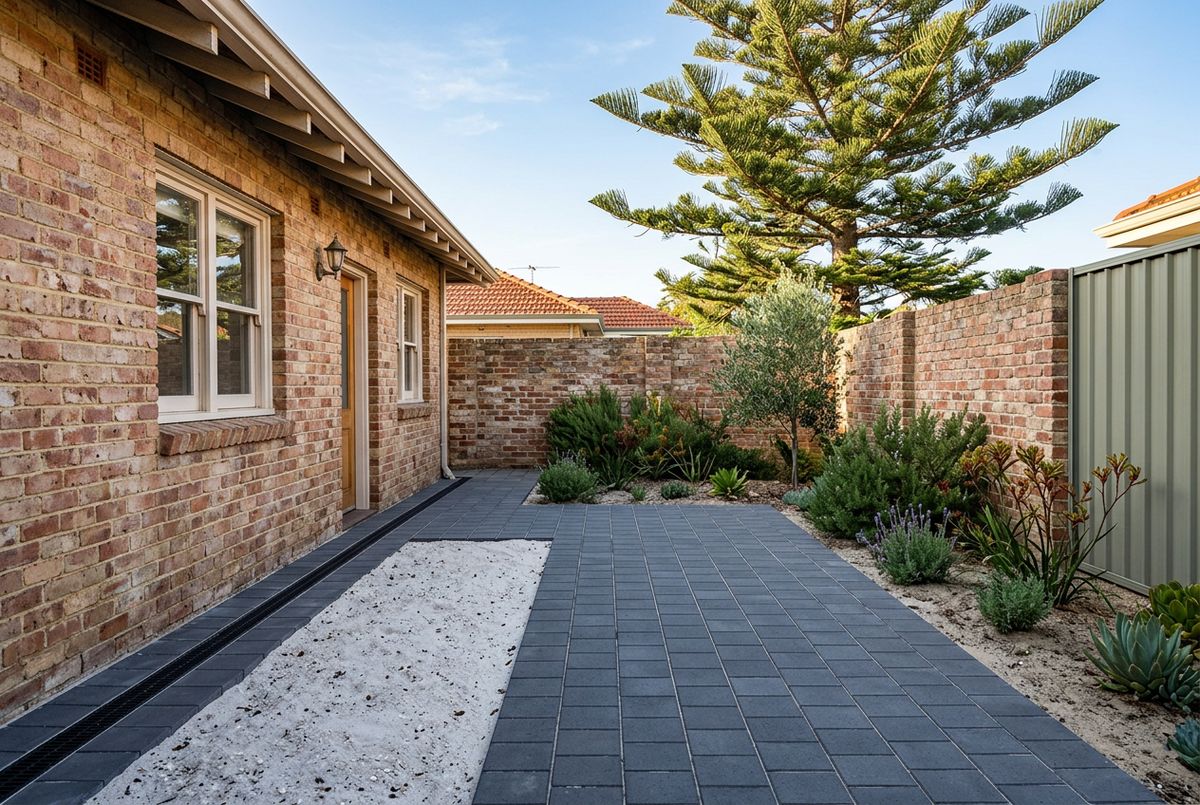
Why ordinary pavers fail within a kilometre of the surf
Nowhere in Scarborough is more than about 1.5 km from the water, and most of it is far closer. The masonry durability classes used in Australia describe a site within 1 km of a surf coast as severe marine and a site 1 to 10 km from surf as marine. Severe marine calls for exposure grade clay units; marine calls for general purpose units at minimum. Those classes were written for bricks and mortar, and no Perth supplier publishes a paver equivalent, so we apply the stricter band across the suburb.
In practice that means exposure grade clay pavers or a dense wet cast concrete paver, never a porous budget block. We bed on washed sand so no salt is introduced from the base, keep joints sand swept rather than mortared so the surface can breathe, and apply a penetrating sealer once the paving has cured. Our sealing and cleaning page covers the resealing cycle, which on the front dune is shorter than inland.
Source: Midland Brick and Think Brick, Brick Durability factsheet (August 2025), salt attack classification under AS/NZS 4456.10.
Stirling's drainage rules on a dense coastal lot
The City of Stirling requires all rain falling inside the lot boundary to be contained on site, and for a standard lot it sizes the storage at 15 mm across the whole site: impervious area in square metres multiplied by 0.015 gives the cubic metres of soakwell needed, with a 900 mm by 600 mm unit the smallest allowed for roof water. Soakwells sit at least 1 m from any structure or boundary, and anything under a driveway or carport has to be trafficable with an approved base.
Scarborough's redevelopment sites often fall outside the standard case. Where a development is more than two storeys, has a basement, is over 90 percent impervious or has groundwater within 1.2 m of the surface, the City requires a Drainage Management Plan and the on site storage is designed for a 1 in 20 year critical storm rather than the 15 mm minimum.
Source: City of Stirling, On Site Stormwater Drainage Criteria (June 2024).
Two further points from the same document matter on these lots. Roof water and water off paved areas are to be stored and infiltrated separately, so a courtyard needs its own soakwell rather than sharing the downpipe unit. And the City encourages permeable paving, which on a strata driveway can cut the soakwell volume you have to find room for. The full set of rules is on our City of Stirling soakwell requirements page.
The limestone ridge, Trigg Bushland and the crossover
Scarborough's dune sand is white and shelly near the beach and yellower on the higher ground to the east, where a limestone ridge runs under the suburb. Soakwell holes on the ridge can meet caprock within a metre, which is why we probe every site before pricing.
North of the suburb, Trigg Bushland is closed by the City on days of high fire danger. Homes along that edge do well with non combustible brick or stone paving right up to the walls instead of decking or mulch. On the street, a new or altered crossover in Stirling needs a Crossover Installation Application before work starts, and the City pays a subsidy equal to half the cost of a standard 3 m concrete crossover on a property's first crossover, or when an old bitumen one is replaced, claimed within 12 months. Verge paving is capped at one third of the verge, excluding the crossover and footpath, and must stay 2 m from a street tree.
Source: City of Stirling, Crossover Policy and Crossover Guidelines Residential and Non Residential; Verge Treatment Policy and guidelines (August 2022).
Trigg, North Beach and the suburbs behind the dunes
Trigg and North Beach are on the same dune sand and in the same salt band, so we service both under this page. Inland, Karrinyup and Balcatta are a few minutes east, and Sorrento and Duncraig are up the coast. Doubleview, Innaloo and Wembley Downs are covered from here too. The complete list is on the areas we service page.