

Stratton paving, by arrangement from Landsdale
Paving work in Stratton is usually a driveway that has started to dip, a patio they want to extend or a soakwell that no longer copes. IBP Paving does all of that, in brick, concrete and natural stone. Stratton is about 18 km from our base in Landsdale on a straight line, beyond our everyday service area, so we work there by arrangement and ask for the job details before we commit to a date. Each job comes with our lifetime workmanship warranty and the benefit of over 20 years of experience.
Foothills ground at the base of the scarp
Stratton is different underfoot from the clay suburbs closer to the river. It typically sits on the Ridge Hill Shelf, the foothill band at the base of the Darling Scarp, where the soils are gravelly and sandy. Along drainage lines the ground is more likely to be an imperfectly drained duplex soil, sandy on top over a denser layer below. The Groundwater Atlas notes the foothills hold little groundwater, and Jane Brook lies roughly to the north east.
For paving, gravelly ground gives a firm base once compacted, but its drainage can change within a single block. We test infiltration where a soakwell is planned, and on duplex soils we may use wider, shallower units or a piped outlet. Parts of the suburb towards Jane Brook and Swan View are likely to carry bushfire considerations, and there we suggest non combustible paving around the house rather than mulch or bark.
Wexcombe to Stratton: homes from the late 1980s on
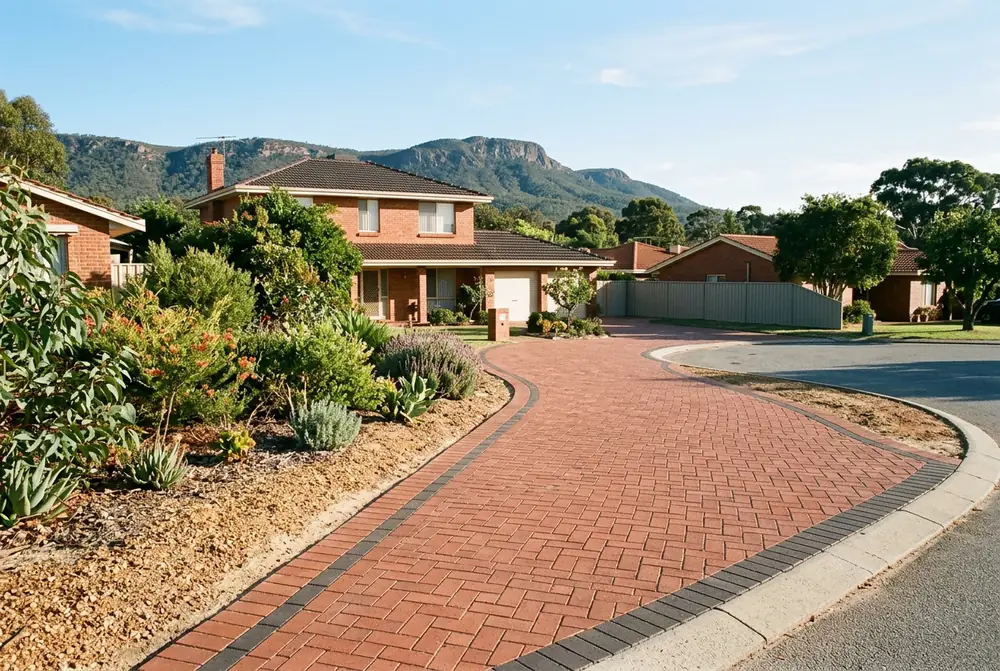
The housing is typically late 1980s and 1990s, which means the paving laid with those homes is now in mid life. The most likely job is a relay: lifting a driveway that has sunk in the wheel tracks, rebuilding the base and relaying the same pavers. Close behind is a patio or alfresco extension at the back of the house, often paired with a new soakwell to handle the added roof. For driveways that carry daily traffic, a herringbone pattern locks pavers together and holds up better than straight courses. Where the original pavers are sound, reusing them keeps the colour matched to paths and edges that are staying put.
City of Swan drainage and crossover rules
Stratton is in the City of Swan. Run off from your property has to go either to Council's stormwater system or into approved on site retention such as soakwells.
The City's general sizing guide is 0.0122 cubic metres of soakwell per square metre of impervious area, roughly 12.2 litres per square metre, based on sandy soil of high permeability. Paved crossovers use concrete or clay solid pavers at least 60 mm thick on 150 mm of limestone or road base with 25 mm bedding sand, a concrete beam between road and paving, and new materials only. No stormwater is to be discharged over the crossover or verge onto the road. Council contributes $400 to a first residential crossover built to its specification.
If you want to pave the verge as well, the City needs a written Application to Alter Verge first, and asphalt, concrete or loose gravel are refused. Verge paving must also be clearly delineated from the crossover. Our City of Swan soakwell requirements page covers the detail.
Source: City of Swan, Property Development Design Guidelines, Specification D12 (August 2016); Specification for the Construction of Vehicle Crossovers (February 2022); Verge Guidelines and Application to Alter Verge.
Named for a trotting man
The suburb was called Wexcombe until 1989, when it was renamed after John Peter Stratton, president of the WA Trotting Association from 1930 to 1966. Since most homes here usually date from around the time of the rename, much of the suburb's paving tends to reach the same age together, and neighbours often find they have the same problems. If your driveway is dipping, there is a fair chance the one next door is too, and two jobs in the same street are easier for us to schedule on a trip east than one on its own.
Around Stratton
Stratton's neighbours are Middle Swan, Jane Brook, Midvale and Swan View. We take work in all of them by arrangement; see areas we service for the full list.