

Tuart Hill driveways, paths and soakwells from Landsdale
If you are looking for paving in Tuart Hill, IBP Paving is about 11 km away in Landsdale and the suburb is part of our regular area. The work here is mostly renewal: pulling up driveways and side paths that have served a post-war house for decades, laying new brick or concrete pavers on a proper base, and fitting soakwells that meet the City of Stirling's drainage criteria. Every job carries our lifetime workmanship warranty, backed by over 20 years of paving in Perth.
Houses built after the war on lots first sold in 1905
Tuart Hill has an unusual timeline. The City of Stirling records that lots were sold from 1905, yet the area stayed mostly rural until World War II. Building then picked up quickly and the suburb was fully developed by the 1960s. The result is a street pattern of older subdivisions filled with mid century homes.
For paving, that age profile usually means the original surfaces are at the end of the line. Concrete driveways crack across the slab, early pavers chip and fade, and the sand beneath has often migrated into an undersized or collapsed soakwell. Rather than patch, we normally recommend a full paving replacement with a new compacted limestone base, then a driveway in clay or concrete pavers chosen to suit the house. Side and rear paths get the same treatment, and a red or tan brick paver in a simple bond tends to sit well against post-war brickwork. Infill townhouses on subdivided lots can be the other common job, where a shared driveway and new garden paths are laid from scratch.
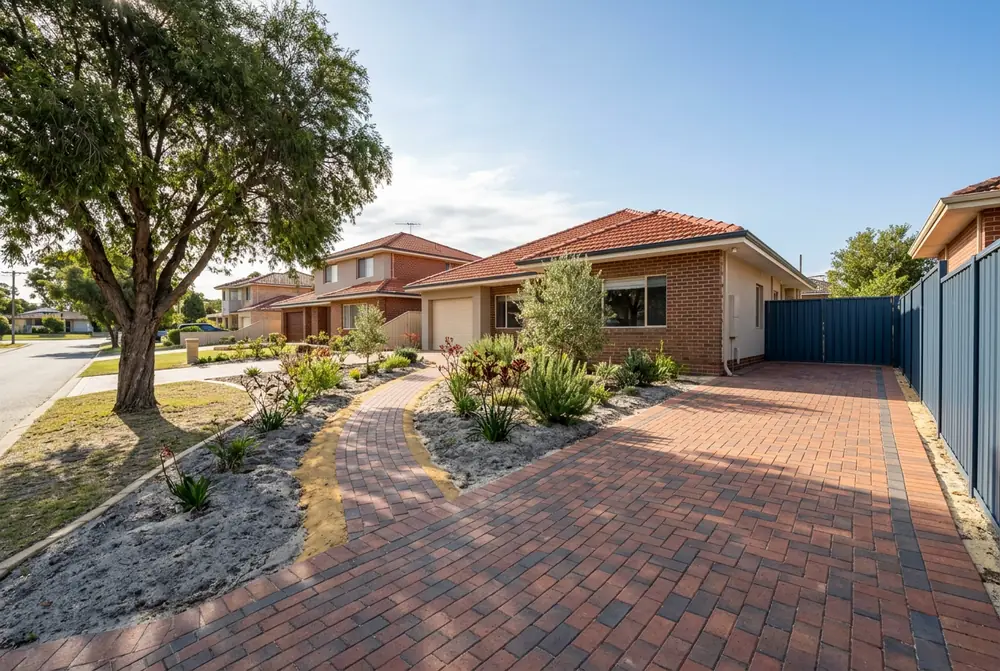
Replacing a Tuart Hill crossover under Stirling's policy
A new driveway usually raises the question of the crossover, the section between the boundary and the road. The City of Stirling controls that strip, and its rules shape how we price and plan the front of a Tuart Hill job.
Before a crossover is built or modified, the owner needs an approved Crossover Installation Application. Generally only one crossover is allowed per street frontage, and a single residential crossover is 3.0 to 6.0 m wide. Pavers must be heavy duty and rated for vehicles, and asphalt is not permitted for residential crossovers. The City subsidises 50 percent of a standard 3 m grey concrete crossover for the first crossover to a property, claimed within 12 months of completion.
Street trees matter here as much as anywhere in Stirling. A crossover has to be set back from a street tree by 1 m to 4 m, depending on the trunk diameter, and the City's street trees must not be interfered with. On an older street where a mature tree has already pushed up the pavers, we work around the roots rather than through them; our page on pavers lifted by tree roots explains the options on the private side of the boundary.
Source: City of Stirling, Crossover Policy and Crossover Guidelines Residential and Non Residential.
Yellow sand and the volume a soakwell must hold
Most of Tuart Hill usually sits on yellow Spearwood sand, the Karrakatta type. It drains freely, the water table is generally several metres down and there is no wetland inside the suburb, although tuarts once grew around nearby Dog Swamp. That makes on site drainage straightforward, which is just as well, because the City requires all rain falling on the lot to be held there by soakwells or another approved system.
Standard lots are sized for at least a 1 in 1 year, 60 minute storm, about 15 mm over the site, so the impervious area in square metres multiplied by 0.015 gives the storage in cubic metres. A typical Tuart Hill house with 180 m2 of roof and 70 m2 of paving needs about 3.75 m3. Our soakwell installs are sized to that figure, and the City of Stirling soakwell requirements page covers the rest of the criteria.
Source: City of Stirling, On Site Stormwater Drainage Criteria (June 2024).
Robinson Reserve, the show and a school from 1910
Two landmarks anchor the suburb. The Osborne Park Agricultural Society has run its annual show at Robinson Reserve since 1914, and Tuart Hill Primary School, now heritage listed, opened in 1910 as Grenville State School. Both predate most of the houses around them, which says a lot about how slowly the area filled before the war and how fast it filled after.
Joondanna, Yokine and the streets next door
Tuart Hill shares its post-war character with Joondanna to the south and Yokine to the east, while Osborne Park, Balcatta and Nollamara are close by as well. All are serviced from Landsdale; the full list is on our areas we service page.