

Warwick paving, about 7 km south west of Landsdale
For paving in Warwick, IBP Paving comes from Landsdale, about 7 km to the north east as the crow flies. Warwick dates from the late 1960s, so most paving work here is renewal: taking out driveways and paths that have done fifty years of service, building new courtyards and entertaining areas, paving verges within the City's limits and upgrading drainage. We have over 20 years in Perth paving and every job comes with a lifetime workmanship warranty.
A late 1960s suburb grown around Warwick Grove
Warwick was developed from the late 1960s. Warwick Grove Shopping Centre opened in 1974, and Warwick station followed in 1993. The paving laid with the first wave of houses is often past repair. Thin pavers have broken, old concrete has cracked into slabs and many original bases were never properly compacted.
That is why full replacement is the usual answer in Warwick. A new driveway goes down on a compacted crushed limestone base with 60 mm pavers, and the same visit often takes in the front path and porch. At the back, owners are turning tired patios into paved courtyards and outdoor rooms, frequently in honed limestone or concrete pavers that suit both the older brick and the newer render on extensions. Where tree roots have lifted pavers we follow the approach on our lifted pavers and tree roots page.
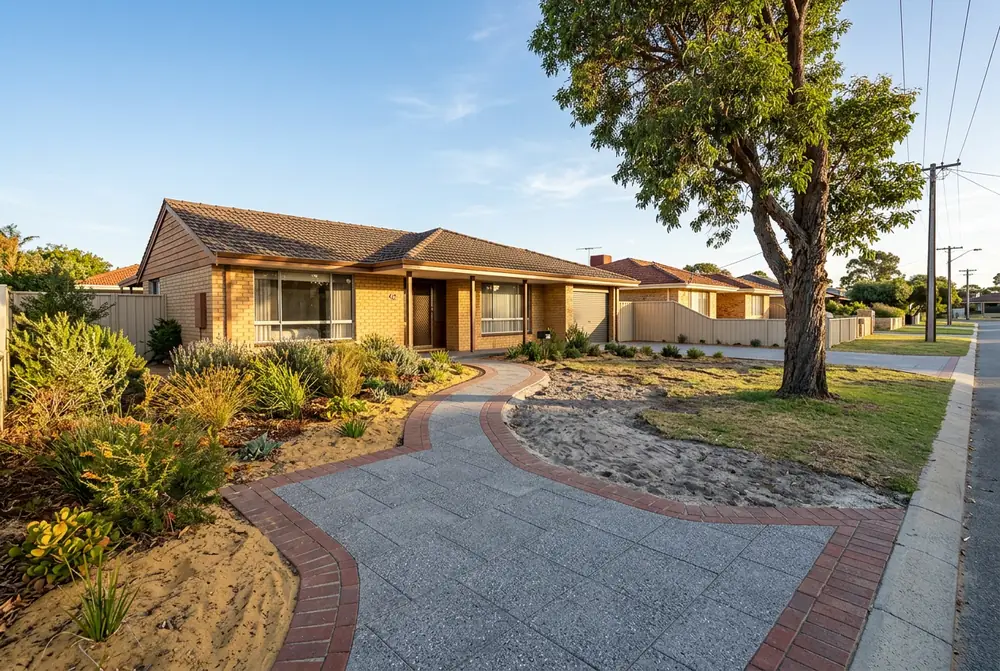
Verges, crossovers and the City of Joondalup
Front of house work in Warwick is governed by the City of Joondalup, which publishes detailed verge and crossover rules. These are the rules that come up most often on a Warwick job.
Verge hardstand can be brick paving, concrete, poured limestone or synthetic turf, up to 75 m2 or 50 percent of the verge, whichever is less, on a standard lot, and 150 m2 or 50 percent on a corner lot, with 1 m clear around street trees. Crossovers may be clay or concrete pavers, coloured or exposed aggregate concrete or flagstone, but not asphalt, gravel, crushed brick, compacted limestone, loose stone or polished finishes, and the apron and kerb must be grey pre-mix concrete. The City pays a one off $375 subsidy for a first crossover or for replacing an old bitumen one, claimed within six months.
Sources: City of Joondalup, Street Verge Guidelines (December 2016, version 2.6); Crossover Guidelines Residential and Non-Residential (May 2026); Verges and crossovers web page.
If your crossover is still bitumen, replacing it in pavers when the driveway is redone usually qualifies for that subsidy. No application is needed to modify an existing crossover, but a non standard one needs Planning Services approval. Street trees are not pruned or removed for non essential crossovers or verge paving, so the design works around them.
Spearwood sand and soakwell sizing
Most of Warwick is likely to sit on the yellow to brown sands of the Spearwood dunes, the Karrakatta unit, which is typical of this side of the corridor. It drains well and compacts firmly under a limestone base. The water table is usually several metres below the surface and we know of no major wetland in the suburb. The beach is roughly 5 km west, so salt in the air is light at most and ordinary concrete or clay pavers perform well.
The City of Joondalup's soakwell guidance asks owners to keep runoff within the property, suggests a downpipe for about every 15 square metres of roof with no more than 12 m between them, and gives a table of six concrete soakwell sizes from 180 to 3100 litres for normal rainfall, each set back from buildings and boundaries by at least its own width. Older Warwick homes may have one small soakwell per downpipe, so new paving is a good time to add capacity. Our City of Joondalup soakwell requirements page sets out the table.
Source: City of Joondalup, Residential soakwells (stormwater runoff) web page.
Homes beside the Warwick Open Space
The eastern third of Warwick is native bushland, the Warwick Open Space. Bush can bring fire risk, so for homes that back onto it we recommend hard, non combustible surfaces next to the house: clay or concrete pavers and limestone rather than mulch or timber near walls and doors. A paved strip along the rear fence also makes the boundary easier to maintain. Check your lot on the DFES bushfire prone map before planning a larger outdoor area.
Greenwood, Duncraig and nearby suburbs
Warwick neighbours Greenwood, Hamersley, Carine, Duncraig and Kingsley. We work across all of them; see areas we service.