

Replacing Hamersley's original driveways
Hamersley is about 7 km south west of IBP Paving's base in Landsdale, measured in a straight line. The suburb was built in one long push between 1968 and 1981, so a large share of its driveways, paths and patios went down in the same decade and are wearing out together. The work here is likely to be mostly full replacement of that first generation of paving, new entertaining areas behind the house, and soakwells to the City of Stirling's formula. Over 20 years in the trade sits behind each job, along with a lifetime workmanship warranty.
What a 1970s Hamersley block usually needs
Hamersley was a State Government response to rising land prices, first subdivided in 1968 and completed in 1981. That puts most of its original paving at 45 to 55 years old. At that age a replacement is normally the honest recommendation: the concrete has cracked through, early clay pavers have worn soft, and whatever base there was has long since shifted.
A typical Hamersley job runs in a set order. The old driveway comes out, the subgrade is compacted, a crushed limestone base goes in and a new driveway is laid in clay or concrete pavers. Behind the house, a 1970s concrete slab is often replaced with a larger alfresco area, and the extra roof and paving that come with it need new soakwell capacity. Where a mature tree in the yard has lifted the old paving, our page on lifted pavers and tree roots covers the options.
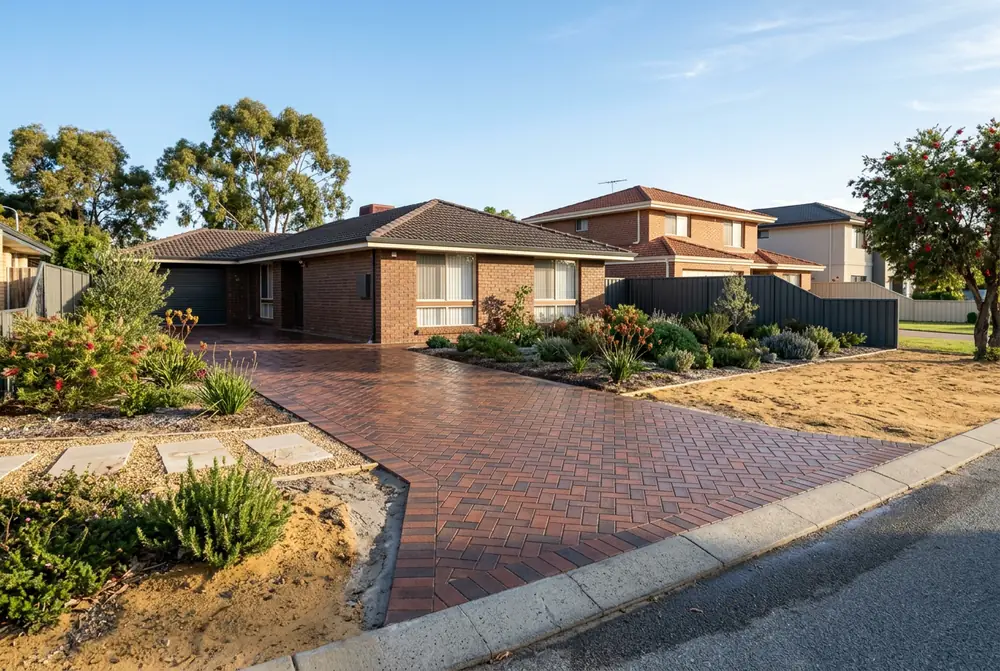
Cul-de-sacs, crossovers and street trees
Hamersley was one of Perth's first cul-de-sac suburbs, and the layout affects driveway work. Lots around the head of a cul-de-sac have short, angled frontages, and where a verge tree has grown up in front of one, the position of a new or widened crossover is often fixed by the tree rather than by the owner's preference.
The City of Stirling requires a Crossover Installation Application to be approved before a crossover is built or modified, and in general allows one crossover per street frontage. A crossover must be set back 1 m to 4 m from a street tree depending on the trunk diameter, and the City's street trees must not be interfered with.
Source: City of Stirling, Crossover Policy; Crossover Guidelines Residential and Non Residential.
We measure the trunk and the frontage at the first visit, so the driveway design and the application match from the start.
Yellow sand with limestone below
Hamersley's soil is Karrakatta Sand, a yellow brown, infertile sand, with Tamala Limestone underneath. The sand holds an unconfined aquifer of low salinity groundwater recharged by rainfall, and there is no named wetland in the suburb. For paving that means fast drainage and a firm base once the sand is compacted. For soakwells it means water is taken away quickly, though a deep excavation can run into the limestone, in which case a wider, shallower unit or two smaller ones reach the same volume.
The City of Stirling sizes storage by multiplying impervious area in square metres by 0.015, so 250 square metres of roof and paving calls for 3.75 cubic metres. No roof water soakwell may be smaller than 900 mm in diameter by 600 mm deep, and each unit stays at least 1 m from structures and boundaries. See our City of Stirling soakwell requirements page for the rest.
Source: City of Stirling, On Site Stormwater Drainage Criteria (June 2024).
Hamersley is about six kilometres from the Indian Ocean, far enough that salt does not drive the choice of paver.
The ABC tower reserve and Hamersley's bushland
The 180 metre guyed ABC radio tower, built in 1939, stands in a bushland exclusion zone in the south east of the suburb. That restricted reserve covers 14.4 percent of Hamersley, and the Rannoch-Tay-Earn Reserve adds more bushland. Homes facing either area have a bush edge, and there we suggest paving right up to the walls in place of mulch or timber decking, since pavers do not burn.
Suburbs next to Hamersley
Carine, Balcatta, Warwick and Greenwood surround Hamersley, and Balga is a short way east. All are serviced from Landsdale, and the complete list is on areas we service.