

Paving Wembley Downs by arrangement
Wembley Downs is about 15 km south west of IBP Paving's base in Landsdale in a straight line. We take paving work here by arrangement, and we ask for the job details first: what needs doing, the approximate area and a few photos. With that in hand we can confirm the job and plan the visit. The work itself is the same as anywhere we go: driveway and path replacement, retaining, outdoor areas and soakwells, with over 20 years of experience and a lifetime workmanship warranty.
Limestone outcrops and Spearwood sand
When building began here, it was slowed by limestone outcrops, and that rock has not gone anywhere. The suburb typically sits on Spearwood sand over Tamala Limestone. The sand drains freely and makes a good compacted base, but anyone digging a soakwell in Wembley Downs is likely to meet limestone. We price for breaking it out, and on shallow rock we often spread the storage over two or three smaller units.
Water is less of a constraint. There is no named wetland in the suburb and the water table is generally several metres down on these dune sands. The coast is roughly 2 to 3 km west, close enough for some salt on the wind but not the heavy exposure of the beachfront suburbs, so a quality concrete or clay paver with a sealer on outdoor areas is usually enough.
The garden suburb plan around Hale and Weaponess Roads
Wembley Downs has a 1960s garden suburb layout, with streets that circle the intersection of Hale Road and Weaponess Road rather than running in a grid. Hale School is in the suburb. Curving streets tend to leave lots with angled frontages and odd shaped front gardens, and where a block also changes level, retaining walls and stepped garden paths become part of the paving job. We set out angled driveways from the crossover first, so the pattern lines up with the street rather than the house, and cut the pavers along the boundary instead. Where a level change is modest, a limestone retaining wall suits the local stone.
Houses from the 1950s to the 1970s
The land was subdivided in 1927, but growth came from the 1950s, and by the 1970s the suburb was almost fully developed. Most homes are now mature, and their paving is the original or an early replacement. That makes a full replacement the most common job: take out the old surface, rebuild the base on compacted limestone and lay new pavers. A new driveway is usually the first piece, followed by paths, a patio and the drainage to suit. On rebuilt lots everything is new at once, and it pays to plan the paving, retaining and soakwells as one design.
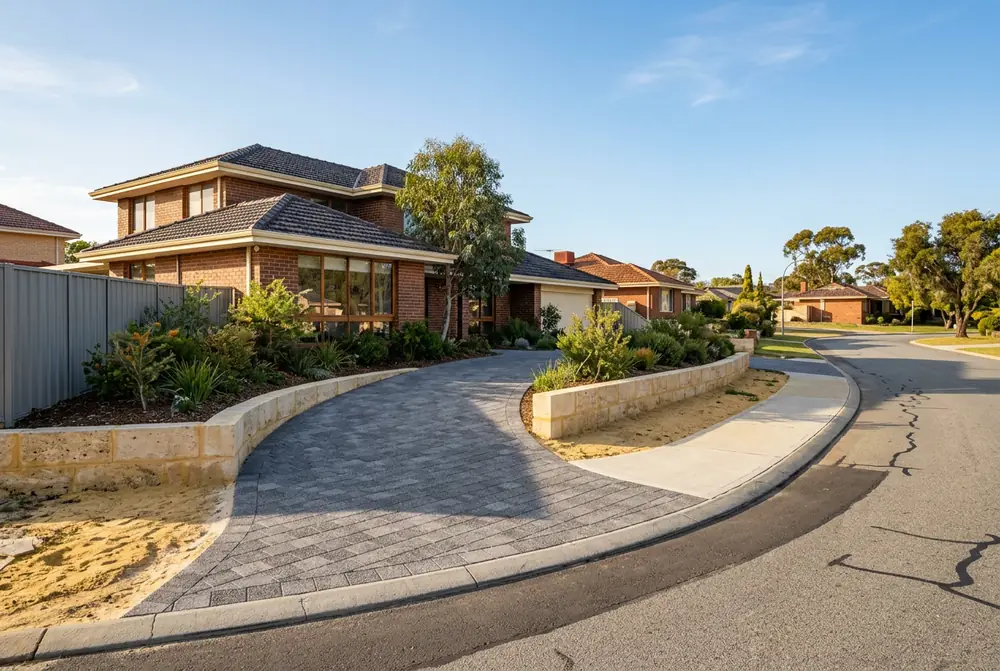
City of Stirling drainage and crossover rules
Wembley Downs is in the City of Stirling, which sets its rules in a set of published criteria and policies. These are the points that shape a paving job here.
All rainfall within the lot must be contained on site by soakwells or approved alternatives. Standard lots are designed for a 1 in 1 ARI 60 minute event of 15 mm, so impervious area x 0.015 m gives the m3 required, and the minimum roof water soakwell is 900 mm diameter x 600 mm deep. A Crossover Installation Application is needed before a crossover is built or modified, generally one per street frontage, and single residential crossovers are 3.0 to 6.0 m wide. Verge paving needs prior approval and may cover only one third of the verge, at least 2 m from a street tree.
Source: City of Stirling, On Site Stormwater Drainage Criteria (June 2024); Crossover Policy; Crossover Guidelines Residential and Non Residential; Verge treatment guidelines (August 2022).
A home with 280 m2 of roof and paving needs 4.2 m3 of soakwell storage under that formula, which on Wembley Downs limestone often means several units rather than one. Our City of Stirling soakwell requirements page covers the detail.
Suburbs beside Wembley Downs
City Beach is to the south west and Scarborough to the north. Inland are Churchlands, Doubleview and Floreat. See areas we service for the full list.