

Yanchep, our furthest regular run north
At about 36 km from IBP Paving's base in Landsdale, Yanchep is the northern limit of where we work, and we go there by arrangement. A minimum job size may apply, which in practice means a driveway, an alfresco, a pool surround or a soakwell installation rather than a single lifted paver. We lay brick, limestone and stone paving and install soakwells, with over 20 years of experience and a lifetime workmanship warranty.
Two Yancheps: Sun City and the new estates
The old core dates from 1972, when the first homes of Alan Bond's Sun City were built near the lagoon, and it filled out through the 1970s and 80s. Those houses are on large lots with driveways and patios laid half a century ago, and the work is replacement: broken concrete and bitumen out, 60 mm heavy duty pavers in on a new base, often with limestone paving around the garden because it suits the coastal scrub and the pale rock the suburb sits on.
Around that core, estates from the 2010s and 2020s are adding streets every year, with houses that arrive on a sand pad and nothing else. There the jobs are a new driveway and crossover, an alfresco in large format pavers under the new roof, side paths and the soakwells to carry all of it.
Karst, caves and Loch McNess
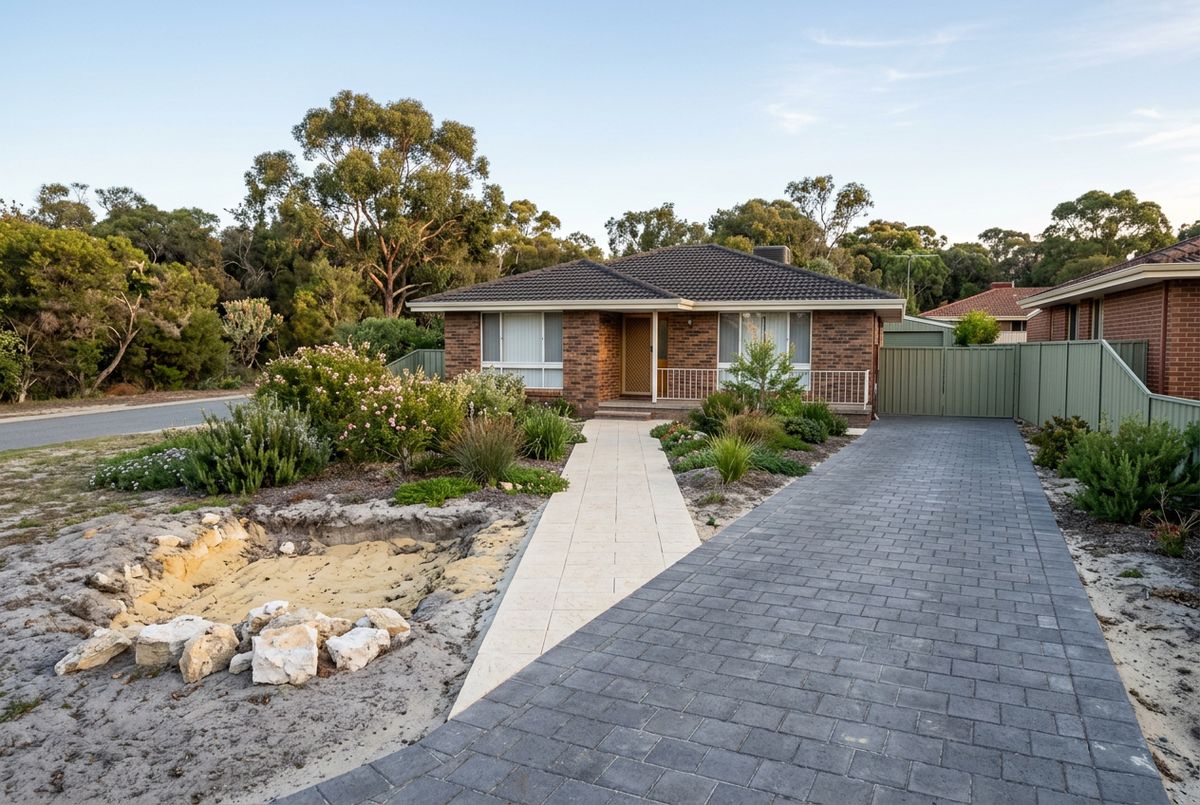
The City of Wanneroo lists Yanchep by name among the places where the Quindalup dune system reaches the coast, so the beachside streets are on white shell sand. Move inland and the ground becomes Spearwood sand over Tamala Limestone, a karst rock full of solution cavities. Yanchep National Park's caves, Crystal Cave among them, are in this same limestone, and Loch McNess and the park's wetlands sit in the swale of the Spearwood system. For us that means three things. Soakwell holes can meet rock and have to be moved or widened. Rock can also hide voids, so we never assume a probe that drops freely means clean sand. And on the low ground near the loch and the park wetlands the water table is closer to the surface than the sand would suggest, so soakwell bases are kept shallow there.
Salt applies to the western streets within about a kilometre of the surf, where the masonry durability classes call for exposure grade units; we use exposure grade clay or dense wet cast concrete pavers there, washed bedding sand and a sealer. Bushfire is the other factor. The suburb takes in Yanchep National Park and part of the Gnangara to Moore River State Forest, and homes on those edges do best with non combustible paving between the house and the bush.
Source: City of Wanneroo landscape descriptions (Quindalup dunes at Yanchep, Loch McNess within the Spearwood system); Midland Brick and Think Brick, Brick Durability factsheet (August 2025).
Paving the big Sun City verges
The 1970s streets have wide nature strips, and owners often want part of them paved for a second car or a trailer. The City of Wanneroo permits it in residential areas, with conditions.
"In residential areas, brick paving or concrete may be laid on the nature strip. Refer to the City of Wanneroo Standard Drawings (TS 07-9) for further details." The nature strip must keep a positive 2 percent gradient from the back of the kerb to the property boundary, no gravel, crushed bricks or loose stones are permitted, and the strip 2 m back from and parallel to the kerb is to be kept clear of landscaping. Hardstand treatments are not permitted on nature strips in industrial or commercial estates.
Source: City of Wanneroo, nature strip guidelines; Residential Verge Hardstanding Layouts and Sections, Standard Drawing TS 07-9.
The City publishes no percentage cap for verge paving, so we do not quote one; we work to the drawing. Street trees are protected by the City Tree Policy, which says a tree being in the way of a verge paving treatment is not sufficient reason to remove it, and a crossover must sit 1.5 m from a City tree. The City recommends lodging a nature strip landscape proposal before work starts, and we can prepare the sketch for you.
Source: City of Wanneroo, City Tree Policy (approved 10 December 2024).
Soakwells and downpipes on sand and rock
Wanneroo homeowners are told that runoff must stay inside the lot, that roughly one downpipe is needed for every 15 square metres of roof, and that common concrete soakwells run from a 600 mm unit serving about 14 square metres to an 1800 mm by 1200 mm unit serving about 250 square metres. The same sheet cautions that the table assumes normal rainfall and that overflow can occur depending on the soil, naming limestone as one such soil. On Yanchep's inland lots we take that at face value and size one step up the table. Soakwells sit at least their own width from buildings and boundaries. The City's engineering specification, for designers, allows one cubic metre of storage per 60 square metres of impervious area, and both documents are on our City of Wanneroo soakwell requirements page. Soakwell installation explains the units and sealing and cleaning covers care of pavers near the beach.
Source: City of Wanneroo, Stormwater Runoff Information Sheet; Development Design Specification WD5 (June 2019).
Two Rocks and the coast road south
Two Rocks, the next settlement north with the marina, is serviced from this page on the same arrangement. Heading back toward Landsdale we pass Alkimos, Eglinton, Butler, Clarkson and Mindarie, and we try to book Yanchep jobs alongside work in those suburbs. The full list is on the areas we service page.